

Our third foundational topic is Justice. This is our nickname for when we do the same thing to both sides of an equation.
Recall that we called an equation with the format y = something an algorithm. These worked like a recipe. To follow the recipe we plug in numbers, simplify, and get an answer.
A more complicated equation is a puzzle, not a recipe.
y − 3 = 47
length × width = 36
age + 3 = age × 2
Our math toolbox is nearly full.
We know how to "shapeshift" a number by rounding or by changing formats (fraction, decimal, percent, and measurement units).
We know how to use "mad science" to simplify an expression using arithmetic (adding, subtracting, multiplying, dividing, and exponents) and grouping structures (parenthesis, fraction bars, square roots, and algorithms).
Now we get one last tool in our toolbox. For the three above example equations the key is to do the same thing to both sides of the equation. But an equation is like a tangle of yarn. Yes, we can "pull at it" by doing the same thing to both sides of the equation. But some types of pulling will make it more tangled instead of less.
So we must study different situations to see which action, or series of actions, will unravel the equation and reveal the answer we want.
To summarize, we will explore more deeply how to use "justice" to be not only fair (doing the same action to both sides of the equation) but wise (picking the action that unravels the tangle). This exploration will take us through the first three subsections (Fractions, Ratios, and Percentages).
Then we will shift our focus twice. In the Measurement subsection we wil study situations where we "build" an equation, even though the equation we build is not solved by doing the same series of actions to both sides. In the Patterns subsection we will think about where most of the equations used in real life come from.
As we study this topic, work on making helpful and organized notes, so you have handy the comments, formulas, and example problems you need.
Before we deal with formulas and equations, we should take a step back to look at what a formula really is.
Where do formulas come from? How are they invented? Why do they work? How do they make sense?
All those questions have the same answer: patterns.
The easiest way to watch patterns become formulas is to make a table. In each row put which place in the pattern we are at, what the pattern looks like, and the number-value for that place. We can then look at the table to analyze the pattern and create a formula.

Each row adds four toothpicks. The pattern is y = n × 4.
By the way, we use n as the formula's input letter instead of x because of tradition. Using n shows that only "normal" counting numbers are inputs—never fractions, decimals, or negative numbers. A formula with x would allow those.
Here are more patterns to analyze and turn into formulas. To help you meet your classmates, work on each pattern with a different partner, and introduce yourselves as you work quietly together.

Each row adds three toothpicks in a C shape, and there is always one extra toothpick at the far right edge to close the right-most box. The pattern is y = (3 × n) + 1.
Notice that we do not need the parenthesis. The order of operations for arithmetic already has us multiply before adding. But the parenthesis do help communicate where the pattern came from.

Each row adds five toothpicks in the shape of a house with no right wall, and there is always one extra toothpick at the far right edge to close the right-most house. The pattern is y = (5 × n) + 1.
As before, we do not need the parenthesis because the order of operations already has us multiply before adding. But the parenthesis do help communicate where the pattern came from.
Let's use your creativity in a group activity.
Khan Academy
Time for some area patterns.

The pattern is y = n × n, which can also be written y = n2.
This pattern is "tautological" because the formula does what its name says. The reason we call an exponent of two squaring a number because it makes a square whose side length is the number.

In this pattern the rectangles have sides of length n and (n + 1). The area formula multiplies these sides.
Our answer is y = n × (n + 1).
Remember that the formula A = l × w is also tautological. In our illustration is the second rectangle three rows of two tiles, or two columns of three tiles? Either way, making copies of an amount is simply what multiplcation does by definition.

Notice that each triangle in this pattern is half the size of the corresponding rectangle in the previous pattern. Since the previous pattern was y = n × (n + 1), we want half of that. We need to divide by two at the end.
Our answer is y = n × (n + 1) ÷ 2
The formula we just found is called the Triangle Formula. Outside of a math classroom it is not as famous as the Square Formula or the Rectangle Area Formula. But it does deserve its own name because it is very useful.
We have all seen how dust floats in the air. Each dust particle has weight and is pulled down by gravity—but the upward force of air resistance can be equally strong. Just like water strider bugs can walk on water because they do not weigh enough to sink through the surface tension of water they stand on, a dust particle can "stand" on the air below it.

Tagentially, watch this.
Mark Willis
We just found the Triangle Formula.
The Triangle Formula
The triangle pattern goes 1, 3, 6, 10,... with each step increasing additively by one more than the previous step.
Its formula is y = n × (n + 1) ÷ 2
The Triangle Formula appears surprisingly often in real-life applications. Here are three pattern problems that seem tricky until you realize how the answer is made by tweaking the Triangle Formula.

Each step in the pattern is three times as big as the Triangle Pattern. So we need to multiply by three at the end.
The pattern is y = n × (n + 1) ÷ 2 × 3.

Each step in the pattern is four times as big as the Triangle Pattern. So we need to multiply by four at the end.
If we divide by two and then multiply by four, the overall result is simply multiplying by two. Instead of ÷ 2 × 4 we can simply do × 2.
The pattern is y = n × (n + 1) × 2.

Each step in the pattern is one more than the Triangle Pattern. So we need to add one at the end.
The pattern is y = n × (n + 1) ÷ 2 + 1.
Try these ten exercises on scratch paper. Work in a study group if you can! Notice where your notes need improvement. After you are very happy with your answers, you can use this form to ask me to check your work. Can you get at least 8 out of 10 correct?
1. Triangular tables are placed in a row to seat more people. One table has 3 seats. Two tables have 4 seats. Create a formula where we put in the number of tables (as n) and get out the number of seats (as y).

2. Now we switch to square tables. We still make a row of tables to seat more people. One table has 4 seats. Two tables have 6 seats. Create a formula where we put in the number of tables (as n) and get out the number of seats (as y).

3. This shape is sort of like a V or W that gets wider with more wiggles. What is the pattern for how many squares are in each row? (As an optional, extra challenge you can also find the pattern for how many toothpicks are in each row!)

4. How about this extra-wide plus shape? What is the pattern for how many squares are in each row?

5. How about this hollow diamond shape? What is the pattern for how many squares are in each row?

6. This shape looks somewhat like the stand that holds up a road construction sign. With each step it gets longer in each direction. What is the pattern for how many cubes are in each row?

7. There are many versions of an old story about the inventor of the game of chess. One version appears below. On which day will the total grains of rice exceed 3 million?
The Chessboard Story

King Radha of India was bored of backgammon, and desired a new game. Sessa, his minister invented chess. King Radha was pleased and asked Sessa what he desired in payment.
Sessa asked that a single grain of rice be placed on the first square of the chessboard, two grains on the second square, four grains on the third, and so on, doubling each time.
King Radha saw that this would require far more rice than his kingdom would ever produce, and had Sessa executed for impudence.
8. Two trains are approaching each other on parallel tracks. Both are traveling at 30 miles per hour. What is the overall speed at which they approach?
9. Continuing the previous problem, the two trains start 9 miles apart. How many minutes does it take for them to pass each other?
10. Continuing the previous problem, a fly zooms back and forth from the headlight of one train to headlight of the other. It starts when the trains are 9 miles apart. By the time it arrives at the other train, the two trains have gotten closer. It instantly reverses direction and heads back to the first train. And so on. The fly moves at 20 miles per hour. How far does it travel before the trains pass?
The Trains and Fly Story
One day at Los Alamos, Richard Feynman noticed something interesting. When he asked a physicist to solve the Trains and Fly problem they all used the shortcut (as above) and got the answer immediately. When he asked a mathematician, they all calculated the fly's trip bit by bit and finding the answer took several minutes.
Eventually Feynman brought the Trains and Fly problem to the most astounding mathematician of the group, John von Neumann, who immediately answered.
"That's not right!" protested Feynman. "You're a mathematician. You're supposed to sum the series, not use the shortcut!"
"What shortcut?" asked von Neumann. "I did sum the series."
Try these exercises on scratch paper. Work in a study group if you can! Notice where your notes need improvement. Check your work when you are done.
The first equations we study are one-step equations.
We only need to do one thing to both sides of the equation to solve the puzzle.
First consider when on one side of the equal sign a letter is either multiplied or divided by a number. On the other side of the equals sign is a number.
To solve these, "undo" what is attached to the letter by doing the opposite.
We undo a "multiply by 5" by doing a "divide by 5". We want to be fair and treat both sides of the equation the same.
On the left side y × 5 ÷ 5 = y and then on the right side 35 ÷ 5 = 7
The result is y = 7
When solving this type of problem it often helps to remember that when multiplying two items the order does not matter. We can swap the order to make the formula look better.
We can swap the order of multiplying 5 and y.
So we can rewrite this equation to match the previous one. It is another y × 5 = 35
We undo a "multiply by 4" by doing a "divide by 4". We want to be fair and treat both sides of the equation the same.
On the left side b × 4 ÷ 4 = b and then on the right side 20 ÷ 4 = 5
The result is b = 5

How does this picture help us solve for b? Where is division for both sides hiding?
In the picture, we can divide the large rectangle on the right that weighs 20 into four pieces that each weigh 5. Then we can see the correspondence: each "b" rectangle on the left matches with a "5" rectangle on the right.
So far we have only started with multiplication, and used division to undo it.
What about the other way around?
We undo a "divide by 6" by doing a "multiply by 6". We want to be fair and treat both sides of the equation the same.
On the left side p ÷ 6 × 6 = p and then on the right side 8 × 6 = 48
The result is p = 48

How does this picture help us solve for p? Where is multiplication for both sides hiding?
In the picture, we can make a complete circle called "p" on the left side by making six copies of the shaded slice. We can also make a complete circle on the right side with six copies of 8. Then we can see the correspondence: the circle named "p" will equal the circle of size 48.
When we solve an equation we should write each step on its own line.
Use the vertical Format
3 × y = 210
÷ 3 ÷ 3
y = 70
Writing each step on its own line makes clear what you were thinking in each step. This helps you check your work, contribute in a study group, earn partial credit on tests, and most importantly use your work later in the term to refresh your memory about how to solve that problem.
Later, in future math classes, writing each step on its own line will also helps avoid careless errors in more complicated problems.
Students who try to cram everthing into one line run into trouble.
Do Not Use the Horizontal Format
Solve 3 × y ÷ 3 = 210 ÷ 3 = 70
This only looks okay because we are using different colors and write very neatly.
If we did not add those cosmetic details...
Hard to Read Horizontal Format
Solve 3 × y ÷ 3 = 210 ÷ 3 = 70
Now we have trouble even identifying what the original problem was!
Watch how I write this next problem on the board.
I used one color for the equations, and a second color for the intermediate "what we are doing to both sides" descriptive lines. In our class you need not use colors, but you should at least write each step on its own line.
If you take an algebra class one of your goals will be to eventually wean yourself from always writing the "what we are doing to both sides" descriptive lines. The instructor will write fewer of these steps on the board. You will train your eye to "see" those steps even if they are not actually written.
But that is for a later algebra class. In this class we will always include the "what we are doing to both sides" descriptive lines.
There are two other reasons to use the vertical format.
First, it promotes doing homework in two or three columns per page. This often saves paper. By their nature, homework problems are seldom as wide as a page.
Second, putting work in that shape makes it easier to do scratch work off on the side. Watch how that helps me stay organized when solving for y when fraction arithmetic happens.
Notice that there are many possible ways to write the step of dividing both sides by 8. The clearest is to use the vertical format and write either ÷ 8 or /8 on its own line, as we just did.
Please avoid bad math grammar.
Bad Math Grammar #1
Do not use parenthesis to incorrectly mean "do this to the entire equation".
3 × y = 210
(3 × y = 210) ÷ 3
Our process involves doing the same thing separately to each side of the equation. Putting the entire equation in parenthesis might make logical sense, but it is bad grammar because it implies we are not modifying each side of the equation separately.
Bad Math Grammar #2
Do not use parenthesis on each side of the equation improperly.
3 × y = 210
÷ 3 (3 × y) = (210) ÷ 3
The right hand side is legitimate. But the left hand side begins confusingly with the ÷ symbol.
Bad Math Grammar #3
In a future math class studying algebra you will encounter other incorrect ways, for more complicated equations.
Here we show that writing ÷ 3 to the right of each side of the equation can be incorrect.
3 × y + 3 = 210
3 × y + 3 ÷ 3 = 210 ÷ 3
This violates the distributive property, which you will learn about in an algebra class.
One step equations that involve addition and subtraction are very similar.
First we solve an equation that has addition.
We undo an "add 9" by doing a "subtract 9". We want to be fair and treat both sides of the equation the same.
On the left side u + 9 − 9 = u and then on the right side 200 − 9 = 191
The result is u = 191
Can you draw a balance scale picture that describes solving the equation u + 9 = 200?
Next we solve an equation that has subtraction.
We undo a "subtract 12" by doing an "add 12". We want to be fair and treat both sides of the equation the same.
On the left side x − 12 + 12 = x and then on the right side 75 + 12 = 87
The result is x = 87
Can you draw a balance scale picture that describes solving the equation x − 12 = 75?
Let's do a few more example problems.
We undo an "add 4.5" by doing a "subtract 4.5". We want to be fair and treat both sides of the equation the same.
On the right side v + 4.5 − 4.5 = v and then on the left side 50 − 4.5 = 45.5
The result is 45.5 = v which if we want we can rewrite as v = 45.5
We undo a "subtract 15" by doing an "add 15". We want to be fair and treat both sides of the equation the same.
On the right side y − 15 + 15 = y and then on the left side 45 + 14 = 60
The result is 60 = y which if we want we can rewrite as y = 60
We undo a "divide by ½" by doing a "multiply by ½". We want to be fair and treat both sides of the equation the same.
On the left side w ÷ ½ × ½ = w and then on the right side 8 × ½ = 4
The result is w = 4
Besides the four fundamental arithmetic operations (addition, subtraction, multiplication, and division) there are other arithmetic operations that have opposites. We can also create one step equations using those. But those are not part of our class.
Nevertheless, here is one as a token example.
This problem asks, "What number, when multiplied by itself, equals 9?" The answer is 3.
Bittinger Chapter Tests, 11th Edition
Chapter 1 Test, Problem 28: Solve: 28 + x = 74
Chapter 1 Test, Problem 29: Solve: 169 ÷ 13 = n
Chapter 1 Test, Problem 30: Solve: 38 × y = 532
Chapter 1 Test, Problem 31: Solve: 381 = 0 + a
Chapter 2 Test, Problem 34: Solve: 7⁄8 × x = 56
Chapter 2 Test, Problem 35: Solve: t × 2⁄5 = 7⁄10
Chapter 3 Test, Problem 9: Solve: 1⁄4 + y = 4
Chapter 3 Test, Problem 10: Solve: x + 2⁄3 = 11⁄12
Chapter 4 Test, Problem 32: Solve: 4.8 × y = 404.448
Chapter 4 Test, Problem 33: Solve: x + 0.018 = 9

Textbook Exercises for One Step Equations
This list of recommended odd-numbered textbook problems is designed for a hypothetical student with a "typical" math background. If your math foundation is weak, do even more odd-numbered problems. If your math foundation is strong, do fewer.
Please read the advice on doing homework in the study skills page.
Section 1.5 (Page 60) # 99, 101, 103
Section 5.4 (page 278) # 11, 13, 15, 17, 19
Section 11.2 (Page 585) # 11, 13, 23, 47, 49
Section 11.3 (Page 593) # 1, 9, 11, 51, 53
Section 11.5 (Page 616) # 29, 31 (officially too hard for our class, but you can do these!)
We will only consider two kinds of two step equations, which "fix" problems with one step equations.
When we have a multiplication one step equation, it does not matter whether the side of the equation with the multiplication has the y or the number written first.
We undo a "multiply by 3" by doing a "divide by 3". We want to be fair and treat both sides of the equation the same.
On the left side y × 3 ÷ 3 = y and then on the right side 9 ÷ 3 = 3
The result is y = 3
This is the same problem as before! The order of multiplication does not matter. We can rewrite 3 × y so it becomes y × 3.
On the left side y × 3 ÷ 3 = y and then on the right side 9 ÷ 3 = 3
The result is y = 3
But for division we can get stuck if the equation starts with a ÷ y
This equation can be solved in one step:
We undo a "divide by 3" by doing a "multiply by 3". We want to be fair and treat both sides of the equation the same.
On the left side y ÷ 3 × 3 = y and then on the right side 30 × 3 = 90
The result is y = 90
But the next equation does not work like the ones above. It cannot be solved it with one step.
We could begin by dividing both sides by 30. But this creates 1 ÷ y = 3⁄30 which is increasing the complexity.
It is better to begin by multiplying both sides by y.
We undo a "divide by y" by doing a "multiply by y". We want to be fair and treat both sides of the equation the same.
On the left side 30 ÷ y × y = 30 and then on the right side we have 3 × y. The result is 30 = 3 × y
This is now a familiar one-step equation. We divide both sides by 3 and find the answer is 10 = y.
Notice that we created 30 = 3 × y which looked nicely familiar. We changed a problematic division equation into a well-understood multiplication equation.
This trick always works. Let's write it in a box.
How to Fix Starting with ÷ y
To solve an equation that looks like a one step equation but it starts with ÷ y, begin by multiplying both sides by y.
Here are a few more example problems.
To get u by itself we want to remove a ×20. So we do ÷20 to both sides. 0.4 ÷ 20 = 0.02
To get v by itself we want to remove a ÷20. So we do ×20 to both sides. 0.4 × 20 = 8
To get 20 by itself we want to remove a ÷w. So we do ×w to both sides.
The equation becomes 20 = 0.4 × w, which is now a one step equation.
To get w by itself we want to remove a ×0.4. So we do ÷0.4 to both sides. 20 ÷ 0.4 = 50
To get x by itself we want to remove a ×4. So we do ÷4 to both sides. 1⁄8 ÷ 4 = 1⁄32
To get y by itself we want to remove a ÷4. So we do ×4 to both sides. 1⁄8 × 4 = 1⁄2
To get 4 by itself we want to remove a ÷z. So we do ×z to both sides.
The equation becomes 4 = 1⁄8 × z, which is now a one step equation.
To get z by itself we want to remove a × 1⁄8. So we do ÷ 1⁄8 to both sides. 4 ÷ 1⁄8 = 32
Similar shenanigans can happen with subtraction.
To get y by itself we want to remove a −7. So we do +7 to both sides. 10 + 7 = 17
That problem worked great. Adding 7 to both sides solved the puzzle.
Subtracting 10 from both sides is not the best way to begin. It creates − y = 7 − 10 which is increasing the complexity.
What do you think is the right way to begin?
To get 10 by itself we want to remove a −y. So we do +y to both sides.
The equation becomes 10 = 7 + y, which is now a one step equation.
To get y by itself we want to remove a +7. So we do −7 to both sides. 10 − 7 = 3
Notice that we created 10 = 7 + y which looked nicely familiar. We changed a problematic subtraction equation into a well-understood addition equation.
This trick always works. Let's write in in a box.
How to Fix Starting with − y
To solve an equation that looks like a one step equation but it starts with − y, begin by adding y to both sides.
Here are a few more example problems.
To get u by itself we want to remove a +0.8. So we do −0.8 to both sides. 1.4 − 0.8 = 0.6
To get v by itself we want to remove a −0.8. So we do +0.8 to both sides. 1.4 + 0.8 = 2.2
To get 2 by itself we want to remove a −w. So we do +w to both sides.
The equation becomes 2 = 1.4 + w, which is now a one step equation.
To get w by itself we want to remove a +1.4. So we do −1.4 to both sides. 2 − 1.4 = 0.6
To get x by itself we want to remove a + 1⁄8. So we do − 1⁄8 to both sides. 1⁄2 − 1⁄8 = 3⁄8
To get y by itself we want to remove a − 1⁄8. So we do + 1⁄8 to both sides. 1⁄2 + 1⁄8 = 5⁄8
To get 1⁄3 by itself we want to remove a −z. So we do +z to both sides.
The equation becomes 1⁄3 = 1⁄9 + z, which is now a one step equation.
To get z by itself we want to remove a + 1⁄9. So we do − 1⁄9 to both sides. 1⁄3 − 1⁄9 = 2⁄9
We have done a lot of solving formulas!
Here is a quick tangent before we do more. Math folks might call the letters in a formula variables. Why?
The jargon "variable" can be useful in the contexts where a single variable is written with more than one letter. For example, in an equation that includes more than one type of force the gravitational force might be written as Fg to keep it distinct from a tension force. The two letters Fg only represent a single number despite the subscript letter hanging from the F for force. In other words, when we look at Fg we see one variable, even if it is two letters.
The jargon "variable" can be useful in the contexts where we write an entire word for an amount. For example, the total calories in a food equals the sum of its calories from carbohydrate, protein, and fat. So we can write
total calories = carbohydrate calories + protein calories + fat calories
and this is much more understandable than if we tried to made a code with single letters. (If you go back to circle formulas you will notice we wrote them both with words and with letters. Using entire words is often more readable. Using only letters is more common in textbooks.)
Anyways, we solved many formulas! Yay us! Notice that all of the above problems involved the most common definition of "solving" a formula. The formula had only one letter in it. We did the same thing to both sides of the equation, once or twice. The goal is to isolate that letter so that it is the only thing on its side of the equal sign, and then use Mad Science to smush together as much as possible the expression on the other side of the equal sign.
If we write each step as a new line, the end result is "solved" because we can read the final formula and it tells us what value the letter equals.
y + 1.8 = 4.5
subtract 1.8 from both sides of the equation
y = 4.5 − 1.8
y is now isolated on the left, so it is time to smush together the 4.5 − 1.8 expression on the right
y = 2.7
this can be red aloud as "y equals 2.7"
There is a second definition for what "solving" a formula means. What if the formula only had variables, and had no normal numbers? We could still do the same steps to rearrange it so any variable was isolated.
We can see how this works with example problems.
We would like the fat calories to be the only item on its side. So we subtract from both sides "carbohydrate calories + protein calories".
The equation becomes total calories − carbohydrate calories − protein calories = fat calories and we are done!
Notice that when we solved y + 1.8 = 4.5 there was a final step of smushing together an expression. But in this problem everything is variables, so nothing combines.
In other words, solving an equation by isolating one variable among many is often easier than the type of solving we did earlier with a bunch of numeric values and only one variable. There is no final step about simplifying an expression. Less work for us!
We would like the annual rate to be the only item on its side. So we divide by principal on both sides, and divide by years on both sides.
The equation becomes simple interest ÷ principal ÷ years = annual rate and we are done!
We would like the radius to be the only item on its side. So we divide by π on both sides, and divide by 2 on both sides.
The equation becomes circle circumference ÷ π ÷ 2 = radius and we are done!
We would like the V to be the only item on its side. So we divide by P on both sides.
The equation becomes V = n × R × T ÷ P and we are done!
We would like the v2 to be the only item on its side. So we divide by 0.5 on both sides, and divide by m on both sides.
The equation becomes Ek ÷ 0.5 ÷ m = v2 and we are done!
This is a bit more than the previous problem. As an extra step we need to take the square root of both sides to change v2 into a plain v.
The equation becomes √ (Ek ÷ 0.5 ÷ m) = v and we are done!
Perhaps the most famous example of solving for a variable happens with the Pythagorean Theorem.
This theorem states that for a right triangle (the jargon naming a triangle that has a 90° right angle) the sum of the squares of the shorter sides equals the square of the longer side.
You can test this with square blocks.

When using blocks, you are limited to the cases where whole numbers work.
32 + 42 = 52
52 + 122 = 132
82 + 152 = 172
A similar construction but with liquid (as in this video) shows it works even with decimal lengths.
If we isolate for the length of the long side we get the result:

c = √ (72 + 242) = √ (49 + 576) = √625 = 25
None yet
Textbook Exercises for Two Step Equations
This list of recommended odd-numbered textbook problems is designed for a hypothetical student with a "typical" math background. If your math foundation is weak, do even more odd-numbered problems. If your math foundation is strong, do fewer.
Please read the advice on doing homework in the study skills page.
(Our textbook has no exercises for this topic.)
Try these ten exercises on scratch paper. Work in a study group if you can! Notice where your notes need improvement. After you are very happy with your answers, you can use this form to ask me to check your work. Can you get at least 8 out of 10 correct?
1.Solve y + 2.6 = 16⁄10
2. Solve 2.6 + y = 16⁄10
3. Solve y − 1⁄20 = 1⁄5
4. Solve 1⁄20 − y = 1⁄5
5. Solve y × 12 = 0.6
6. Solve 12 × y = 0.6
7. Solve y ÷ 1⁄10 = 0.5
8. Solve 1⁄10 ÷ y = 0.5
9. Solve y − 2.8 = 3.2 + 8.7
10. Solve 2.8 − y = 3.2 + 8.7
I need to make the random exercises for Justice Fractions.
This problem is more difficult than our one- or two-step equations! Can you solve it anyway?
Percent sentences are the simplest word problems that involve percents.
We will soon see that the key to doing harder percent word problems is to first translate them into percent sentences before trying to write an equation.
So percent sentences are both a kind of problem and a tool to solve other problems.
Percent Sentence
A Percent Sentence is a short word problem that includes the words is, of, what, and %.
Those four words can appear in any order.
Here are sample percent sentences. (We will solve them later.)
What is 35% of 60?
12 is what percent of 5?
5 is 2% of what?
There are two different methods for solving percent sentences. You only need to master one method. On the homework and on tests you can always do which method you choose.
The first method is to translate the percent sentence into an equation. As usual in math:
Do not translate the word percent into something. Instead, use RIP LOP to move between decimal format and percent format mentally, with two decimal point scoots.
The percent sentence is translated into y = 0.35 × 60
Solve for y. The answer is 21.
The percent sentence is translated into 12 = y × 5
We solve for y and we get 2.4.
But the problem asked for an answer in percent format. So use RIP LOP to see the answer is 240%.
The percent sentence is translated into 5 = 0.02 × y
Solve for y. The answer is 250.
The second method is to write the percent sentence into a proportion. The steps are always the same.
Let's redo the same examples.
The percent sentence becomes the proportion 35⁄100 = y⁄60
Solve for y. The answer is 21.
The percent sentence becomes the proportion y⁄100 = 12⁄5
Solve for y. The answer is 240. Notice we do not use RIP LOP. We write 240%.
(The proportion includes writing the percentage over 100. This is already one of our four replacements for the percent symbol. So we do not need RIP LOP.)
The percent sentence becomes the proportion 2⁄100 = 5⁄y
Solve for y. The answer is 250.
Mathispower4u
Solving Percent Problems Using The Percent Equation
YouTube Problems
Chapter 6 Test, Problem 5: What is 40% of 55?
Chapter 6 Test, Problem 6: What percent of 80 is 65?
Chapter 6 Test, Problem 21: 0.75% of what number is 300?
Notice that percent sentences appear three different patterns:
(In these patterns Y and Z are two numbers.)
We could try to memorize rules for what arithmetic steps happen in each pattern. But this is too much work! It is much easier to simply learn either the translation method or the proportion method since those two methods can always be used.
However, we should notice that in every pattern the word "is" appears before the word "of". This is important! We like that!
Not every percent sentence is friendly enough to have "is" appear before "of". All three patterns have an alternate form in which the "of" apperas before the "is".
It is not important to memorize how the three patterns have alternate forms. Both the translation method and the proportion method work in all situations. We are fully prepared!
Yet when we write our own percent sentences we should be polite and always have "is" appear before "of". For most people this looks and reads more natural.

Be careful! This nice picture falsely implies that the part/change/new amount is always smaller than the whole/original/baseline amount. But that is not true! Real life is not so simple. Prices go up, as well as going on sale. People gain weight, as well as losing weight. Investments appreciate, as well as depreciate.
$105,000 is what percent of $65,000?
The translate method makes it $105,000 = y × $65,000 (and needs RIP LOP as a final step)
The proportion method makes it y⁄100 = $105,000⁄$65,000 (and does not use RIP LOP)
Either way, the answer is about 162%.

Now that we can do "X is what percent of Y?" type problems, we can make pie charts.
Let's use a worksheet named How Many Vowels?.
Today people can make a pie chart using a computer. But doing the old-fashioned process is still a useful project to help cement our understanding of percentages.
We will make a bar chart first, and then use scissors and tape to turn the bar chart into a pie chart.
Most students like using a reliable process that always works. We have just learned two: the translation method and the proportion method. If either of those makes you happy, great! You have a routine you like. Skip this next thing.
A few students like juggling a bunch of specific shortcuts. Shortcuts can feel clever and powerful. For these students, it seems worth the extra effort to keep track of many rules, and to pay attention to when to use each rule.
If you are that kind of student, here are the shortcuts for percent sentences. You would develop this intuition anyway after doing a bunch of problems using the translation method or the proportion method.
Percent Sentence Shortcuts
Any percent sentence involves three values: a number that is the part/change/new amount, a percentage, and a number that is the whole/original/baseline amount.
- If you are missing the part/change/new amount, multiply the percentage and the whole/original/baseline amount.
- If you are missing the percentage amount, divide the part/change/new amount by the whole/original/baseline amount.
- If you are missing the whole/original/baseline amount, divide the part/change/new amount by the percentage.
If you like shortcuts, please be wary. In other books or websites you might encounter different percent sentence shortcuts that only work when the part/change/new amount is smaller.
Some word problems include with the words "What percent of...?"
These can be solved the ways we learned above, changing them into a percent sentence and then using either the Translation Method or the Proportion Method.
Guppies with Percent Sentences
In a tank of 10 fish, 8 are guppies. What percent of the fish are guppies?
First make into a percent sentence with is before of.
Ask, "8 is what percent of 10?"
Then solve. Let's use the Translation Method for the sake of brevity.
8 = y × 10
0.8 = y
80% = y
But we can also think of these problems as asking for a fraction. Look for a part divided by a whole. As before, the whole always follows the word of.
Guppies with Fraction Trick
In a tank of 10 fish, 8 are guppies. What percent of the fish are guppies?
Consider the part and whole.
realize that 8 is the part, 10 is the whole
Write this as a fraction, then change it into a percent.
8⁄10 = 0.8 = 80%
None yet
Textbook Exercises for Percent Sentences
This list of recommended odd-numbered textbook problems is designed for a hypothetical student with a "typical" math background. If your math foundation is weak, do even more odd-numbered problems. If your math foundation is strong, do fewer.
Please read the advice on doing homework in the study skills page.
Section 6.2 (Page 327) # 1, 3, 5, 9, 11, 13, 17, 19, 25, 27, 29, 31, 3, 35, 37, 45
Recall the definition of a Percent Sentence.
Definition
A Percent Sentence is a short word problem that includes the words is, of, what, and %.
Those four words can appear in any order.
Here is a long word problem to translate into a percent sentence. (Only translate the word problem. Do not solve it.)
There is more than one correct translation!
Check if a Setup is Correct
Which percent sentences correctly translate the problem? How do we know they are right?
- 58% of what is 300?
- 300 is 58% of what?
- What is 58% of 300?
- 58% of 300 is what?
The last two options are valid translations.
The first two options falsely imagine a huge group bigger than 300. They ask, "A bit more than half of what huge group is 300?"
But the situation has no group bigger than 300. We are looking for a group smaller than 300 because the students who prefer tablets are only a part of the total students.
Now let's solve the problem
We ask, "What is 58% of 300?"
The translate method makes it y = 0.58 × 300 = 174 students
The proportion method makes it 58⁄100 = y⁄300 and of course the answer is the same: 174 students.
When solving percent word problems the four steps of the proportion method turn into this diagram:

If you prefer the proportion method you can memorize that diagram and skip writing the percent sentence.
Your job is still to read the word problem identify the "part as amount", "part as percent", and "whole". Two of these will be numbers you know. The last will be something to solve for.
Your turn to create a word problem solvable with a percent sentence.
Create Your Own
Recall that percent sentences appear three different patterns:
- what first: What is Y percent of Z?
- what second: Y is what percent of Z?
- what third: Y is Z percent of what?
As a group, follow these four steps.
- Pick one of these patterns
- Make up numbers for Y and Z
- Invent a word problem for those numbers
- Trade problems and race to solve them
We ask, "What is 15% of 396 miles?"
The translate method makes it y = 0.15 × 396 miles ≈ 59 miles
The proportion method makes it 15⁄100 = y⁄396 and of course the answer is the same: about 59 miles.
We ask, "20,600 is what percent of 180,700?"
The translate method makes it 20,600 = y × 180,700. We divide both sides by 180,700 and then use RIP LOP to get 11.4% (notice we keep three non-rounded digits, to match the problem's original numbers)
The proportion method makes it y⁄100 = 20,600⁄180,700 and of course the answer is the same: about 11.4%.
We ask, "20,600 is what percent of 24,400?" (Do you see why we added the undergraduate and graduate students together?)
The translate method makes it 20,600 = y × 24,400. We divide both sides by 180,700 and then use RIP LOP to get 84.4% (again we keep three non-rounded digits, to match the problem's original numbers)
The proportion method makes it y⁄100 = 20,600⁄24,400 and of course the answer is the same: about 84.4%.
We ask, "What is 18% of $41.50?"
The translate method makes it y = 0.18 × $41.50 ≈ $7.47
The proportion method makes it 18⁄100 = y⁄$41.50 and of course the answer is the same: about $7.47.
We ask, "7 is 29% of what?"
The translate method makes it 7 = 0.29 × y. We divide both sides by 0.29 to get about 24 grams
The proportion method makes it 29⁄100 = 7⁄y and of course the answer is the same: about 24 grams.
We ask, "60 is what percent of 230?"
The translate method makes it 60 = y × 230. We divide both sides by 230 and then use RIP LOP to get 26%
The proportion method makes it y⁄100 = 60⁄230 and of course the answer is the same: about 26%.
We ask, "$2.25 is what percent of $1.50?"
The translate method makes it $2.25 = y × $1.50. We divide both sides by $1.50 and then use RIP LOP to get 150%
The proportion method makes it y⁄100 = $2.25⁄$1.50 and of course the answer is the same: about 150%.
We ask, "$0.35 is what percent of $1.65?" (Why are we using $0.35 instead of $2.00?)
The translate method makes it $0.35 = y × $1.65. We divide both sides by $1.65 and then use RIP LOP to get about 21%
The proportion method makes it y⁄100 = $0.35⁄$1.65 and of course the answer is the same: about 21%.
We ask, "$0.07 is what percent of $3.71?" (Why are we using $0.07 instead of $3.64?)
The translate method makes it $0.07 = y × $3.71. We divide both sides by $3.71 and then use RIP LOP to get about 2%
The proportion method makes it y⁄100 = $0.07⁄$3.71 and of course the answer is the same: about 2%.
We ask, "What is 5% of $249?"
The translate method makes it y = 0.05 × $249. We multiply to get $12.45
The proportion method makes it 5⁄100 = y⁄$249 and of course the answer is the same: $12.45.
We ask, "$35.50 is what percent of $499?"
The translate method makes it $35.50 = y × $499. We divide both sides by $499 and then use RIP LOP to get about 7%
The proportion method makes it y⁄100 = $35.50⁄$499 and of course the answer is the same: about 7%.
We ask, "What is 7% of $3,900?"
The translate method makes it y = 0.07 × $3,900. We multiply to get $273
The proportion method makes it 7⁄100 = y⁄$3,900 and of course the answer is the same: $273.
We ask, "$80 is what percent of $1,500?"
The translate method makes it $80 = y × $1,500. We divide both sides by $1,500 and then use RIP LOP to get about 5.3% (commission rates are often measured to the tenth of a percent)
The proportion method makes it y⁄100 = $80⁄$1,500 and of course the answer is the same: about 5.3%.
The first store gives her $1.75 back plus the $5 coupon for a total of $6.75.
The second store gives her $7.00 back, which is greater.
Bittinger Chapter Tests, 11th Edition
Chapter 6 Test, Problem 8: Garrett Atkins, third baseman for the Colorado Rockies, got 175 hits during the 2008 baseball season. This was about 28.64% of his at-bats. How many at-bats did he have?
Chapter 6 Test, Problem 10: There are about 6,603,000,000 people living in the world toay, and approximately 4,002,000,000 live in Asia. What percent of people live in Asia?
Chapter 6 Test, Problem 11: The sales tax rate in Oklahoma is 4.5%. How much tax is charged on a pruchase of $560? What is the total price?
Chapter 6 Test, Problem 12: Noah's commission rate is 15%. What is the commission from the sale of $4,200 worth of merchandise?
Textbook Exercises for Percent Word Problems
This list of recommended odd-numbered textbook problems is designed for a hypothetical student with a "typical" math background. If your math foundation is weak, do even more odd-numbered problems. If your math foundation is strong, do fewer.
Please read the advice on doing homework in the study skills page.
Section 6.3 (Page 334) # 1, 3, 5, 7, 9, 19, 21
Section 6.4 (Page 340) # 3, 5, 7, 9, 11, 15, 17
Try these ten exercises on scratch paper. Work in a study group if you can! Notice where your notes need improvement. After you are very happy with your answers, you can use this form to ask me to check your work. Can you get at least 8 out of 10 correct?
1. 56.32 is 64% of what number?
2. 42 is 30% of what number?
3. What number is 150% of 30⁄45?
4. Out of 245 racers who started the Junction City Marathon, 203 completed the race, 38 gave up, and 4 were disqualified. What percentage of racers did not complete the marathon?
5. Patrick left a tip of $8 on a restaurant bill of $50. What percent tip is that?
6. A project on Kickstarter.com was aiming to raise $15,000 for a precision coffee press. They ended up with 714 supporters, and raised 567% of their goal. How much did they raise?
7. A student got 35 problems correct on a test with 45 problems. What is his percentage score?
8. A salesman earns a 40% commission. One week he earns $552 in commission. How much did he sell?
9. In my city 85% of the people who take a driver's licence test pass the first time. In January 289 people passed the test. How many people took the test?
10. At the zoo an elephant is put on a diet until it weighs only 91% of its original 9,671 pounds. What weight was the diet's goal?
Try these exercises on scratch paper. Work in a study group if you can! Notice where your notes need improvement. Check your work when you are done.
Definition
A proportion is an equation of the format "ratio equals ratio" (or "rate equals rate").
Here is an example of a proportion: 7 miles⁄2 hours = 35 miles⁄10 hours
Note that proptions are much easier to read if the ratios are not written as "slanted fractions" the way HTML forces web page typing to do. During lecture we will rewrite these problems on the board as the vertical fractions that are easier to work with.
The most common thing to do with a proportion is to play a game involving "multiply in an x shape". Many students have seen this already and are good at doing it. But we should still discuss the technique.
Consider these two pictures. In each, two ratios claim to be equal. But only the top problem's equality is true. The pictures claim you can check if ratios are equal by multiplying in an x shape.


Why does this trick work? In a group, think about common denominators until you develop an explanation for the top picture that involves putting together the 2 and 10, and the 5 and 4.
What is happening when we check if two-fourths is equal to five-tenths by multiplying in an x shape? Why are we putting the 2 and 10 together? Or the 5 and 4 together?
If I had 2 pieces that were one-fourths, and cut each into 10 parts, I would have 20 pieces that were one-fortieths. Similarly, if I had 5 pieces that were one-tenths, and cut each into 4 parts, I would also have 20 pieces that were one-fortieths. Both cutting processes give me 20 pieces that are one-fortieths.
In other words, the "multiply in an x shape" trick is simply telling you to find common denominators using the brute force method.
So a proportion can be false, like the second picture.
This leads to another definition.
Definition
Two ratios are proportional if they are equal.
The word "proportional" is just a fancy new term for the old concepts of "equal" or "equivalent fractions".
Let's do some problems about checking if a proportion is true.
Remember to be better than this webpage, and write your fractions vertically instead of diagonally!
First, a couple problems in which all of the numbers are whole numbers.
Does 3 × 35 equal 7 × 15? Yes. The ratios are proportional. The proportion is true.
Does 4 × 28 equal 9 × 12? No. The ratios are not proportional. The proportion is false.
Second, in which some or all of the numbers are decimals.
Does 7 × 7.2 equal 9 × 5.4? No. The ratios are not proportional. The proportion is false.
Does 1.2 × 7.56 equal 1.8 × 4.99? No. The ratios are not proportional. The proportion is false.
Strangely, we need to do the "multiply in an x shape" trick more than once if both diagonals of the "x shape" include fraction arithmetic. (Unless we can simply see the answer, which might happen with the next example.)
Does ⅓ × 2 equal 3 × ½? In other words, does 2⁄3 equal 3⁄2 ?
You can probably see the answer. But if you could not, perhaps because the numbers were trickier with decimals or something, then use the "multiply in an x shape" trick again.
Does 2 × 2 equal 3 × 3? No. The ratios are not proportional. The proportion is false.
We could re-write the previous problem in a way that might be easier to read when typed:
Does ⅓ × 2 equal ½ × 3? In other words, does 2⁄3 equal 3⁄2 ?
You can probably see the answer. But if you could not, perhaps because the numbers were trickier with decimals or something, then use the "multiply in an x shape" trick again.
Does 2 × 2 equal 3 × 3? No. The ratios are not proportional. The proportion is false.
Does 1⁄3 × 3⁄5 equal 2⁄5 × 2⁄3? In other words, does 3⁄15 equal 4⁄15 ?
Remember that we can think of "fifteenths" as a label, like apples or miles. No, 3 of them is not the same as 4 of them. The ratios are not proportional. The proportion is false.
Notice that we did not reduce 3⁄15 when multiplying. We could have written it as 1⁄5 but that would only have made the problem harder!
Does 2⁄3 × 6⁄4 equal 3⁄4 × 4⁄3? In other words, does 12⁄12 equal 12⁄12 ?
Yes. The ratios are proportional. The proportion is true.
Notice that we did not reduce fractions, either before multiplying or after multiplying. That would only have made the problem longer!
Parvin Taraz
Proportions and Cross Multiplying
Bittinger Chapter Tests
Chapter 5 Test, Problem 10: Check if 7⁄8 is proportional to 63⁄72
Chapter 5 Test, Problem 11: Check if 1.3⁄3.4 is proportional to 5.6⁄15.2
Textbook Exercises for Proportions and Cross Multiplying
This list of recommended odd-numbered textbook problems is designed for a hypothetical student with a "typical" math background. If your math foundation is weak, do even more odd-numbered problems. If your math foundation is strong, do fewer.
Please read the advice on doing homework in the study skills page.
Section 5.4 (Page 284) # 1, 3, 5, 7 (do not worry about this book's jargon words "means" and "extremes")
Proportions with Variables
Section 5.4 (Page 284) # 9, 11, 13, 15, 21, 23, 25, 31, 33, 35, 51, 53
Checking if the ratios in a potential proportion are really equal is only slightly interesting. Much more interesting is when we are told three of the four values in a proportion and must solve for the missing value. We still use the "multiply in an x shape" game. The process does not change if the ratios include decimals or mixed numbers.
Remember to be better than this webpage, and write your fractions vertically instead of diagonally!
The proportion turns into the one step equation y × 8 = 96
To get y by itself we want to remove a ×8. So we do ÷8 to both sides. 96 ÷ 8 = 12
The proportion turns into the one step equation 124.8 = y × 1.2
To get y by itself we want to remove a ×1.2. So we do ÷1..2 to both sides. 124.8 ÷ 1.2 = 104
Notice that we have the power to make two choices...
We can put those two choices together and agree to always write the diagonal with the variable to the left of the equal sign, and to always put the variable before the multiplication symbol.
The proportion turns into the one step equation y × 9 = 576
To get y by itself we want to remove a ×9. So we do ÷9 to both sides. 576 ÷ 9 = 64
The proportion turns into the one step equation y × 13 = 312
To get y by itself we want to remove a ×13. So we do ÷13 to both sides. 312 ÷ 13 = 24
The proportion turns into the one step equation y × 52 = 364
To get y by itself we want to remove a ×52. So we do ÷52 to both sides. 364 ÷ 52 = 7
There is an important warning about the "multiply in an x shape" game. The following warning is only for students who have been taught a certain "shortcut", who have been taught to include division with the multiplying. If you have not been taught this "shortcut" then the warning will not make sense. Please ignore it! It is not for you.
Some students know a supposed shortcut that allows solving for x in one step: multiply diagonally and then divide by the other number. It may seem faster to do this than to always write out the "multiply in an x shape" step.
Let us solve 8⁄12 = y⁄9 both ways to compare the differences.
You are advised to not use this shortcut! If the problem was even slightly harder the shortcut would hide options about how multiple ways to solve the problem. Don't build bad habits that will cause trouble in later classes.
Consider 8⁄3 = (y + ⅓)⁄2.
When we multiply in an x shape we get 8 × 2 = 3 × (y + ⅓)
We could change that into either 16 = 3 × (y + ⅓) or 16 = 3y + 1.
The options lead to different natural next steps. The "shortcut" always picks the first option. So the habit of always solving proportions using the shortcut will later on force your to follow one path (which might be the hard one) instead of noticing both options.
This is why in this class we clearly define:
Definition
Cross multiplying is the "multiply in an x shape" step for dealing with a proportion.
Cross multiplying is usually followed by a step involving division. This is always true in our class. It is not always true in later math classes.
Note that some textbooks or websites call the combined process "cross multiplying", all the way from starting the problem until getting the answer. But wrapping the division step into what you name "cross multiplying" makes it harder to talk about the actual cross multiplying step while analyzing a problem written on the board.
(Our textbook avoids this isssue by using jargon involving "means" and "extremes". You can ignore that jargon.)
For now, work on good habits. Approach proportions by writing three steps.
Chapter 5 Test, Problem 12: Solve: 9⁄4 = 27⁄x
Chapter 5 Test, Problem 13: Solve: 150⁄2.5 = x⁄6
Chapter 5 Test, Problem 14: Solve: x⁄100 = 27⁄64
Chapter 5 Test, Problem 15: Solve: 68⁄y = 17⁄25
Textbook Exercises for Proportions with Variables
This list of recommended odd-numbered textbook problems is designed for a hypothetical student with a "typical" math background. If your math foundation is weak, do even more odd-numbered problems. If your math foundation is strong, do fewer.
Please read the advice on doing homework in the study skills page.
Section 5.4 (Page 284) # 9, 11, 13, 15, 21, 23, 25, 31, 33, 35, 51, 53
Just as the previous sections involving checking the correctness of proportions before we tried to solve for the missing value with proportions, now we will check if word problems are correctly put into proportions before we try to solve any word problems.
We begin by examining the patterns that differentiate correct and incorrect proportions. Below are four situations, each involving a pair of events. For each situation four possible proportions are listed. In groups, use cross-multiplying to check which proportions are correct. When most groups are done we will discuss what patterns people found.

The pattern your group should have found was that the two events needs to be "kept together" symmetrically, either vertically or horizontally.
If the two events are spread out upside down compared to each other then the proportion will not be correct.
If the two events are spread out diagonally then the proportion will not be correct.
The pattern your group should have found while checking if a setup was correct is that the two events needs to be "kept together" symmetrically.
Most students remember this with the rule The labels on the right must match the labels on the left—do not flip them!
Here are more proportion word problems. As we solve them look for the symmetry we just discussed.
The proportion is 120 cal⁄1 serv = y cal⁄3.5 serv
After cross multiplying, the equation without fractions is y = 120 × 3.5 = 420 calories
(For this example you could probably see to multiply even without setting up a proportion. An easy example is still an appropriate way to get used to a new process!)
The proportion is 5 ml⁄25 lbs = y ml⁄80 lbs
After cross multiplying, the equation without fractions is y × 25 = 5 × 80
The division step tells us y = 5 × 80 ÷ 25 = 16 ml
The proportion is 12 pages⁄16 min = y pages⁄300 min (notice how we had to change 5 hours into 300 minutes, so the words on top would match)
After cross multiplying, the equation without fractions is y × 16 = 12 × 300
The division step tells us y = 12 × 300 ÷ 16 = 225 pages
The proportion is 3 problems⁄11 min = 20 problems⁄y min
After cross multiplying, the equation without fractions is y × 3 = 11 × 20
The division step tells us y = 11 × 20 ÷ 3 ≈ 73 minutes
The proportion is 8 feet⁄$14.49 = 158 feet⁄y dollars
After cross multiplying, the equation without fractions is y × 8 = 158 × $14.49
The division step tells us y = 158 × $14.49 ÷ 8 ≈ $286.18
The proportion is 4 cups⁄5 days = y cups⁄365 days (notice how we had to change 1 year into 365 days, so the words on top would match)
After cross multiplying, the equation without fractions is y × 5 = 4 × 365
The division step tells us y = 4 × 365 ÷ 5 = 292 cups
Some proportion problems are really tricky. These are the "catch and release" problems. Everyone's natural intuition about labels for rates is of absolutely no help in creating "symmetrical" labels for the two rates in these proportions. So don't feel bad that these are hard. They are tricky for everyone.
Let's look at two examples of "catch and release" problems.
The proportion is 24 tagged in entire pond⁄y total in entire pond = 3 tagged in second catch⁄19 total in second catch
After cross multiplying, the equation without fractions is y × 3 = 24 × 19
The division step tells us y = 24 × 19 ÷ 3 ≈ 152 fish
The proportion is 260 tagged in entire lake⁄y total in entire lake = 20 tagged in second catch⁄144 total in second catch
After cross multiplying, the equation without fractions is y × 20 = 260 × 144
The division step tells us y = 260 × 144 ÷ 20 ≈ 1,872 fish
Chapter 5 Test, Problem 16: An ocean liner traveled 432 kilometers in 12 hours. At this rate, how far would it travel in 42 hours?
Chapter 5 Test, Problem 17: A watch loses 2 minutes in 10 hours. At this rate, how much will it lose in 24 hours?
Chapter 5 Test, Problem 18: On a map, 3 inches represents 225 miles. If two cities are 7 inches apart on the map, how far are they apart in reality?
Chapter 5 Test, Problem 21: A grocery store special sells ingredients for a traditional turkey dinner for eight people for $33.81. How much should it cost if that deal applied to a dinner for fourteen people?
Textbook Exercises for Proportion Word Problems
This list of recommended odd-numbered textbook problems is designed for a hypothetical student with a "typical" math background. If your math foundation is weak, do even more odd-numbered problems. If your math foundation is strong, do fewer.
Please read the advice on doing homework in the study skills page.
Section 5.5 (Page 291) # 1, 3, 5, 7, 9, 13, 19, 21
Now you know three methods to solve a proportional rate.
Let's do the same problem in using three methods.
Our first method is to find an intermediate unit rate.
First we find the unit rate using both pieces of information from the well-known situation. 36 feet ÷ 1.8 minutes = 20 feet per minute.
Then we use the number from the second situation. 20 feet per minute × 12 minutes = 240 feet.
Our second method is to use a proportion.
The proportion is 36 feet⁄1.8 minutes = y feet⁄12 minutes
After cross multiplying, the equation without fractions is y × 1.8 = 36 × 12
The division step tells us y = 36 × 12 ÷ 1.8 ≈ 240 feet
Our second method is to use unit analysis.
Notice that the well-known situation becomes the way we modify the second situation that has only one number.
12 minutes⁄1 = 12 minutes⁄1 × 36 feet⁄1.8 minutes = 432 feet⁄1.8 = 240 feet
So...
Which method do you like best? Why?
You do not need to be fluent with all three methods. But you should be able to understand all three, for when you are watching a lecture (the instructor might use any of the three methods) or doing group work (your group members might use any of the three methods).

Many of the proportion problems we solved above involve reducing or un-reducing.
When this happens the number we are un-reducing with is called the scale factor.
In the first example to the right, we can say we scaled up the speed of 40 miles per hour by 2.
In the second example to the right, we can say we scaled up the parking meter cost of 25 cents per 15 minutes by 3.
We do not need to notice the scale factor to solve a proportion problem with a missing value. We can always cross multiply.
However, when we are asked to do an entire set of similar problems it can be efficient to notice and use the scale factors.
We can find scale factors by doing division. Identify which amounts are "new" and which are "original". Then do new ÷ original.
The scale factor is new ÷ original = 12 feet ÷ 4 feet = 3
The three heights, when changed to inches, are 50", 52", and 54". (Why is this step needed?)
So the three shadows will be 50" × 3 = 150" = 12' 6", 52" × 3 = 156" = 13', and 54" × 3 = 162" ≈ 13' 6"
The scale factor is new ÷ original = 600 pixels ÷ 750 pixels = 0.8
So the four new heights will be 600 × 0.8 = 480 pixels, 720 × 0.8 = 576 pixels, 800 × 0.8 = 640 pixels, and 1,200 × 0.8 = 960 pixels
The scale factor is new ÷ original = 3 ÷ 0.5 = 6
So the three hike lengths will be 1.5 × 6 = 9 miles, 1.75 × 6 = 10.5 miles, and 2.1 × 6 = 12.6 miles
Some problems are best to solve with scaling instead of cross multiplyying simply because the problem gives us the scale factor.
The scale factor is 5.
The two heights, when changed to inches, are 50" and 66". (Why is this step needed?)
So the two shadows will be 50" × 5 = 250" = 20' 10" and 66" × 5 = 330" ≈ 27' 6"
Scaling can happen with two objects (a girl and her shadow), when an object changes size (the digital images were shrunk), or when something is measured differently (moving from a daily to annual amount).
We can think of simple interest problems as using two scale factors. We scale the principal by both the interest rate and the years of time.
Many problems that use scaling involve pictures. The picture below is from the website MathIsFun. Click on that link or the picture below to go to a page where you can drag a picture of a butterfly to resize it and see the appropriate scale factor.

In general, these pictures are called scale diagrams. When the pictures are geometric shapes, they are also called similar figures.
When using scale factors be wary of how often they are "triggered" over time.
The first claim has only one instance of doubling. Whatever the strength of cable was in 1950, we are now at that × 2.
The second claim has only an instance of doubling every year. Whatever the strength of cable was in 1950, we are now at that × 2 × 2 × 2 × 2 × 2 × 2 × 2 × 2...
The second claim results in a very much bigger answer!
If you already know how to graph lines, you can see that the slope of a line is another example of a situation that involves scaling.
You may have memorized the formula "rise over run" to find slope. This is simply using "top ÷ bottom" to find a unit rate.

In the example below, the rise is 7 and the run is 5, so the slope is 7 ÷ 5 = 1.4

Every point on the line is a scaled version of the measured points.
We could move along the line "one slope" to move (+1, +1.4) from any known point.
We could move along the line "two slopes" to move (+2, +2.8) from any known point.
We could move along the line "three slopes" to move (+3, +4.2) from any known point.
We could move along the line "five slopes" to move (+5, +7) from any known point. The graph above shows this!
Does it help to think of the slope as unit rate that we can multiply by a scale factor?
Bittinger Chapter Tests, 11th Edition
Chapter 5 Test, Problem 1: Write the ratio "85 to 97" in fraction notation. Do not simplify.
Chapter 5 Test, Problem 2: Write the ratio "0.34 to 124" in fraction notation. Do not simplify.
Chapter 5 Test, Problem 6: A twelve pound shankless ham contains sixteen servings. What is the rate in servings per pound?
Chapter 5 Test, Problem 7: A car will travel 464 miles on 14.5 gallons of gasoline in highway driving. What is the rate in miles per gallon?
Chapter 5 Test, Problem 8: A sixteen ounce bag of salad greens costs $2.39. Find the unit price in cents per ounce.
Chapter 5 Test, Problem 10: Check if 7⁄8 is proportional to 63⁄72
Chapter 5 Test, Problem 11: Check if 1.3⁄3.4 is proportional to 5.6⁄15.2
Chapter 5 Test, Problem 12: Solve: 9⁄4 = 27⁄x
Chapter 5 Test, Problem 13: Solve: 150⁄2.5 = x⁄6
Chapter 5 Test, Problem 14: Solve: x⁄100 = 27⁄64
Chapter 5 Test, Problem 15: Solve: 68⁄y = 17⁄25
Textbook Exercises for Scale Factors
This list of recommended odd-numbered textbook problems is designed for a hypothetical student with a "typical" math background. If your math foundation is weak, do even more odd-numbered problems. If your math foundation is strong, do fewer.
Please read the advice on doing homework in the study skills page.
Section 5.6 (Page 299) # 1, 3, 5, 7, 9, 17, 19, 23, 25, 27, 31
Another name for proportional situations is direct variation. What is "direct" is that an increase or decrease affects both numbers.
For example, 80 miles every 2 hours is proportional to 120 miles every 3 hours (scaling up the miles using ×1.5 "directly" scales up the hours by the same scale factor).
Continuing the example, 80 miles every 2 hours is also proportional to 40 miles every 1 hour (scaling down the miles using ÷2 "directly" scales down the hours by the same scale factor).
We spent a lot of time with proportional situations because these happen so often in real life. You can think of more situations that involve direct variation.
At a constant rate, the longer you drive the farther you go.
At a constant pace and elevation, the more time you spend jogging the more calories you burn.
At a constant price, the more candy bars you buy the more money you spend.
There are other real life situations that work in the opposite way. We call these indirect variation (or in some textbooks inverse variation). When one number goes up with multiplication, the other number goes down with division.
Try to think of situations that involve indirect variation.
The more people equally share a cake, the smaller is each person's slice.
The more people equally pay for a dinner, the less each person pays.
The more people equally help to fold a thousand paper cranes, the fewer each person must fold.
One way to explain the difference between direct and indirect variation is that in proportional situations with direct variation each situation's two numbers divide to the same amount. (This division creates a unit rate, and the unit rates for the two situations are equal.)
Direct Variation (Proportional, Scaling Up or Down)
In a situation with direct variation,
Initial Amount 1⁄Initial Amount 2 = Other Amount 1⁄Other Amount 2
But in situations with indirect variation each situation's two numbers always multiply to the same amount.
Indirect Variation
In a situation with indirect variation,
Initial Amount 1 × Initial Amount 2 = Other Amount 1 × Other Amount 2
One example of indirect variation is dilution.
 Consider diluting frozen orange juice concentrate. For the sake of efficient packaging and shipping, it is packaged with quadruple concentration. Mixing it with three cans of water brings the concentration down to the normal concentration for orange juice. The volume changes by ×4 (getting bigger) while the concentration changes by ÷ 4 (getting smaller).
In a chemistry laboratory, many chemicals are stored as a stock solution that has a high concentration. Similar to frozen orange juice concentrate, these stock solutions must be diluted before use.
We are given an initial situation with Initial Amount 1 × Initial Amount 2 = 500 mL × 0.1 concentration = 50
For each situation the two numbers must multiply to the same amount. So we need a diluted situation with Other Amount 1 × Other Amount 2 = 50
We can rewrite this second situation, the stock solution, as y mL × 0.25 concentration = 50
Solving for y tells us to use 200 mL of stock solution (and the other 300 mL will be the water we add).
When scientists measure a gas in a container (such as air in a piston) they often focus on volume, pressure, and temperature.
The gas is called ideal when its volume and temperature have direct variation. This relationship is named Charles' Law after the French scientist Jacques Charles.

We can write Charles' Law as a proportion:

In the follow problem, pressure is described with the measurement unit mmHg. You do not need to understand that unit as long as it is used in both situations. But that link is a short and interesting read, about the history of measuring air pressure with barometers.
Because the variation is direct, an increase by 30% to temperature will also cause an increase by 30% to volume.
We can use the One Plus Trick to represent increasing by 30% as multiplying by 1.3.
So we have 10 cubic feet × 1.3 = 13 cubic feet.
It is also true that an ideal gas will have an indirect variation between pressure and volume . This relationship is named Boyle's Law after the Anglo-Irish scientist Robert Boyle.

We have Amount 1 × Amount 2 = 200 mL × 750 mmHg = 150,000
For each situation the two numbers must multiply to the same amount. So we need a second situation with Other Amount 1 × Other Amount 2 = 150,000
We can rewrite this second situation, with the new pressure, as y mL × 250 mmHg = 150,000
Solving for y tells us the new volume will be 600 mL.
We have a tank with Amount 1 × Amount 2 = 250 mL × 1,000 mmHg = 250,000
For each situation the two numbers must multiply to the same amount. So we need a second situation with Other Amount 1 × Other Amount 2 = 250,000
We can rewrite this second situation, the new pressure the patient will receive, as y mL × 200 mmHg = 250,000
Solving for y tells us each tank will provide 1,250 mL of oxygen before it is empty and a new tank must be swapped into the equipment.
We can combine these two gas laws to make the general gas proportion.

If you have taken physics classes, you may be familiar with an equation named the ideal gas law. This also includes two other letters: n to represent amount of the gas, and R as a constant to make the measurement units work out nicely.
If we look at swapping out a single gear, the number of teeth and rotational speed have indirect variation.
For example, if the gear's teeth are being moved at a constant rate, switching to a gear with twice as many teeth will mean it has half the rotational speed.
This is similar to counting people who are standing in a line. If we count people at the same rate for a bit of time, doubling the number of people in the line will mean we only get half as far along the line in that bit of time.
In contrast, a pair of spur gears have direct variation when comparing their numbers of teeth and diameters.
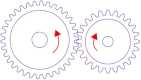
For example, a spur gear with 40 teeth and a 8 inch diameter will fit nicely with another spur gear with 50 teeth and a 10 inch diameter. (Scaling up the teeth using × 1.25 "directly" scales up the diameter by the same scale factor.)
With two spur gears, the rotational speeds will also have direct variation with either their number of teeth or their diameter
For example, if a motor drives a spur gear with 45 teeth to rotate 9 times each minute, the other spur gear with 60 teeth that it fits into will be rotated 12 times each minute. (Scaling up the teeth using × 1.33 "directly" scales up the speed by the same scale factor.)
Spur gears are the easiest to draw. But there are many types of gear combinations.

With all types the contrast remains. Swapping out a single gear is a matter of indirect variation. Comparing a pair of gears when combined is a matter of direct variation.
Why use different types of gear combinations?
None yet
Textbook Exercises for Two Step Equations
This list of recommended odd-numbered textbook problems is designed for a hypothetical student with a "typical" math background. If your math foundation is weak, do even more odd-numbered problems. If your math foundation is strong, do fewer.
Please read the advice on doing homework in the study skills page.
(Our textbook has no exercises for this topic.)
Try these ten exercises on scratch paper. Work in a study group if you can! Notice where your notes need improvement. After you are very happy with your answers, you can use this form to ask me to check your work. Can you get at least 8 out of 10 correct?
1. Is the ratio "2.4 to 3.6" proportional to the ratio "1.8 to 2.7"?
2. Solve the proportion: "7 to 1/4" is proportional to "28 to what?"
3. Fifteen hours of studying before a test lets you score 75 points. At that rate, how many points would you expect from studying 18 hours?
4. Julia's car can drive 120 miles on 4.5 gallons of gas. While driving across the country the tank gets down to 0.9 gallons. How many miles are left, for her to find a gas station?
5. Typically 5 people produce 13 kilograms of garbage each day. How many kilograms of garbage are produced each day by the 346,560 people in Lane County?
6. In a class of 40 students, on average six will be left-handed. A certain class has nine left-handed students. How large would you estimate the class is if its proportion of left-handed students is average?
7. The United States debt-to-GDP ratio is currently 255 to 200. If the U.S. debt is currently 28.8 trillion dollars, what is the gross domestic product?
8. A 25 pound turkey serves 18 people. How many pounds does each serving weigh?
9. A 25 pound turkey serves 18 people. What is the unit rate of servings per pound?
10. To determine the number of deer in a game preserve, a forest ranger catches, tags, and releases 318 deer. Later he catches 168 deer and sees that 56 of them are tagged. Use a proportion to estimate the number of deer in the game preserve.
Try these exercises on scratch paper. Work in a study group if you can! Notice where your notes need improvement. Check your work when you are done.
The previous example makes me uneasy.
Yes, I agree that the situation has an end result, what I called the overall sample space, with only four options.
But when I use the English verb "sample" in daily life it means to randomly take one time.
When I sample some chocolates I take one piece (or one pinch with a few pieces) but I do not reach into the bowl many times. That would be a different verb: helping myself to the chocolates, or eating the chocolates, or pigging out on chocolate.
When I sample some music I listen to each song briefly. I do not cycle among the songs, listening to each multiple times. That would be a different verb: comparing the songs, or evaluating my mood, or deciding what to listen to.
So my brain more naturally says the second card dealing situation has two active sample spaces: one with ten cards, then another with nine cards. Those are the groups of cards from which we actually take a single sample.
If that distinction also makes your brain happier then you will like what we do next.
A toddler owns four books.

Like most toddlers, she is fascinated by putting things in order and making combinations and patterns.
In how many orders can she put those books on her shelf?
We could make a table with every outcome. But it would be a big table! Too much work.
Instead let's think carefully.
When we pick out the first book to put on the shelf the current sample space has four options. So we have four choices.
When we pick out the second book to put on the shelf the current sample space has three options. So for each of those above four in-progress points we have three choices. We are up to 4 × 3 = 12 different ways.
When we pick out the third book to put on the shelf the current sample space has two options. So for each of those above twelve in-progress points we have two choices. We are up to 12 × 2 = 24 different ways.
When we pick out the four book to put on the shelf it is the only book left in our hands. The current sample space has only one option. We have no choice. We remain at 24 different ways.
We could draw a tree of the six choices that following first picking The Alphabet Room.

Similar trees could show the six choices that followed any of the other first picks.
Notice that what we ended up doing was multiplying 4 × 3 × 2 × 1 = 24.
Why did we multiply by a list of decreasing numbers? For the first book we had 4 options. For the second book we had 3 options. For the third book we had 2 options. For the last book we had 1 option.
Now we can talk about arrangements in more general terms.
An arrangement is a possible way to place items from a group. Arrangements do not allow repetition. Once we put an item in its place, it stays there. We do not select or put it again.
There are two questions to ask about arrangements.
• Do we place all of the items, or stop after we place only some of them?
• After we are done, do we care about the order of placed items? If we do, we say the arrangement is ordered. If we do not, we say the arrangement is unordered.
Here is a handy chart, which we will then explain.
As we talk about each type of arrangements, we will also ask what is the chance in that situation for a particular arrangement to happen if the options are all equally likely.
| remember that arrangements have no repetition allowed | n Ordered Items | n Unordered Items | |||
|---|---|---|---|---|---|
| Use Only r Items | Use All Items | Use Only k Items | Use All Items | ||
| An Arrangement is Called | Partial Permutation | Complete Permutation | Combination | Trivial | |
| Way to Write How Many Possible Arrangements | P(n,r) n permute r |
n! n factorial |
C(n,k) n choose k |
1 | |
| Real-Life Example | who earns 1st, 2nd, 3rd place in a contest | put books on a library shelf | pick a few people from a group | everyone gets their hand stamped | |
| Formula | n! ÷ (n−r)! | n! | n! ÷ (n−k)! ÷ k! | 1 | |
An ordered arrangement of all items is called a complete permutation. (Think of putting away books on a library shelf. All the books are put away. The order of the books does matter in a library.)
While looking at toddler books, we already saw the pattern for finding the number of possible complete permutations. We multiply, starting with the number of items and decreasing by 1 each time. This happens because the active sample space decreases in size by 1 each time we place a book on the shelf.
This pattern happens often enough that mathematicians give it a name, a symbol, and a button on the calculator. It is named "factorial" and the symbol is an exclamation mark.
We already saw that 4! = 4 × 3 × 2 × 1 = 24
As another example, 5! = 5 × 4 × 3 × 2 × 1 = 120
As another example, 6! = 6 × 5 × 4 × 3 × 2 × 1 = 720
In general, we use the letter n to represent a variable that is always a counting number (never a negative or decimal amount) and so write n! for "n factorial".
The Factorial Symbol for Complete Permutations
n! = n × (n − 1) × (n − 2) × ... × 2 × 1

The number of possible arrangements is 4! = 4 × 3 × 2 × 1 = 12 complete permutations of gumball colors.
So the chance of getting that particular arrangement is The number of possible arrangements is 1 ÷ 12 ≈ 0.08 = 8%.
An ordered arrangement of some items is called a partial permutation. (Think of a contest with three winners. Only some people in the contest win. The order of who earns 1st, 2nd, and 3rd place matters!) A partial permutation was called a variation in older literature.
We can think of a partial permutation as starting to make a complete permutation but then stopping early. Imagine that our in our example with a toddler's four books, the toddler only put two books on the shelf and then decided leave the others on the floor to chew on.

The multiplication for a partial permutation thus begins the same. The toddler has 4 options (of which we only pictured one above, first picking the book The Alphabet Room) and then 3 options (numbered with green).
But after doing that 4 × 3 she quits to start teething. She never gets to the × 2 × 1 part (marked with grey).
The clever way to write this involves using division of factorials.
First write too much of the multiplication. Go all the way down the decreasing list. We will color the numbers we really want green, and the others red. 4 × 3 × 2 × 1. Then we will remove the unwanted red numbers by using division. They are merely a smaller factorial, after all.
We can use parenthesis and color to emphasize how bits cancel out: 4 × 3 × (2 × 1) ÷ (2 × 1) = 12.
In other words, the number of partial permutations that involve a group of total of n items but only use r of them is n! ÷ (n − r)!
This pattern happens often enough that mathematicians give it a name, two symbols, and a button on the calculator. It is named "n permute r" and the symbols are nPr or P(n,r) depending upon whether you find subscripts or parenthesis more annoying.
The Permute Symbol for Partial Permutations
P(n,r) = n! ÷ (n − r)!

The number of possible arrangements is P(10,5) = 10! ÷ (10 − 5)! = 10! ÷ 5! = 30,240 partial permutations of five digits.
So the chance of getting that particular arrangement is The number of possible arrangements is 1 ÷ 30,240 ≈ 0.00003 = 0.003%. Three-thousandths of a percent is extremely unlikely to happen!
An unordered arrangement of some items is called a combination. (Think of a raffle with three identical prizes for three winners. Only some people in the raffle win. The order of who wins does not matter.) A combination is also called a binomial coefficient in some literature.
When we moved from complete to partial permutations we "crossed off" or "cancelled out" many of the possibile arrangements. We said that complete arrangements with identical endings should be considered the same. When only considering the first two letters, the words RITE and RIET are the same.
Now we do that even more. We look at the partial permutations and say that the order of the letters does not matter. When only considering the first two letters and ignoring the order then the words RITE, RIET, IRTE, and IRET are the same.
So we need to "cancel out" those partial permutations whose r items we do use that are merely reorderings of each other. How many of those are there? We have already found this answer. There are r! of them.
In other words, the number of combinations that involve a group of total of n items but only use r of them is n! ÷ (n − r)! ÷ r!
To be extra clear, many texts switch which letters they use when taking about combinations. The letter n is still used for the total number of items. But the number of items used in the combination is k (instead of r). That way students who see an r know the problem deals with permutations, and students who see an k know the problem deals with combinations. This website will do this. You are encouraged to do this too, so that your scratch work will be as clear as possible when working with classmates or getting graded.
The combination pattern happens often enough that mathematicians give it a name, three symbols, and a button on the calculator. It is named "n choose k" and the symbols are nCk or C(n,k) or  depending upon whether you find subscripts or parenthesis more annoying.
The Choose Symbol for Partial Combinations
C(n,k) = n! ÷ (n − k)! ÷ k!

The number of possible arrangements is C(15,3) = 15! ÷ (15 − 3)! ÷ 3! = 455 combinations of winners.
So the chance for a particular arrangement of three winners to happen is 1 ÷ 455 ≈ 0.002 = 0.2%. Two-tenths of a percent is very unlikely to happen!
An unordered arrangement of all items is trivial. We put all the items on the shelf. Done! There is only 1 solution, because all shufflings are considered to be the same solution.
What happens if we do allow repetition?
An ordered mixture of some items that allows repetition is called an word, or a n-tuple. If an alphabet has n different letters, the number of (probably unpronouncable nonsense) words with c letters that we can make is nc because the choice of n letters is repeated on c occasions. You can think of the exponent c as counting the number of characters in the word.

The number of possiblefour-character "words" that can be made out of ten "letters" is 104 = 10,000.
So the chance of that particular "word" is 1 ÷ 10,000 = 0.0001 = 0.01%. A hundredth of a percent is not very likely to happen!.
An unordered combination of some items that allows repetition is uninteresting except for Scrabble players. No one else wonders what words would be like if STOPS and SPOTS were the same word.
When we do arithmetic with numbers the basic operations are +, −, ×, and ÷. Sometimes there are extra rules with fractions.
When we do arithmetic with probabilities the basic operations are and and or. Sometimes there are extra rules with conditional events.
Playing cards are the traditional situation used in example problems for probability arithmetic. Drawing a card is an outcome with two features: suit and rank. This allows us to ask questions such as "What is the chance of drawing a king or a red card?" that are interestingly complex because some kings are red cards and others are not.
But those exampel problems create headaches. Too many 52s and other awkwardly large numbers.
Normal six-sided dice have nice small numbers, but do not naturally make questions of equivalent interest and complexity.
So we will modify six-sided dice to get the best of both words: interesting complexity with small numbers. Huzzah!
Imagine two young siblings invented a special dice game. They put stickers on a six-sided die in the following ways:
You could use stickers and a six-sided die to make your own copy. Or you could print, cut out, fold, and tape/glue this version:

The rules to the game are:
1. Both kids start with a pile of pennies they pretend are spaceships. Perhaps these piles have equal size, or perhaps one kid is younger and gets to start with more. Doesn't matter. Also, some extra pennies are set to the side. The kids also get a small number of tiny pebbles.
2. On your turn roll the die. Rolling a spaceship means your fleet builds a new spaceship: take a new penny from the extras. Rolling an explosion means you defeat an enemy ship: remove one of your sibling's pennies. Rolling a bomb means one enemy ship is doomed: put three pebbles on one of your sibling's pennies.
3. If you rolled an explosion, roll again! This can keep happening until you do not roll an explosion. Then your turn ends and the other kid starts a turn.
4. Remember bombs? At the start of your turn, remove one pebble from all of your ships that have any pebbles. When the last pebble is removed from a ship, that ship blows up: also remove that penny.
5. You win when your sibling's fleet is completely destroyed!
When doing probability with or we add, being careful to subtract any overlap.
For example, the chance to roll a ship is ½. The chance to roll an explosion is ½. But the chance to roll a ship or explosion is not ½ + ½ = 1. Do you see why? How do we fix that addition?
When combining independent events with and we multiply.
For example, the chance to roll an explosion is ½. Then we can roll again, and on the second roll we again will get an explosion half the time. So the chance to roll at least two explosions is ½ × ½ = ¼. Do you see why?
When combining conditional events with and we imagine that we are telling a story, going chronologically backwards. "We defeated the dragon! But first we had to find its cave." Start at the most recent event, and multiply by the probability that we actually did get that far already.
For example, what is the chance to get all three outcomes once? This can only happen one way: first rolling "bomb and explosion" and then rolling "only ship". The chance to roll "only ship" is ⅓. The chance to have actually rolled "bomb and explosion" earlier is ⅙. So the chance both happens is ⅓ × ⅙ = 1⁄18. Do you see why?
What happens when we tell a story involving or?
For example, what is the chance that a player's first two rolls damage exactly three ships with bombs or explosions? There are four ways this could happen. A player could first roll "bomb and explosion", and then on the second roll get either "only explosion" or "explosion and ship". Or that player could first roll either "only explosion" or "explosion and ship", and then on the second roll get "bomb and explosion". Finish answering this problem.

Because of a strange bit of history we cannot use proportions or Unit Analysis for temperature conversion between Celsius and Fahrenheit. Instead we need to use (but not memorize) formulas.
First we need a formula to switch from Celsius to Fahrenheit. Here are three equivalent and equally workable options. Pick your favorite and ignore the other two.
We also need a formula to switch from Fahrenheit to Celsius. Again, here are three equivalent and equally workable options. Pick your favorite and ignore the other two.
The last formula of each group was created in 2005 by Robert Warren. He thinks they are easier to remember. They are based on the coincidence that -40 °C is also -40 °F.
F = 1.8 × C + 32 = 1.8 × 39 + 32 = 102.2 °F
C = (F − 32) ÷ 1.8 = (73 − 32) ÷ 1.8 = 22.8 °C
By the way, when we used Charles' Law earlier, the example problem snuck in the phrase "absolute temperature". This means we are using neither Fahrenheit nor Celsius, but a different type of temperature measurement that shifts all the values so that zero happens at the coldest possible temperature, nicknamed "absolute zero".
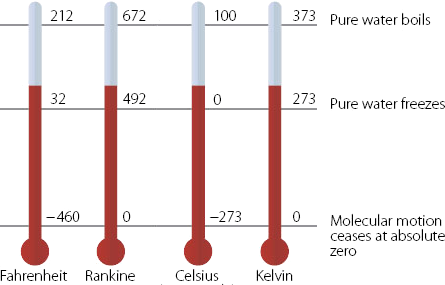
After a Fahrenheit temperature is shifted to absolute temperature it is named a Rankine temperature.
The distance between degrees on a Fahrenheit thermometer and a Rankine thermometer are the same. But absolute zero is − 459.67 °F.
After a Celsius temperature is shifted to absolute temperature it is named a Kelvin temperature.
The distance between degrees on a Celsius thermometer and a Kelvin thermometer are the same. But absolute zero is − 273.15 °C.
The math about scale factors (including measurement conversion rates) only works when zero really means a complete lack of something. Zero yards and zero meters are both no distance, so we can use a scale factor to change between measurements in yards and meters. Zero ounces and zero grams are both no weight, so we can use a scale factor to change between measurements in ounces and grams.
Laboratory scientists like using the Kelvin temperature scale because it shifts zero to where there really is no thermal molecular motion. Then scale factors work, including the scale factors hidden in equations such as Charles' Law.
Aviation mechanics use the Rankine temperature scale for the same reason, but they need the Imperial version instead of the SI version.
Formally the ° symbol is not used with Kelvin or Rankine temperature measurements. But sometimes the degree symbol is used merely for clarity, especially if there is another variable using the letter K or R on that page.
Chapter 8 Test, Problem 22: Convert 95°F to Celsius.
Chapter 8 Test, Problem 23: Convert 59°C to Fahrenheit.
Textbook Exercises for Temperature
This list of recommended odd-numbered textbook problems is designed for a hypothetical student with a "typical" math background. If your math foundation is weak, do even more odd-numbered problems. If your math foundation is strong, do fewer.
Please read the advice on doing homework in the study skills page.
Section 7.4 (Page 397) # 23, 25, 49
Many problems make finding area puzzle-like. Sometimes we can "stick together" small pieces to find a big area. Sometimes we can "remove" a small piece from a big area to get the shape in question. And sometimes either method will work!

When finding the area, which plan did you use?
This "subtract pieces" plan?

(big rectangle) − (small rectangle) = (6 × 2.5) − (2 × 1.5) = 15 − 3 = 12 square inches
This "glue pieces together" plan?

(left rectangle) + (right rectangle) = (1 × 2) − (2.5 × 4) = 2 + 10 = 12 square inches
Or this other "glue pieces together" plan?

(top rectangle) + (bottom rectangle) = (1 × 6) − (1.5 × 4) = 6 + 6 = 12 square inches
All of those work! Which plan seems most natural varies from person to person. Our brains are not all built the same!
Let's do another example of a puzzle-like area problem.

(rectangle) + (triangle) = (length × width) + (½ × base × height) = (10 × 12) + (½ × 10 × 6) = 120 + 30 = 150 square inches
Here is a "heads up" warning. When solving geometry problems do not get confused if the diagram provides too many numbers!
Consider this problem:

length × width = 16
Here is the same problem with extra numbers.

length × width = 16
The extra numbers do nothing! The area does not change. The problem does not magically change from an area problem into a perimeter problem merely because all the sides were labeled.
Be wary! Keep the formulas in mind. Ignore extra numbers.
Let's do two more examples of puzzle-like area problems.

(big triangle) + 6 × (little triangle) = (½ × base × height) + 6 × (½ × base × height) = (½ × 6 × 6) + 6 × (½ × 1 × 1) = 18 + 3 = 21 square centimeters
We could also photocopy the shape, rotate the copy, and fit them together to make a rectangle with sides 6 cm and 7cm. That big rectangle thus has an area of 42 sq. cm., so half of it is our original shape with an area of 21 square centimeters

The picture can be confusing! Try drawing the footprint of the building instead.
The problem is easy once you draw flat rectangles.

(big rectangle) − (small rectangle) = (113.4 × 75.4) − (110 × 72) = 8,550.36 − 7,920 ≡ 630 square feet
The queen of area puzzles is Catriona Shearer. You can read an interview with her on the website Math With Bad Drawings. She has a book too.

The king of area puzzles that only involve rectangles is Naoki Inaba. More of his easier puzzles are here. You can also buy a book of them.

None yet
Textbook Exercises for Area Puzzles
This list of recommended odd-numbered textbook problems is designed for a hypothetical student with a "typical" math background. If your math foundation is weak, do even more odd-numbered problems. If your math foundation is strong, do fewer.
Please read the advice on doing homework in the study skills page.
Section 8.2 (Page 431) # 9, 11, 15, 23, 29, 35
Prisms
A prism is a three-dimensional shape formed by holding one copy of a polygon above another and then connecting matching corners.
According to this definition the polygon copies start as the top and bottom of the prism. We often rotate a prism so the two polygons look like the front and back of the shape.
(Be aware that according to this definition a cylinder is not a prism because its top and bottom are copies of a circle instead of a polygon. But many people use the phrase "cylindrical prism". We will not study cylinders.)
We just finished looking at flat area puzzles. The surface area of prisms is a different kind of area puzzle. You can image the prism was created by folding flat surfaces to make a three-dimensional shape.
Working backwards, we can "unfold" a prism to make its surfaces lie flat again.
A nice slideshow by Shyanne Delaney has some examples.

Time for some example problems.
First, imagine a rectangular box whose sides have lengths 2 meters, 2.5 meters, and 4 meters.
???

Next, imagine an old-fashioned "soldier tent" with fabric on all four sides and its floor. The triangular front and back of the tent is 4 feet high and 6 feet across the base. The two rectangular sides make the tent 8 feet deep, and are 5 feet tall (this is taller than the height of the tent because they slant). The floor of the tent is another fabric rectangle.
???

The puzzle lovers Peter and Serhiy Grabarchuk tried to make this unfolding fun on their old (now discontinued) website.
???

While we are looking at prisms, we might as well think about the volume of prisms.
We can think of a rectangular prism as a skyscraper whose footprint is a certain size rectangle, and whose height count how many stories tall it is.
Each story tall is another copy of the ground floor. So after we find the area of the ground floor (using a formula for the area of a flat shape), we can multiply by the number of stories to find the overall size of the skyscraper.
prism volume = ground floor footprint area × height
???

One famous skyscraper is 432 Park Avenue in Manhattan, which was the third-tallest building in the United States when constructed. Its ground floor has area 412,637 square feet. Its height is 1,396 feet.
???

Your turn for one more volume example.
???
We can add up a stack of rectangular blocks to find the total volume in a block tower.
This works even if the tower is "sloppy" because the blocks are not all the same size, or are not lined up well. We combine three-dimensional pieces in a manner quite similarly to how we did earleir solved flat area puzzles.
Maybe think of the towers made by the toddler blocks.

Or maybe think of the towers made by the Tower Blocks Game by Stever Gardener.

???
Is a pyramid a prism?
Officially, a pyramid is not a prism. No matter which we rotate it, it does have two identical polygons as its ceiling and base (with matching corners connected).
But it seems to be a cousin of the prism. Can we find its volume formula?
Yes. There is a clever proof described in this YouTube video by mathematicsonline.

pyramid volume = one-third × footprint area × height
This is a nice formula. The volume of a pyramid is one-third of the smallest rectangular prism that surrounds it.
Is a cylinder a prism?
Officially, a cylinder is not a prism. It has identical circles, not identical polygons, as its ceiling and base.
But cylinders work a lot like prisms. We can picture them as a skyscraper. The ground floor footprint area is the area of the bottom circle.
cylinder volume = π × radius2 × height
It is not surprising that a cone is like a pyramid, but it fits inside a cylinder instead of a prism.
We expect the volume of a cone will be one-third of the smallest cylinder that surrounds it.
cone volume = one-third × π × radius2 × height
A careful proof does require calculus, so we will skip over it.
How about the volume of a sphere?
We just declared that the volume of a cone will be one-third of the smallest cylinder that surrounds it.
Interestingly, the other two-thirds forms the volume of the largest sphere that fits into that cylinder.
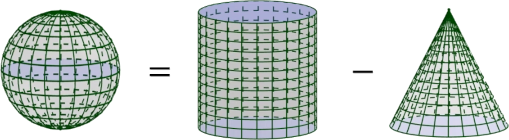
The simplest proof is explained in a nice YouTube video by Chen Hongming.
cylinder volume = two-thirds × volume of cylinder
Now we can make a formula for the volume of a sphere. First we realize that the height of the cylinder is the sphere's diameter.
cylinder volume = two-thirds × π × radius2 × diameter
Then we replace diameter by 2 × radius and simplify.
cylinder volume = four-thirds × π × radius3
Textbook Exercises for One Step Equations
This list of recommended odd-numbered textbook problems is designed for a hypothetical student with a "typical" math background. If your math foundation is weak, do even more odd-numbered problems. If your math foundation is strong, do fewer.
Please read the advice on doing homework in the study skills page.
Section 8.3 (Page 442) # 3, 23
Section 8.4 (page 452) # 3, 5, 27
Try these ten exercises on scratch paper. Work in a study group if you can! Notice where your notes need improvement. After you are very happy with your answers, you can use this form to ask me to check your work. Can you get at least 8 out of 10 correct?
1. 86 degrees Celsius is what temperature in degrees Fahrenheit?
2. 44 degrees Fahrenheit is what temperature in degrees Celsius?
3. A square with sides 10 feet long has the top quarter removed (like a triangular "bite" taken out of the top). What is the remaining area?
4. A circle of radius 6 cm has its southwest quarter removed. What is the perimeter of that "Pac-Man" shape?
5. A half-circle window has diameter of 8 feet. What is its perimeter?
6. You want to install a two foot wide sidewalk around a circular swimming pool. The diameter of the pool is 30 feet. What is the area of the donut-shaped sidewalk, rounded to the nearest square foot?
7. Clarabelle's Confusing Pizza Parlor sells a 20 inch diameter pizza for $18.99, and a 40 cm diameter pizza for $14.99. Which is the better buy? (1 inch = 2.54 centimeters.)
8. How large a circle (how big an area?) can fit inside a rectangle of base of 12 feet and height of 5 feet?
9. A square is cut in half. The perimeter of the resulting rectangle is 30 feet. What was the area of the original square?
10. The circumference of a quarter is 7.85 cm. What is its area?
Try these exercises on scratch paper. Work in a study group if you can! Notice where your notes need improvement. Check your work when you are done.

Unfortunately, there is vagueness about how to measure the probability of a change.
Imagine a medicine that can reduce one of your family member's cancer risk from 44 cases among 10,000 people down to 11 cancer cases among 10,000 people. The medicine has some bad side effects. Is the reduction in cancer risk worth suffering these side effects?
Absolute Change Example
The old risk is 0.44%. The new risk is 0.11%.
0.44% − 0.11% = 0.33%
We could say that with the medication the risk is reduced by 0.33%. (Only a third of one percent? That does not sound like much.)
We could also use a percent change to measure how much less likely is the new risk. Like all percent changes, this is a ratio comparing change to original.
(The funky part of this problem is how the change and original amount are both percentages.)
Relative Change (Less Likely)
The old risk is 0.44%. The new risk is 0.11%. Subtracting tells us the change is 0.33%. Then we do change ÷ original.
0.33% ÷ 0.44% = 0.75 = 75%
We could say that with the medication the occurrence of cancer is 75% less likely than before. (That sounds impressive!)
Relative Change (As Likely)
The new risk is 0.11%. The old risk is 0.44%.
0.11% ÷ 0.44% = 0.25 = 25%
We could say that with the medication the occurrence of cancer is only 25% as likely than before. (That still sounds impressive!)
The moral of the story is to pay attention (especially when dealing with small numbers) to whether a speaker is using an absolute change or a relative change. The former made the medicine sound like it is probably not worth the risk of its side effects. The latter made the medicine sound amazing.

The weighted average of a group of situations measures the "average result" of that group.
To find an weighted average, use a table. Each possible outcome is a row. Work across with multiplication: the value for that outcome times its percent probability. Then add those products.
This answer requires making a table, as below. The answer is not surprising. Most people already know that the "average value" when rolling two dice is seven. The expected value table confirms that common knowledge is precise instead of rounded: the expected value is indeed seven exactly, not slightly more or less. (The original Google spreadsheet is here.)

Here is a sample spreadsheet that shows Billy spends an average of about 2.1¢ each trip to the grocery store.

For many students the most commonly used weighted average table is finding their overall grade in a class.

Here is a sample spreadsheet that shows the overall grade is 81.9 in the class.

The weighted average is sometimes called the expected value. It does make sense to say "the expected value of the sum of two dice is 7". It almost makes sense to say "the expected value of one of Billy's trips to buy a gumball is 2.1¢." But it does not make sense to call the overall class grade an "expected value" because that situation does not involve condensing mutually exclusive outcomes into an average outcome.
Try these ten exercises on scratch paper. Work in a study group if you can! Notice where your notes need improvement. After you are very happy with your answers, you can use this form to ask me to check your work. Can you get at least 8 out of 10 correct?

1. When rolling two dice, what is the probability of the sum being an even number?
2. When rolling two dice, whatare the odds of the sum being an even number?
3. When rolling two dice, what is the probability of the sum being 8 or more?
4. When rolling two dice, what are the odds of the sum being 8 or more?
5. The medicine trastuzumab, which fights breast cancer in women who already have breast cancer, was popularized because of a certain study. In the control group of 1,700 women, 34 died. In the group treated with trastuzumab, 23 of 1,643 women died. What percentage of the women in the control group died? What percentage of the women in the treated group died?
6. Continuing the previous problem, what was the absolute change (subtraction) in risk?
7. Continuing the previous problem, what was the relative change (percent change) in risk?
8. Trastuzumab also has some dangerous side effects. Most notably, 40% of the women who take it develop flu-like symptoms, 7% develop mild heart problems, and 5% suffer a stroke or severe heart failure. About how many of the 1,643 women in the study who were treated with trastuzumab suffered a stroke or severe heart failure because of drug?
(Tangentially, if you were in charge of publicity for this drug, what type of claim could you truthfully make about the medicine? If you were trying to discredit trastuzumab—perhaps concerned about the side effects and trying to convince a family member with breast cancer not to take the medicine—what type of claim could you truthfully make about the medicine?)
9. Your little brother thinks that ten is a very big number. He wants to play a dice game about the number ten. He proposes a game where you each start with a pile of candies, and he finds the sum of two dice several times. Whenever the sum is less than ten, he gives you one candy. Whenever the sum is ten or greater, you give him more than one candy—but he is not sure how many is fair. Help your brother finish inventing his game by using an expected value table to find how many candies must you give him when he "wins" so that the game has an expected value of zero.
10. Your friend is starting a food cart business. She has read that new food carts have a 35% chance to go out of business during the first year with a $10,000 loss, a 30% chance to earn $20,000 profit the first year, a 15% chance to earn $30,000 profit the first year, a 15% chance to earn $40,000 profit the first year, and a 5% chance to earn $50,000 profit the first year. Assuming these numbers are true, and your friend has typical skill and luck in her new business, what is the expected value of her first year's income?
Try these exercises on scratch paper. Work in a study group if you can! Notice where your notes need improvement. Check your work when you are done.
Brainstorming it Personal
Share specific examples from your own life:
- a percentage that is a part of a whole, and a percentage that is not a part of a whole
- a list of categorical data, and a list of quantitative data
- a list of data whose mean and median are very different
- a list of data whose range is greater than its highest value and which does not have a mode
- a list of data that has high standard deviation, and a list of data that has zero standard deviation
- a data set appropriately written in a frequency table, and data set inappropriate to write in a frequency table
- a data set appropriately written in a contingency table, and data set inappropriate to write in a contingency table
- a data set appropriately drawn as a pie chart, and data set inappropriate to draw as a pie chart
- a compliment, complementary outcomes
- a simple outcome, and a compound outcome


