Our first foundational topic is Shapeshifting. This is our nickname for when we do something to a single number.
What can we do with a single number?
Consider a situation in which child rolls a die 1,000 times. An even number is rolled 499 times.
We can write this result in fraction format as 499⁄1,000.
This fraction is very close to one-half. In fact, we would expect that if the child rolled the dice many more times the nearness to one-half would increase. The child has "proved" in his or her mind that the chance rolling an even number is one-half. So it makes sense to round the answer to one-half.
We could change the number one-half to decimal format by writing it as 0.5.
Tangentially, when it is spoken aloud the decimal 0.5 has three possible names. An instructor who is lecturing would use the dictation name and say "zero point five" because saying "zero point..." gives a heads-up to listening ears. People thinking to themselves or working together would probably use the casual name and say "point five". There is also a formal name, "five tenths", created from the place value of the final digit.
We could change the number one-half to percent format by writing it as 50%.
Finally, if the number was a measurement we could change the format of its measurement units. For example, a length of 0.5 feet could also be written as 6 inches.
To summarize, we will explore more deeply how and when we "shapeshift" a number by rounding or by changing formats (fraction, decimal, percent, measurement units).
As we study this topic, work on making helpful and organized notes, so you have handy the comments, formulas, and example problems you need.
My scale tells me I weigh 150 pounds.
That's just a number. Numbers are part of math.
Here is one of the geometry formulas we will learn:
Area of a rectangle = length × width
This formula expects us to plug in two measured lengths, and then it provides an area. Formulas are part of math.
We could actually use the formula to calculate an answer. If a rectangular field was 500 feet long and 700 feet wide, the formula claims that the field's area is length × width = 500 ft × 700 ft ≈ 350,000 square feet. Calculations are part of math.
Here is a quick version of the famous barometer story.
The Barometer Story
A physics test asked the question, "How could you measure the height of a tall building, using a barometer?"
One student gave the expected answer: "I could measure the barometric pressures at the top and the bottom of the building, and use the formula about pressure to determine the building’s height," but instead of stopping there provided many other answers.
- I could drop the barometer off the roof, time its fall, and use the formulas about falling speed to find the distance it traveled before it shattered on the sidewalk below.
- I could walk down the stairwell while making marks on the wall equal to the barometer's height, and then multiply the number of marks by that height.
- I could tie the barometer to a string, lower it from the roof to the ground, and measure the length of the string.
- I could tie the barometer to a string, lower it from the roof to the ground, swing it like a pendulum, time its frequency, and use the pendulum formulas to find the length of the string.
- I could stand the barometer on the sidewalk, measure its height and the length of its shadow, measure the length of the building's shadow, and use the formula about proportional triangles.
- I could go to the building superintendent and offer him a brand-new barometer if he will tell me the height of the building.
That story talks about numbers and formulas and computations. But it does not actually include any. Thinking about numbers and formulas and computations is also math.
A math class should focus on all four parts of math.
We use lots of numbers! No big deal. Numbers themselves are rarely exciting.
We learn a bunch of famous formulas! We will plug in numbers and use these formulas. But equally important is to learn how to use the formulas. For example, if we were measuring the area of a field that is not perfectly rectangular, how accurate and useful will our answer be?
We do a lot of computation! Correctly doing small problems with right answers helps you feel good about your math ability.
The computations we do are not themselves hard. They can be hard when they are new, just because anything can be hard when it is new! But once they stop being new, they also stop being hard.
Finally, we do a lot of thinking about numbers and formulas and computations.
Most of our thinking about numbers and formulas and computations is planning.

How do you plan a diet to manage your weight? How do you plan a meal to feed a hundred people? How do you plan a household budget, or plan what size house to buy to fit a budget? How do you plan saving for retirement? How do you plan the pricing strategy for a store or restaurant?
These are big problems without right answers. Math can guide us to make good decisions even if there is no one right answer for that situation.
What is Math?
The Map of Mathematics (Domain of Science)
Is math discovered or invented? (Jeff Dekofsky, TED-Ed)
Sapere aude! Have the courage to use your own understanding.
- Kant
Decimals can be very accurate.
LEGO bricks fit together so well because the molds that make them are even more precise. Their accuracy is within two thousandths of a millimeter.
How much is two thousandths?
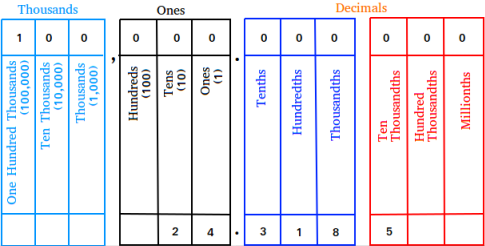
Let's review the place value names.
That digit does not mean 8, but 80,000,000. It can say it is "eight ten-millions".

That digit does not mean 8, but 0.008. It can say it is "eight thousandths".
Thousands vs. Thousandths

2,000 0.20 0.02 0.002
Which of these numbers is two thousands?
Which of these numbers is two thousandths?

0.0006
If it helps, work in steps. 0.6 is six tenths. 0.06 is six hundredths. 0.006 is six thousandths. Finally we get to 0.0006 as six ten-thousandths.
from left to right: hundreds, tens, ones, tenths, hundredths, thousandths, ten-thousandths, hundred-thousandths

We should also do two problems that check whether zeroes in place values confuse us.
20,680 2,680 2,860 2,608
2,608 → 2,680 → 2,860 → 20,680
0.57429 0.57491 0.574905 0.57949
0.57429 → 0.574905 → 0.57491 → 0.57949
 Here is an example in which so many decimal places really matter.
Cole Paviour invented a famous machine that used a computerized motion-capture of an athlete moving to control the timing of more than two thounsand separate water drop dispensers. This machine needs accuracy to the millionths place.
Imagine that one of Cole Paviour's measurements was 5.714286 seconds.
Yes. The 7 is in the tenths, the 1 in the hundredths, the 4 in the thousandths, the 2 in the ten-thousandths, the 8 in the hundred-thousandths, and the 6 in the millionths.
In the situation above the decimals really were amazingly accurate. However, some decimals look accurate but are not.
The most common source of fake accuracy is division.
Consider three different division stories that use 40 ÷ 7 = 5.714286....
To fairly distribute 40 pieces of candy into 7 party favor bags, each bag gets 5 pieces. I can see 5 pieces ÷ 7 = 35 pieces. Then I eat the remaining 5 pieces myself.
An alert student might notice that this problem did not follow the usual rules for rounding. The tenths place was 5 or more (it was 7) but we still rounded down. That is okay. Real life can be like that.
It is true that 40 ÷ 7 = 5.714286... which looks like the number from Example 4. But rounding this answer with any decimal places does not make sense. No one will get a part of a candy. We should just drop all the decimal places.
Notice how the decimal places appeared because of division, not careful measurement. They were fake accuracy.
Since the initial value was only accurate to a whole number of milligrams, we could use the same number of decimal places and say 40 milligrams ÷ 7 ≈ 6 milligrams. Making equal piles might not increase our accuracy beyond what we originally knew. We have no reason to believe the medicine's accurate total weight is precisely 40 milligrams. It could be 39.6 milligrams or 40.4 milligrams, or some other amount that whomever sent it to the pharmacist had rounded. The pharmacist did not re-weigh the medicine before dividing it into doses, knowing that for this medicine that would be a waste of her time. So 6 milligrams is an honest answer.
We could also use one more decimal place and say 40 milligrams ÷ 7 ≈ 5.7 milligrams. The pharmacist's scale can measure accurately to the tenth of a milligram. Making equal piles can often increase our accuracy by one decimal place. That is another honest answer.
But if we said 40 milligrams ÷ 7 ≈ 5.71 milligrams we would be exaggerating. The pharmacist's scale is not accurate to the hundredth of a milligram. No matter how carefully we make equal piles we probably cannot increase our accuracy by two decimal places.
Notice how the decimal places appeared because of division, not careful measurement. But adding one more decimal place could be justified. Making about ten piles could increase our accuracy by a tenth. Also, the pharmacist's scale could measure accurately to the tenth of a milligram.
If we said 40 inches ÷ 7 ≈ 6 inches we probably insult the carpenter. A tape measure and saw should be accurate to the tenth of an inch.
We should use one more decimal place and say say 40 inches ÷ 7 ≈ 5.7 inches. That is an honest answer.
If we said 40 inches ÷ 7 ≈ 5.71 inches we are probably exaggerating. Maybe the original board was not actually shorter than 40 inches, maybe the carpenter was extremely careful and used his tools to the limit of their accuracy, and maybe the extra wood was discarded unstead of letting the final piece be a smidgen too long. In this situation the tools might justify using two more decimal places in our answer. But those are a lot of maybes.
Notice how the decimal places appeared because of division, not careful measurement. But adding one more decimal place is very justified. Making about ten piles could increase our accuracy by a tenth. Also, the carpenter's tools should measure accurately to the tenth of an inch.
In conclusion, a measurement tool can be very accurate. But when division is the source of a decimal answer, the general guideline is to not add more than one more decimal place than in the original values.
A General Rule
The examples above suggest a a General Rule for Accuracy: when division is the source of a decimal answer, use the same number of decimal places as in the original values, or perhaps one more decimal place.
However, the real-life context takes priority. When making party favor bags, do we cut candies into pieces? When sawing a board, how accurate can we cut?
Your turn to do an example.
15 pints ÷ 16 pints per gallon = 0.9375 of a gallon ≈ 0.94 of a gallon
We can reliably divide a gallon into 100 pieces, each would be about 2.5 tablespoons. Clara's salsa production is probably not accurate to the tenth of a tablespoon, so we should stop there.
In the examples above the decimal answer was rounded for you. Now it is your turn to round decimal answers!
First, a carefully worded definition.
Definition
Rounding is ideally reducing the accuracy of an answer to remove fake accuracy, using four steps:
• Pick an appropriate place value
• Make zero the digits to the right (this removes decimal digits)
• Of the digits just made zero, if the largest/leftmost was 5 or more then increase by 1 the digit of the picked place value
• Do not change the digits to the left
No one else defines rounding so carefully. But we can be extra awesome.
Let's unpack this definition.
First, we ideally only round answers with fake accuracy. The exceptions should be few. When someone like Cole Paviour works hard to be genuinely super-accurate it would be a shame to throw away that accuracy for no reason!
Second, we pick an appropriate place value. You were just introduced to the relevant issues. How accurate are the situation's initial values? How accurate are the tools being used? Is the situation one of the rare cases when making equal sized piles can add not merely one but two decimal places of accuracy?
(In general, students worry much more about this decision than math instructors. We want you to learn math, not spend time agonizing over whether a teaspoon is accurate to the hundredth or thousandth of a pint.)
Third, notice that we are making digits zero. It can be tempted to use sloppy thinking and imagine that we are "removing" decimal place digits. But truthfully they are still there. We have only set them to zero, which means we can skip writing them.
Time for many more examples!
(a) 4,573 to the ones, 4,570 to the tens, 4,600 to the hundreds, 5,000 to the thousands
(b) 625 to the ones, 620 to the tens, 600 to the hundreds, 1,000 to the thousands
(c) 17,349 to the ones, 17,350 to the tens, 17,300 to the hundreds, 17,000 to the thousands
(a) 2.0 to the tenth, 1.95 to the hundredth, 1.953 to the thousandth, 1.9528 to the ten-thousandth
(b) 3.9 to the tenth, 3.85 to the hundredth, 3.853 to the thousandth, 3.8526 to the ten-thousandth
(c) 0.1 to the tenth, 0.07 to the hundredth, 0.072 to the thousandth, 0.0725 to the ten-thousandth
(d) 25.8 to the tenth, 25.79 to the hundredth, 25.790 to the thousandth, 25.7901 to the ten-thousandth
(e) 0.7 to the tenth, 0.67 to the hundredth, 0.667 to the thousandth, 0.6667 to the ten-thousandth
(f) 1.3 to the tenths, 1.27 to the hundredths, 1.273 to the thousandths, 1.2727 to the ten-thousandths
(g) 5.7 to the tenth, 5.75 to the hundredth, 5.750 to the thousandth, 5.7495 to the ten-thousandth
In part (d) of the above problem please notice the unexpected thing when rounding to the nearest thousandth. When we are asked to write to the thousandths place, we must write three decimal digits. We write a zero to "fill up" to the thousandths place.
The hundreds digit is less than five, so when rounding to the nearest thousand we get 0 instead of 1,000.
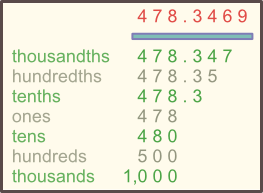
Our definition of rounding warned us to not round in the middle of a problem. If we round too early we introduce error. Let's consider a few examples.
1.15 inches × 52 weeks = 59.8 inches
1 inch × 52 weeks = 52 inches
Soon we will have the tools to see that rounding too early in the problem made the answer about 13% too small. That might matter a lot if we were farmers budgeting for our annual water bill.
Here is another example of rounding too early.
(3.25 + 5.25) × $8,500
(3 + 5) × $8,000
Soon we will have the tools to see that rounding too early in the problem made the answer about 6% too small. That could be a big deal if we were planning our personal budget.
As a concluding exercise, work with a partner to invent a word problem. Solve it accurately, doing any rounding at the end. Then round too early, and see how much the answer changes. Try to invent a problem for which rounding early would be utterly disastrous.
Corresponding Textbook Sections
Prealgebra §R.3, §4.1
Corresponding Whiteboard ToDoodles
Place Value uses ToDoodles 01 to 07.
Place Value
Place Value (Math Antics)
Math with Mr. J has a playlist with 45 videos.
Mathispower4u has a playlist with 16 videos.
Khan Academy has a playlist with 6 videos.
Rounding
Rounding (Math Antics)
Step by Step Rounding (Math with Mr. J)
Rounding Numbers and Rounding Decimals - The Easy Way! (The Organic Chemistry Tutor)
Mathispower4u has a playlist with 10 videos.
Khan Academy has a playlist with 11 videos.
As we have seen, rounding early can drastically change an answer. But it can be a very helpful thing to do as a quick "check" before we attempt a problem.
Definition
Rounding at the very beginning of a problem is called estimating.
For now, use estimating to quickly get a rough idea how large the answer should be. This an artificial but useful reason to estimate.
After we estimate, we could actually solve the problem. Is our answer close to the estimated amount? If not, we might have made a careless mistake (on paper or with the calculator) and can go back to find what went wrong.
$47,900 ÷ 10 = $4,790, which is not very close to the actual calculation of $47,900 ÷ 12 = $3,991.67
Many real life situations force us to estimate. For example, if I am planning a road trip the price of gasoline will not be the same at every gas station. To budget for my trip I will pick one value to use as my "typical" estimated price.
For that reason we will (later on) do math in situations that start with estimation and have no precise "right answer" to afterwards compare.
Note: answers will be different if the amount rounded is different.
(a) 60 + 30 = 90
(b) 350 − 90 = 260
(c) 120 + 80 = 200
(d) 460 − 180 = 280
(e) 6,000 + 100 = 6,100
(f) 8.15 − 0.01 = 8.14
(g) 3,500 + 6,300 = 9,800
(h) 1.675 − 1 = 0.675
Note: answers will be different if the amount rounded is different.
(a) 20 × 30 = 600
(b) 930 ÷ 10 = 93
(c) 50 × 5 = 250
(d) 2,000 ÷ 200 = 10
(e) 870 × 10 = 8,700
(f) 460 ÷ 20 = 23
(g) 0.01 × 0.01 = 0.0001
(h) 200 ÷ 200 = 1
Here are more estimation problems.
estimate $3.025 − $0.284 ≈ $3.0 − $0.3 = $2.70
actual $3.025 − $0.284 = $2.741
estimate 2.48 × 4 ≈ 2.5 × 4 = 10 feet
actual 2.48 × 4 = 9.92 feet
will be an overestimate / will be an underestimate / could be either an overestimate or underestimate
will be an overestimate
will be an overestimate / will be an underestimate / could be either an overestimate or underestimate
will be an underestimate
will be an overestimate / will be an underestimate / could be either an overestimate or underestimate
could be either an overestimate or underestimate
Corresponding Textbook Sections
Corresponding Whiteboard ToDoodles
(none)
Estimating
BittingerBasicMath has video example problems for estimating a sum or a difference, as well as two videos about estimating a product and a final video about estimating a quotient.
Congratulations! You are at the end of the first subtopic (Number Sense) for our first big topic (Shapeshifting).
You have now thought more carefully than most people about decimals, their accuracy, when to round, and how much to round.
Try these ten exercises on scratch paper. Work in a study group if you can! Notice where your notes need improvement. After you are very happy with your answers, you can use this form to ask me to check your work. Can you get at least 8 out of 10 correct?
1. What number is two hundred twelve thousandths?
2. Which is the largest decimal? 0.243, 0.423, 0.324, 0.0423, 0.4023
3. Which is the smallest decimal? 0.243, 0.423, 0.324, 0.0423, 0.4023
4. Round 17,398.967 to the nearest ten.
5. Round 98,807.728 to the nearest tenth.
6. Round 54,498.66118 to the nearest thousand.
7. Notice that 2 ÷ 11 = 0.181818... Round that decimal to the nearest thousandth.
8. Alicia's rectangular garden bed has two long sides of length 2.74 meters and two short sides of length 1.22 meters. Estimate the sum of all four sides.
9. Ben's rectangular garden bed has two long sides of length 3.048 meters and two short sides of length 0.9144 meters. Estimate the sum of all four sides.
10. Which garden bed estimate will be closer to the actual sum? How can you know without calculating the actual sums?
Try these exercises on scratch paper. Work in a study group if you can! Notice where your notes need improvement. Check your work when you are done.
The first fractions we will consider are the common measuring cup sizes, which we will nickname the "kitchen fractions".

The more traditional name for these fractions is unit fractions because their numerator (top) numbers are 1.
We can draw pictures and/or number lines to easily compare the kitchen fractions.
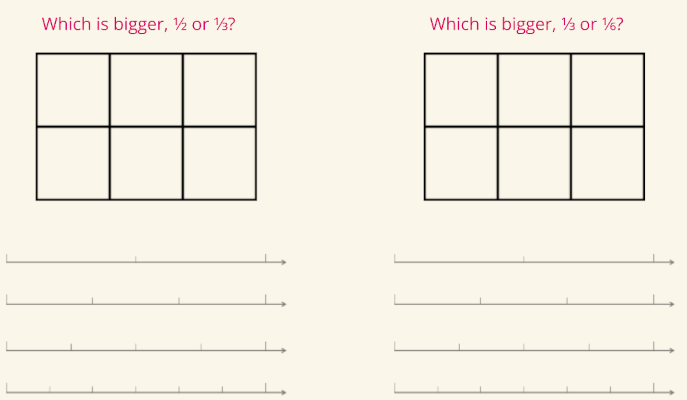
By looking at only these most familiar fractions, we already see one trend: as the denominator (bottom) numbers get bigger the amounts get smaller!
This trend should make sense from real life. If you wanted a big slice of cake, would you rather have one-half a cake or one-sixth of a cake? Six is bigger than two, but one-sixth is smaller than one-half.
How can we change a fraction so it has a desired denominator?
That is an excellent question. We will answer it soon. But first it is time for cake!
Let us consider the fraction one-third drawn as a slice of cake.

The most intuitive thing to do with those big slices of cake is to keep cutting the cake.
If we make a horizontal cut through the center, the two left-most pieces will be shaded.
We can represent this cake-cutting with numbers. We take 1⁄3 and multiply the numerator and denominator by two.
If we make two horizontal cuts, the three left-most pieces will be shaded.
We can again represent this cake-cutting with numbers. We take 1⁄3 and multiply the numerator and denominator by three.
Definition
Un-Reducing a fraction represents with numbers the act of slicing the cake more. The numerator and denominator are multiplied by the same value.
Yikes. I am glad our first three definitions were admirable. Because the fourth was slightly sloppy. And this one talks about cake? What kind of word is "un-reducing" anyway? I don't think that is actual math jargon. Sigh. I thought we had standards.
Writing Un-reducing
"Un-reduce" the fraction 1⁄3 into an equivalent fraction with a denominator of six.
(a) write two little, floating × 2, one each for numerator and denominator
(b) write a single, centered × 2 intended to work on both numerator and denominator
(c) write another fraction: × 2⁄2
(d) cross out the one and three and replace them with the larger values
Do not use (b)! This is how we write multiplication, not "un-reducing" numerator and denominator.
A moment ago we asked, "How can we change a fraction so it has a desired denominator?" Now we have one answer to that question.
If the current denominator is a factor of our desired denominator, we can multiply both numerator and denominator by something.
Enough about "un-reducing"! I don't think it is a real word anyway. I have never heard it before, Google doesn't know about it, and it keeps appearing inside quotation marks.
Can we use a cake diagram to think about dividing both numerator and denominator of a fraction.
Sure. We could make big slices of cake by gluing smaller slices together. Maybe we use very sticky icing?
Here is a whole cake.

We will prepare the whole cake by making two vertical slices and one horizontal slice to show sixths. Shade in the left-most two of the sixths.
(To be extra clear, we will use one color pen for the vertical slices, and another color for the horizontal slice.)
We can represent this cake-gluing with numbers. We take 2⁄6 and divide the numerator and denominator by two.
Next we erase, and prepare the whole cake by making two vertical slices and two horizontal slice to show ninths. Shade in the left-most three of the ninths.
(To be extra clear, we will use one color pen for the vertical slices, and another color for the horizontal slices.)
We can represent this cake-gluing with numbers. We take 3⁄9 and divide the numerator and denominator by three.
Here is our definition.
Definition
We reduce a fraction by dividing the numerator and denominator by the same value. That value must be a factor of both the numerator and denominator.
Since reducing is not make-believe jargon, we actually need a second definition.
Definition
A fraction is fully reduced if its numerator and denominator have no factor in common (except 1).
Many books and websites call a fully reduced fraction "simplified". We avoid that word because it has a bad tendency to be used in too many situations without careful definitions. It ends up fuzzy and vague, for many students meaning no more than "make the instructor happy".
Again there are four ways to write reducing two-sixths into one-third. Three are appropriate. One is wrong.
Writing Reducing
Reduce the fraction 2⁄6 into an equivalent fraction with a denominator of three.
(a) write two little, floating ÷ 2, one each for numerator and denominator
(b) write a single, centered ÷ 2 intended to work on both numerator and denominator
(c) write another fraction: ÷ 2⁄2
(d) cross out the two and three and replace them with the smaller values
Do not use (b)! This is how we write division, not reducing numerator and denominator.
Notice that reducing is a process. Canceling is one possible step in the process. (Reducing and canceling are related, but not the same thing!)
A moment ago we asked, "How can we change a fraction so it has a desired denominator?" Now we have another answer to that question.
If the desired denominator is a factor of our current denominator, we can try to divide both numerator and denominator by something.
Notice the word try. We cannot always reduce. If we wanted thirds, but currently have 5⁄6, we are stuck. Our desired denominator of 3 is indeed a factor of our current denominator of 6. But trying to reduce does not work with that numerator. We do not always get what we want.
An important comment is that efficiency is a convenience, not a virtue when reducing fractions.
That worked great!
That also worked great!
Some students like to reduce with many steps. It can feel satisfying and safe to chip away at the numbers a little bit at a time.
Other students like to reduce with one step. It can feel satisfying and powerful to find which factor is most efficient.
You can use either method.
To help us talk about the difference, we need one more definition.
Definition
The greatest common factor of two numbers is the...um...biggest factor they both have...

Oops. That's not a definition. That's a tautology. Sorry.
We have not yet tried finding a common denominator for two or more fractions. When that task arrives you are prepared with a solid foundation.
One more example problem as a finale.
Video example problems have three images to click on. You can see a video step-by-step answer, a written step-by-step answer, or only the answer. If you find yet more helpful videos, please let your instructor know so that this website can be updated and improved!
Khan Academy

Textbook Exercises for Desired Denominators
This list of recommended odd-numbered textbook problems is designed for a hypothetical student with a "typical" math background. If your math foundation is weak, do even more odd-numbered problems. If your math foundation is strong, do fewer.
Please read the advice on doing homework in the study skills page.
Section 2.1 (page 99) # 31, 33, 35, 37, 47, 49, 51, 53, 65
Section 2.3 (page 117) # 17, 19, 23, 37, 39, 41
Section 3.1 (page 151) # 17, 19, 23, 37, 45, 47, 19, 51
Remember when at the very top of this page we mentioned that decimals have three names?
Decimal Aliases
When it is spoken aloud the decimal 0.5 has three possible names.
• People thinking to themselves or working together would probably use the casual name and say "point five". We could write .5
• An instructor who is lecturing would use the dictation name and say "zero point five" because saying "zero point..." gives a heads-up to listening ears. We could write 0.5
• There is also a formal name, "five tenths", created from the place value of the final digit. We could write five-tenths in a legal document or other type of formal writing.
8 hundredths
0.45
To change a decimal into a fraction, we just say its formal name and then reduce if possible. This is one reason why we need to remember place value names!
5 tenths = 5⁄10 = 1⁄2
You probably knew that 0.5 is the same as 1⁄2. Hopefully you also see how the process works.
8 hundredths = 8⁄100 = 2⁄25
125 thousandths = 125⁄1,000 = 1⁄8
One way to review converting decimals to fractions is to play The Decimals to Fractions Game.
Game Rules: The Decimals to Fractions Game
A moderator provides five numbers.
Students, in teams with one representative at the board, race to change three of the numbers at a time into a correct decimal-to-fraction equation. The three numbers used become the decimal, numerator, and denominator.
How many solutions can the class find?
Example of the Decimals to Fractions Game
The five numbers are 1, 2, 5, 6, and 30.
One possible solution uses the three numbers 1, 2, and 5 to create the equation 0.5 = 1⁄2
A second possible solution uses the three numbers 2, 6, and 30 to create the equation 0.2 = 6⁄30
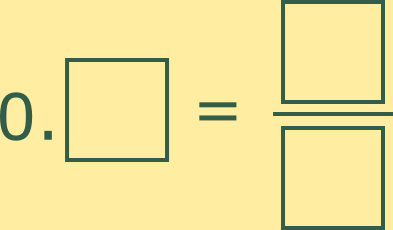
The five numbers are 1, 4, 8, 25, and 125.
The five numbers are 4, 8, 16, 20, and 25.
The five numbers are 3, 6, 15, 20, and 75.
To change a fraction into a decimal, we just treat the fraction as a division problem. We do numerator ÷ denominator = decimal.
Divide top ÷ bottom. 1 ÷ 5 = 0.2
Divide top ÷ bottom. 3 ÷ 8 = 0.375
If we are not allowed to use a calculator, we can sometimes avoid long division. There is a clever way to change a fraction to a decimal by making the denominator a power of ten
Cleverness
1⁄25 = 1⁄25 × 4⁄4 = 4⁄100 = 4 hundredths = 0.04
25 is a factor of 100. So we can "un-reduce" to make the denominator 100, then say the fraction's formal name.
However, this clever trick is not really a shortcut. In most real life situations, checking whether fraction denominator were factor of 10, 100, etc. slows you down a lot compared to simply using a calculator.
We cheated above by pretending that all decimals have a formal name.
But some decimals do not!
Definition
Repeating decimals have a never-ending pattern. We write them using a bar over the repeating portion instead of ellipsis to avoid ambiguity.
Why We Need a Bar
Which do we mean by 0.321...
0.3211111...? 0.321212121... 0.321321321...
For the three most common repeating decimals it is best to simply memorize their fraction equivalents.
Memorize These
One-third = ?
Two-thirds = ?
One-sixth = ?
There is a method for changing a repeating decimal into a fraction, but it is tricky.
Knowing how to do this is not required. We have not discussed equations yet. This will not appear on any homework assignment, quiz or test!
The method involves setting the repeating decimal equal to y, multiplying both sides of the equation by a 10 one or more times, and then subtracting the two equations before solving.
It makes more sense when you see it happen.
Set the repeating decimal equal to y.
y = 0.222222...
Multiply both sides by 10.
10y = 2.22222...
Subtract the first from the second.
9y = 2
Divide both sides by 9 to get y by itself.
y = 2⁄9
Congratulations again! You are at the end of the second subtopic (Fraction Format) for our first big topic (Shapeshifting).
You have now thought more carefully than most people about division, factors, and reducing and "un-reducting" fractions. You know tricks for finding all the factors, and have seen that those tricks are useful when reducing a fraction.
Video example problems have three images to click on. You can see a video step-by-step answer, a written step-by-step answer, or only the answer. If you find yet more helpful videos, please let your instructor know so that this website can be updated and improved!
Khan Academy
Rewriting decimals as fractions
Math Antics
Convert any Fraction to a Decimal
YouTube Problems


Convert 7⁄8 to a decimal Divide 7 ÷ 8 = 0.875 0.875
Textbook Exercises for Fractions and Decimals
This list of recommended odd-numbered textbook problems is designed for a hypothetical student with a "typical" math background. If your math foundation is weak, do even more odd-numbered problems. If your math foundation is strong, do fewer.
Please read the advice on doing homework in the study skills page.
Section 4.5 (page 238) # 5, 9, 11, 21, 23, 25, 27, 29, 31
Try these ten exercises on scratch paper. Work in a study group if you can! Notice where your notes need improvement. After you are very happy with your answers, you can use this form to ask me to check your work. Can you get at least 8 out of 10 correct?
1. Consider the following six numbers: 315, 1101, 7628, 13025, 110124, and 876. Which are divisible by 3?
2. Consider the following six numbers: 315, 1101, 7628, 13025, 110124, and 876. Which are divisible by 4?
3. How many factors does 126 have?
4. What is the prime factorization of 126?
5. Fully reduce the fraction 16⁄120
6. Change 0.45 to a fraction. Remember to simplify.
7. What is the decimal notation for four-twentieths?
8. Write this decimal, which is less than one: three hundred and eleven ten-thousandths.
9. Which decimal is greater, 0.040199 or 0.040201?
10. Little Bo Peep has a dozen sheep. She shears 1 pound of wool from the first, 1.5 pounds from the second, 2 pounds from the third, and so forth increasing by 0.5 pounds each time until she shears 6.5 pounds of wool from the last sheep. What is the average amount of wool taken per sheep? How do you know how much to round this answer?
Try these exercises on scratch paper. Work in a study group if you can! Notice where your notes need improvement. Check your work when you are done.
Many college math classes include a quick review of the topics we have done so far.
This can cause a problem!
If you have only seen review topics, instead of the "real" topics for your class, how do you know if you are in the right math class?
If you attend an Oregon college, you might be taking a class named Level C Math or Math 20. You can look at this class's practice finals.
If those seem easy, or something you could do with a few hours of review with a tutor or videos, then perhaps you should move up to the next math class.
In Oregon, the earlier classes had state required objectives. For Level B Math, students should be able to:
- use place value to check which whole numbers are biggest or smallest
- use place value to round whole numbers
- change fractions to common denominators to check which are biggest or smallest
- describe common polygons and break apart polygons into pieces of equal area
- find the perimeter of polygons, or if given the perimeter find the length of missing side(s)
- read or draw a bar graph
For Math 10, students should be able to not only do the above list but also:
- list all the factors of a number
- make a factor tree to find a prime factorization
- find the greatest common factor of two numbers
- list a few multiples of a number
- change fractions to decimals to compare them with other decimals
- confirm if an order of operations statement is true
- confirm if a measurement unit conversion is true
As you have seen, we will review all of these skills.
If you are rusty, or have never been taught them properly, do not worry!
If the review has been going well for you, then you are in the right class.
If the review has been very confusing, or your reaction is "It feels impossible to make time this term to feel caught up!", then maybe you should consider moving down to the previous math class. Talk to your instructor about your personal math background and your time management issues this term.
Activation is strengthened by repetition in context.
- Gregory Mulder
As we transition from fraction format to percent format, let us review what happens when we multiply or divide by powers of ten.
(a) 1,234.56
(b) 12,345.6
(c) 123,456
The decimal point scoots to the right.
How many scoots just happened compared to the zeroes in the power of ten?
Now let's look at division.
(a) 12.3456
(b) 1.23456
(c) 0.123456
The decimal point scoots to the left.
How many scoots happen compared to the zeroes in the power of ten?
The next step is to multiply and divide by decimal amounts. These are powers of one-tenth.
(a) 12.3456
(b) 1.23456
(c) 0.123456
The decimal point scoots to the left.
How many scoots just happened compared to the zeroes in the power of one-tenth?
So dividing by powers of ten works just like multiplying by powers of one-tenth.
(a) 1,234.56
(b) 12,345.6
(c) 123,456
The decimal point scoots to the right.
How many scoots just happened compared to the zeroes in the power of one-tenth?
So multiplying by powers of ten works just like dividing by powers of one-tenth.
Your turn!
(a) 31,467
(b) 314,670
(c) 31.467
(d) 3,146.7
(e) 3.1467
(f) 0.031467
(g) 3,146,700
(h) 0.31467
(i) 314.67
Your turn again!
(a) 5.9028
(b) 590.28
(c) 0.059028
(d) 5,902.8
(e) 59,028
(f) 0.59028
(g) 0.00059028
(h) 5,902,800
(i) 59.028
Video example problems have three images to click on. You can see a video step-by-step answer, a written step-by-step answer, or only the answer. If you find yet more helpful videos, please let your instructor know so that this website can be updated and improved!
Khan Academy
Multiplying and dividing decimals by 10, 100, 1000
The Organic Chemistry Tutor
Textbook Exercises for Decimal Point Scoots
This list of recommended odd-numbered textbook problems is designed for a hypothetical student with a "typical" math background. If your math foundation is weak, do even more odd-numbered problems. If your math foundation is strong, do fewer.
Please read the advice on doing homework in the study skills page.
Section 4.3 (page 216) # 23, 25, 27
Our society is used to using numerical scales to rate how nice things are.
Here is table to complete. We'll just make up answers, rating things.
Rating Scales
Scale of
1 to 5Scale of
1 to 10Scale of
1 to 100Jogging Banana Runts Elevator Music
 In English, the popularity of product reviews and Auto Club travel guides means a "star" is assumed to be a rating on a scale of 1 to 5.
There is no nice name in English for how something rates on a scale of 1 to 10.

The name for how something rates on a scale of 1 to 100 used to be called per cent, meaning "per 100" since the word "cent" means "100". But over time those words became customarily squished together, and now we say percent.
This idea of "per 100" or "out of 100" is so important that we should be more formal.
Definition
Percent means "out of 100".
Therefore the symbol % can be replaced with "out of 100".
By the way, we know four ways to do "out of 100" with arithmetic.
- ÷ 100
- two decimal point scoots to the left
- writing the number as a fraction with denominator 100
- × 1⁄100
Let's do each of those four operations from the definition of percent.
These examples will look incomplete. They are incomplete. Very soon we will see when each is actually useful. For now we are merely warming up.
If you are a visual learner, it might help to picture percentages using a grid of 100 boxes or a circle with 100 tic marks. These can help us draw pictures for "out of 100". The diagrams are especially helpful for thinking carefully about small percentages.


In real life percents often come as a set of values that add up to 100%, and a missing value must be found using subtraction.

But that type of problem only involves subtraction, so it is too boring to appear again in this class.
Video example problems have three images to click on. You can see a video step-by-step answer, a written step-by-step answer, or only the answer. If you find yet more helpful videos, please let your instructor know so that this website can be updated and improved!
YouTube Problems
Then use RIP LOP to remind us to go "right into percent" two scoots, to get 137.5% 137.5%
Textbook Exercises for Four Replacements for %
This list of recommended odd-numbered textbook problems is designed for a hypothetical student with a "typical" math background. If your math foundation is weak, do even more odd-numbered problems. If your math foundation is strong, do fewer.
Please read the advice on doing homework in the study skills page.
Section 6.1 (Page 316) # 1, 3, 5
Remember our four ways to create "out of 100" using arithmetic?
Let's explore which help us change the format of numbers. We can change among decimal format, percent format, and fractions.
What if we start in percent format and want to switch to decimal format?
We need to replace the % symbol using arithmetic. Which of the four versions of what percent means is the most helpful in this situation?
The easiest replacement is "two decimal point scoots to the left" to get 0.471
(a) 0.03
(b) 0.3
(c) 1.03
(d) 0.103
What if we start in decimal format and want to switch to percent format?
Now we need to create the % symbol by "un-doing" one of those four options. Which of the four versions of what percent means is the most helpful in this situation?
If we stick a % symbol on the number we also need to "undo" it to be fair. After all, we cannot change the number for no reason! The easiest un-doing is "two decimal point scoots to the right" to get 75%.
(a) 4%
(b) 230%
(c) 37.5%
(d) 66.6...%
Definition
The acronym RIP LOP summarizes moving between decimal format and percent format. It stands for Right Into Percent, Left Out of Percent.
Notice that RIP LOP does not tell us "two places of decimal scoots". But we can remember that we always scoot twice.
Percents are always about 100, and 100 always has two zeroes, and we saw earlier that multiplying or dividing by 100 always causes two scoots.
Two decimal point scoots to the right gives us 76%.
Two decimal point scoots to the left gives us 0.033.
What if we start in percent format and want to switch to fraction format?
We again need to replace the % symbol using arithmetic. Which of the four versions of what percent means is the most helpful in this situation?
The easiest replacement is "writing the number as a fraction with denominator 100" to get 42⁄100 which reduces to 21⁄50
Let's do another example.
80% = 80⁄100 = 8⁄10 = 4⁄5
In the previous two example we dealt with a whole number in percent format. What about changing a fraction in percent format into a fraction not in percent format?
A different one the four versions of what percent means is the most helpful in this situation!
This time we will replace the % symbol with × 1⁄100
2 3⁄5 % = 13⁄5 % = 13⁄5 × 1⁄100 = 13⁄500
We have not talked about fraction multiplication yet. If this example does not make sense to you, please file it away in the back of your mind until we do discuss fraction multiplication.
What if we start in fraction format and want to switch to percent format?
A few fractions are too easy. We can simply look at 51⁄100 and see that it is "51 out of 100" or 51%.
In general it is quickest to use division to change the fraction into decimal format, and then use RIP LOP.
1⁄4 = 1 ÷ 4 = 0.25 = 25%
7⁄8 = 7 ÷ 8 = 0.875 = 87.5%
Notice that our percent format answer may include a repeating decimal.
1⁄9 = 1 ÷ 9 = 0.111... = 11.111...%
Congratulations! You are at the end of the third subtopic (Percent Format) for our first big topic (Shapeshifting).
You have now thought more carefully than most people about the relationship between decimals, percentages, and fractions. You word problems arrive you are prepared with a solid foundation.
Video example problems have three images to click on. You can see a video step-by-step answer, a written step-by-step answer, or only the answer. If you find yet more helpful videos, please let your instructor know so that this website can be updated and improved!
Khan Academy
Multiplying a Decimal by a Power of 10
Dividing a Decimal by a Power of 10
Dividing a Decimal by a Power of 10: Pattern
Multiplying Decimals by 10, 100, and 1000 (worksheet)
Dividing Decimals by 10, 100, and 1000 (worksheet)
morgankenneth12
Percents, Fractions, Decimals Review
Mathispower4u
Textbook Exercises for Percents, Decimals, and Fractions
This list of recommended odd-numbered textbook problems is designed for a hypothetical student with a "typical" math background. If your math foundation is weak, do even more odd-numbered problems. If your math foundation is strong, do fewer.
Please read the advice on doing homework in the study skills page.
Section 6.1 (Page 316) # 11, 13, 15, 17, 25, 31, 33, 35, 37, 41, 43, 45, 49, 59, 61, 63, 65
Try these ten exercises on scratch paper. Work in a study group if you can! Notice where your notes need improvement. After you are very happy with your answers, you can use this form to ask me to check your work. Can you get at least 8 out of 10 correct?
1. An easy way to divide a number by 1,000 is to scoot the decimal point ___ places to the _____.
2. An easy way to multiply a number by 0.01 is to scoot the decimal point ___ places to the _____.
3. Write 5.5% as a decimal.
4. Write 0.8911 as a percent.
5.Write 0.8% as a fraction.
6. Write 25 3⁄8 % as a fraction.
7. Write the fraction 5⁄8 as a percent.
8. Write the fraction 17⁄50 as a percent.
9. After we change two-thirds into percent format, do its digits repeat endlessly?
10. Use what you have memorized to write 33 1⁄3 percent as a decimal and a fraction.
Try these exercises on scratch paper. Work in a study group if you can! Notice where your notes need improvement. Check your work when you are done.
We are not done yet with thinking about fractions.
So far all of our fractions were proper fractions. They were cake slice numbers. The denominator counted the number of pieces. The numerator counted the shaded pieces.
Cooks or carpenters deal with those fractions daily. But for many people their real-life fractions are not like that. Their fractions do have a sense of "total pieces" and "shaded pieces".
When is a fraction not a fraction? Cue the suspenseful music...
Let's notice something interesting about fractions and division.
We know that we can change fractions to decimals by doing division. In this sense fractions are like division problems waiting to happen.
A Fraction as Division Waiting to Happen
1⁄5 = 1 ÷ 5 = 0.2
We often reduce fractions. In this sense fractions are not like division. When we divide one number by another we do not reduce the numbers first.
This Hurts My Brain
10⁄5 = 10 ÷ 5 = 2 ÷ 1 = 2
It looks really weird to "reduce" 10 ÷ 5 and change it into 2 ÷ 1 in the middle of a division problem. No one does that!
We talk about "equivalent fractions" but never "equivalent division problems".
 So our first clue is that fraction format is a good way to patiently lurk like a vulture, spying on a situation that does not yet involve division but might soon.
This happens frequently when we compare numbers.
A package of 24 energy drinks costs $35.99. Does anyone care how much one drink costs? Maybe. We lurk, waiting to see if division will happen.
A contractor submits a $2,800 bid for installing a 120 foot long fence. Does anyone care about how much this costs per foot? Maybe. We lurk, waiting to see if division will happen.
So we found a reason to deal with a pair of numbers as if they were the numerator and denominator in a fraction, even though the numbers have meaning very unlike "total pieces" and "shaded pieces".
This is the job for a ratio.
Definition
A ratio is a comparison of two numbers, usually written as a fraction.
Some ratios do have a sense of "total pieces" and "shaded pieces".
Other ratios do not have a sense of "total pieces" and "shaded pieces".
There are even ratios with a hidden sense of "total pieces" and "shaded pieces".
We could look at the ratio and find the whole (20 total people). But the provided numbers do not explicitly tell us the whole.
 Notice that, like Snoopy pretending to be the Flying Ace, we can even write a ratio upside down. This does not lose any meaning. It is not confusing.
How different from a normal fraction, in which the numerator and denominator count "total pieces" and "shaded pieces". Those would have their meaning changed if written upside down.
Often it does not make sense to reduce a ratio. If I reduced Snoopy's breath mint ratio I would switch from an 8⁄10 which involved numbers he actually counted to 4⁄5. Neither the 4 nor 5 represent something from the real world. He did not interview 5 dentists, of whom 4 approved. Yes, the fractions have the same value. But it would be silly to reduce this ratio for no reason.
 Maybe his friends were also asking dentists about other brands of breath mints. But his friends were lazier, and each only spoke to five dentists. In that situation reducing his ratio might be useful, so it could be more easily compared to the ratios representing his friends' data.
Reducing ratios can be sensible. The point is merely that it is not always sensible, unlike how most math classes have a rule that fraction answers should be fully reduced.
Similarly I would lie if I changed Snoopy's ratio to 80⁄100 this makes it sound like he did a lot more work by interviewing 100 dentists. (Note that many people, especially in advertising, do change ratios in this manner.)
Tangentially, not all ratios are written as fractions. The ratio 8⁄10 can also be written as 8 to 10 or as 8 : 10. But in real life, almost no one but the writers of SAT tests and gamblers write ratios that way.
Some ratios include words to label the numbers.
A Ratio with Word Labels
A child has 18 green candies and 9 yellow candies.
We could write this rate as 18 greens⁄9 yellows.
Time for another definition.
Definition
A rate is a kind of ratio in which the two numbers have different labels.
Once again, we could change a rate into an equivalent fraction but typically do not do so to preserve the record of a real life situation.
Video example problems have three images to click on. You can see a video step-by-step answer, a written step-by-step answer, or only the answer. If you find yet more helpful videos, please let your instructor know so that this website can be updated and improved!
Khan Academy
YouTube Problems
85⁄97 85⁄97
0.34⁄124 0.34⁄124
Textbook Exercises for Ratios and Rates
This list of recommended odd-numbered textbook problems is designed for a hypothetical student with a "typical" math background. If your math foundation is weak, do even more odd-numbered problems. If your math foundation is strong, do fewer.
Please read the advice on doing homework in the study skills page.
Section 5.1 (page 264) # 1, 3, 5, 11, 13, 15, 17, 21, 23, 29
So far we have imagined ratios and rates as division problems waiting to happen. We lurk nearby, patiently waiting to be told when to divide.
When we stop lurking and finally do the division problem, it changes a rate into a different rate whose second value is 1.
This happens so often there is a special name for it.
Definition
A unit rate is a rate whose second value is 1.
The unit rate is 2 greens⁄1 yellow
This is subtle. 18 ÷ 9 = 2. But our answer is not the plain number 2.
Because we keep both labels, and we write the comparison as a fraction, we still have a rate.
The unit rate is about 33 pieces⁄1 minute
The unit rate can also be written as 33 pieces⁄minute
The unit rate can also be written as 33 pieces per minute
Our answer should retain the same labels.
We often express unit rates in English by omitting the denominator of 1 and using the word "per" to represent the fraction bar between the unit labels.
If you did not click on the button to see the previous problem's answer, please do that. Notice how we can write a unit rate in different ways.
The unit rate is about 2 greens⁄1 yellow
The unit rate can also be written as 2 greens⁄yellow
The unit rate can also be written as 2 greens per yellow
You do not need to write the answer in three different ways. Pick your favorite.
Sometimes the word "average" is used when requesting a unit rate.
Kim solved about 33 pieces per minute.
The unit rate can also be written as 33 pieces⁄minute
The unit rate can also be written as 33 pieces per minute
Any rate can be changed into a unit rate by treating the rate as a division problem. Doing "top ÷ bottom" simplifies the rate into a unit rate.
Unit rates make comparisons easy. We might prefer either the biggest or the smallest unit rate.
Shopping Example
I am shopping for fancy hand lotion. Which is a better deal, 10 ounces for $5 or 24 ounces for $8?
If we find ounces per dollar we want the most ounces per dollar.
- 10 ounces ÷ $5 = 2 ounces per dollar
- 24 ounces ÷ $8 = 3 ounces per dollar ← best buy
In the first case, imagine someone with $1 shopping at a gas station. They want the most gas for their $1.
If we find dollars per ounce we want the least cost per ounce.
- $5 ÷ 10 ounces = $0.50 dollars per ounce
- $8 ÷ 24 ounces ≈ $0.33 dollars per ounce ← best buy
In the second case, imagine someone with who needs 1 ounce of something shopping at the bulk food section of a grocery store. They need an unusual ingredient for a recipe, and want to spend as little as possible for the correct amount.
Video example problems have three images to click on. You can see a video step-by-step answer, a written step-by-step answer, or only the answer. If you find yet more helpful videos, please let your instructor know so that this website can be updated and improved!
Khan Academy
Mathispower4u
YouTube Problems
Textbook Exercises for Ratios and Rates
This list of recommended odd-numbered textbook problems is designed for a hypothetical student with a "typical" math background. If your math foundation is weak, do even more odd-numbered problems. If your math foundation is strong, do fewer.
Please read the advice on doing homework in the study skills page.
Section 5.2 (page 272) # 1, 3, 5, 7, 11, 13, 17, 19, 21, 29
The interesting applications of rates involve variables.
Comparisons using the words "per", "to", "for" almost always can be written as rates.
Write it like a fraction. g grams⁄100 calories
Write it like a fraction. 5 adults⁄k kids
Write it like a fraction. d dollars⁄4 candy bars
Sometimes the words "in", "on", or "from" are also cues to write a rate.
Write it like a fraction. f feet⁄10 seconds
Write it like a fraction. 430 miles⁄g gallons
Congratulations again! You are at the end of the third subtopic (Ratio Format) for our first big topic (Shapeshifting).
You have now thought more carefully than most people about writing one number on top of another, and waiting before doing division. That might not sound like a significant accomplishment, but it will help you in future math topics.
Try these ten exercises on scratch paper. Work in a study group if you can! Notice where your notes need improvement. After you are very happy with your answers, you can use this form to ask me to check your work. Can you get at least 8 out of 10 correct?
1. Recall that a "proper fraction" has the format "part ÷ whole". Invent a situation that is described using a ratio that is not a proper fraction.
2. A contractor submits a $2,800 bid for installing a 120 foot long fence. What is the cost per foot?
3. A contractor submits a $2,800 bid for installing a 120 foot long fence. How many feet of fence are installed per dollar?
4. Karl solved a 300 piece jigsaw puzzle in 45 minutes. Write this as a unit rate.
5. A snack bag has 38 rice crackers and 6 wasabi peas. What is the average number of wasabi peas per rice cracker?
6. Invent a situation that is described using a ratio that includes a variable.
7. A sixteen ounce chocolate mocha coffee with whipped cream contains 520 calories, 18 grams of fat, 60 grams of carbohydrates, and 15 grams of protein. Find the unit rate of calories per ounce.
8. The Leaning Tower of Pisa is 184.5 feet tall and leans 13 feet from its base. What is the ratio of the distance it leans to its height?
9. The area is 0.75 square miles. The population is 35,427 people. What is the unit rate of people per square mile?
10. Brand M soup weighs 54 ounces and costs $4.79. Brand T soup weighs 59 ounces and costs $5.99. Which is the better buy?
Try these exercises on scratch paper. Work in a study group if you can! Notice where your notes need improvement. Check your work when you are done.

We get to play with more toys. Yay!
Each group of students shares one plastic spinner with a clear base.
We can put a spinner onto a circle like the one below to make a game.
The first circle is a very boring game. Half the time a player wins $1. Half the time a player loses $1.

What we want to focus on is that the game is fair. This means that if someone played it a whole lot—long enough for any rare streaks of good or bad luck to cancel out—then overall they would not gain or lose money.
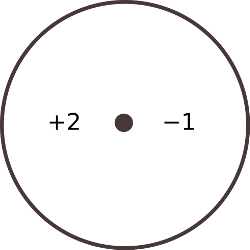
Pretend the circle is a pie, and we are cutting the pie into slices.
You could think that the +2 needs to happen half as often as the −1.
Or you could think that the −1 needs to happen twice as often as the +2.
Either way, we should give the −1 two pie slices, but only give the +2 one pie slice.
That is a total of 2 + 1 = 3 pie slices. So we cut the pie into thirds. The result looks like this:

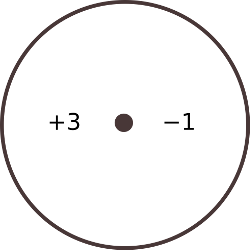
Pretend the circle is a pie, and we are cutting the pie into slices.
You could think that the +3 needs to happen one-third as often as the −1.
Or you could think that the −1 needs to happen three times as often as the +3.
Either way, we should give the −1 three pie slices, but only give the +3 one pie slice.
That is a total of 3 + 1 = 4 pie slices. So we cut the pie into quarters. The result looks like this:


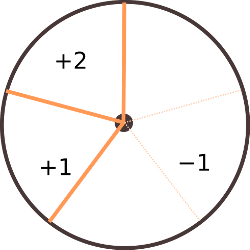
Pretend the circle is a pie, and we are cutting the pie into slices.
If we give the +1 and +2 each one slice of pie, the slice for the +2 counts double. We effectively have three slices of pie for winning +1.
This means we need three slices of pie for the −1.
The two winning numbers each get one slice. The −1 needs three slices.
That is a total of 2 + 3 = 5 pie slices. So we cut the pie into fifths. The result looks like this:
We begin our topic of measurement unit conversions with a definition.
Definition
A measurement's unit is the word that labels the measurement.
Unit = Word Label for Measurements
I am 63 inches tall. The measurement unit is inches.
By convention we use plurals of such words when talking about units.
Plural, Please
A large box is 1 yard tall. The measurement unit is yards.
Note that unit rates have two units.
A Rate Comparing Two Units
A speed limit is 30 miles per hour. The measurement units are miles and hours.
There are measurements that use more than two units, but we will not use them in this class. As one example, thinking carefully about a 20-watt light bulb requires considering six units!
Watt?
A watt is the rate of power of moving a weight of one kilogram at a speed of one meter per second when resisted by a deceleration of one meter per second per second.
Time to take a short break from mathematics to talk about this history of measurement units. (A thank you to Wikipedia for providing much of the following history lesson.)
Where did we get our measurement units? The older system of units from Europe is now named Standard, American, or Imperial units. The newer system is named SI units, but most people still call it by its older name, the metric system.
We'll start by talking about units for measuring length.
Many European countries used lengths named the "inch", "foot", and "yard".
European historical records from the twelfth century show much more care in measuring the inch than the foot or yard. Apparently a town would measure an inch by taking the average value of thumb width of a few men, which produced a result that had little regional variation. Carpentry and other crafts needed a standardized inch more than a foot or yard.
Having twelve inches in one foot was a remnant of the Roman Empire. So a foot was always twelve inches. This was much longer than nearly everyone's feet, but could be estimated by stepping heel-toe heel-toe in boots.
For many centuries a "yard" meant many things in Europe. The common theme was that a yard was about a stride length. In different places a yard was either three feet, average waist circumference, or two cubits (elbow to elbow when touching fingertips). In places that based yards on feet, a yard was always three feet.
The original mile was five thousand Roman "paces". People stopped using these "paces" but kept the mile. The result is that one mile is 5,280 feet. The details involve furlongs, and you can read more here.
The metric system was created in France, beginning in 1791. In 1793 the French Academy of Sciences adopted as the country's official unit of length a meter, defined as one ten-millionth of the distance from the Equator to the North Pole through Paris.
How long was this meter? It is the same meter we use today. The expedition sent to measure this distance was only off by one-fiftieth of a percent. This was remarkable accuracy considering the technology available then! But it does mean the meter we use is not quite the originally intended length, so people felt free to adjust the definition in later years.
In 1889 the first General Conference on Weights and Measures established a new definition. This group built an International Prototype Metre: a bar composed of an alloy of ninety percent platinum and ten percent iridium, marked with two lines whose distance apart was measured at the melting point of ice. The purpose was to keep the same length but have a physical example that could be easily copied by anyone visiting Paris.
Many of the rulers we use have one side with inches and feet, and the other side with centimeters and millimeters. Can you look at such a ruler and see that one inch is about two-and-a-half centimeters? Interest in redefining measurement units for length resurfaced in the late 1950s. Since the meter had a proptype but the inch did not, in 1958 the inch was redefined as exactly 2.54 centimeters.
In 1960 the meter was redefined again, this time as 1,650,763.73 wavelengths of the orange-red emission line in the electromagnetic spectrum of the krypton-86 atom in a vacuum. This definition again aimed to keep the length unchanged while creating a physical example that could be duplicated almost exactly by anyone, anywhere in the world, with common laboratory equipment.
In 1983 the meter was redefined for the last time. Now it is the distance traveled by light in free space in 1⁄299,792,458 of a second. This final definition again kept the length unchanged, and finally created a physical example that could be duplicated exactly by anyone, anywhere in the world, with common laboratory equipment. Much easier and less expensive than visiting Paris to measure a metal bar!
A meter is broken up into 100 centimeters or 1,000 millimeters. (To help remember this think about 100 years in one century and 1,000 years in one millenium.)
The Roman Empire used weights from which we get the words "pounds" and "ounces". After the Roman Empire, an ounce saw various definitions across Europe, usually 450 or 480 grains of barleycorn because that grain is very uniform. The Roman pound was 12 ounces. But soon after the Roman Empire ended, most European merchants switched to a sixteen ounce pound.
For the metric system, a gram was defined as the mass of one cubic centimeter of water. This is a small amount! It is useful in the laboratory, but not as practical for commerce. So 1,000 grams (a kilogram) is used more in normal daily life.
(A question to ponder: Why wasn't one cubic meter of water used as the standard mass? That would be a logical choice, since a meter is the standard length.)
As an aside, scientists use the word mass to denote how much physical stuff an object is made up of. This is different than weight because it is independent of an object's location. The weight of an object changes proportionally to the local gravity.
162 pounds ÷ 6 = 27 pounds
(My mother used to have a t-shirt that said, "I'm not overweight, I'm just on the wrong planet" because she had a thyroid condition that meant she would always be overweight.)
Volume was not used much until the eighteenth century. A standard size bag was much more difficult to measure, let alone construct, than a standard length rod/cord or standard weight of barleycorn grains.
For most of history, volume measurements were not used. When they were used, they were merchants' jargon for the volume taken up by a certain weight of a certain trade good. For example, a gallon was originally the volume of eight pounds of wheat.
In modern times the volumes of the American/Standard/Imperial system have been standardized.
Bakers and canners might have the advantage of already knowing these conversion rates by heart.
Is there an easy way to remember the parts of a gallon? You betcha.
Here is our gallon.
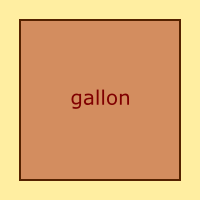
If we chop it into fourths we get quarts. The name quarts is like "quarters".

Each quart is two pints.

Each pint is two cups. Think about two short one-cup milk cartons stacked on top of each other to become the size of a one-pint carton of whipping cream.

Some students prefer to combine all of those diagrams into a single, more complicated picture.

Mind your P's and Q's
Pubs in England used to give credit to regular customers. People would only get paid once per month, and in the meanwhile the bartender would mark p's and q's (for pints and quarts) below their name on the wall behind the bar. At the end of the month this record would show what they owed to bar.
The expression "Mind your p's and q's" meant "Don't drink too much before payday!"
Yet nowadays we usually say that phrase to young children!
Be aware that there is a different unit of volume called a "dry quart" which is not quite the same amount as liquid quarts. We will not use in Math 20. But if you are part of the Willamette Valley grass seed business and shop for bushels of grain the dry quart is important! (It is almost the same amount as a liquid quart, so for grocery shopping no one notices the difference.)
Since a gram was defined as the mass of one cubic centimeter of water, that same size cube was used to define volume in the metric system. A milliliter was defined as the volume of one cubic centimeter. Note that some professions use "cubic centimeter" or cc instead of milliliter.
A milliliter is pretty small! So the liter (1,000 milliliters) is the size more appropriate for most practice uses.
(A question to ponder: Why wasn't a cubic meter used as the standard volume? That would be a logical choice, since a meter is the standard length.)
Video example problems have three images to click on. You can see a video step-by-step answer, a written step-by-step answer, or only the answer. If you find yet more helpful videos, please let your instructor know so that this website can be updated and improved!
Math Antics
Textbook Exercises for Units and Their History
This list of recommended odd-numbered textbook problems is designed for a hypothetical student with a "typical" math background. If your math foundation is weak, do even more odd-numbered problems. If your math foundation is strong, do fewer.
Please read the advice on doing homework in the study skills page.
(Our textbook has no exercises for this topic.)
What happens when we convert between measurement units?
These problems involve either multiplying or dividing.
Consider two examples that use the fact that there are 12 inches in 1 foot.
7.5 feet × 12 = 90 inches
In the above example we split apart each foot into twelve inches. You can imagine breaking, distributing, or shattering a bunch of one-foot rulers.
We will say a foot is multiple inches, in the same way that 15 is multiple 3s. In both cases the bigger thing is several copies of the smaller thing.
Feet are multiple inches. Yards are multiple feet or inches. Miles are multiple yards, or feet.
Pints are multiple ounces. Quarts are multuiple pints or ounces. Gallons are multiple quarts, pints, or ounces.
Centimeters are multiple millimeters. Meters are multiple centimeters or millimeters. Kilometers are multiple meters, centimeters or millimeters.
30 inches ÷ 12 = 2.5 feet
In the above example we grouped together a couple sets of twelve inches to each make one foot. You can imagine fusing, bundling, or gluing inches into one-foot rulers.
We will say an inch is a factor of a foot, in the same way that 3 is a factor of 15. In both cases several copies of the smaller thing make the larger thing.
Yards are a factor of miles. Feet are a factor of yards or miles. Inches are a factor of feet, yards, or miles.
Quarts are a factor of gallons. Pints are a factor of quarts or gallons. Ounces are a factor of pints, quarts or gallons
Meters are a factor of kilometers. Centimeters are a factor of meters or kilometers. Millimeters are a factor of centimeters, meters or kilometers.
So we can see the following guidelines:
Either direction happens in one step.
Definition
A one-step unit conversion can happen when we switch a measurement's unit and we know the rate that compares the old and new units.
(a) We are going to inches, which are smaller than feet, so we multiply to get 69 inches
(b) We are going to feet, which are bigger than inches, so we divide to get 16.5 feet
(c) We are going to cups, which are smaller than gallons, so we multiply to get 192 cups
(d) We are going to gallons, which are bigger than cups, so we divide to get 2.5 gallons
(a) We are going to ounces, which are smaller than pounds, so we multiply to get 2,432 ounces
(b) We are going to pounds, which are bigger than ounces, so we divide to get 9.5 pounds
Video example problems have three images to click on. You can see a video step-by-step answer, a written step-by-step answer, or only the answer. If you find yet more helpful videos, please let your instructor know so that this website can be updated and improved!
YouTube Problems
10.5 ÷ 3 = 3.5 yards 3.5 yards
Textbook Exercises for One Step Conversions
This list of recommended odd-numbered textbook problems is designed for a hypothetical student with a "typical" math background. If your math foundation is weak, do even more odd-numbered problems. If your math foundation is strong, do fewer.
Please read the advice on doing homework in the study skills page.
Section 7.1 (Page 371) # 1, 5, 7, 9, 11, 31
Section 7.3 (Page 388) # 1, 5, 11, 31, 39, 41
We have already seem some examples of metric prefixes:
These examples are part of a general pattern.
Here are the metric prefixes used in these math lectures:
In this list (unit) is a placeholder for the plain unit, whether meters, grams, or liters.
These are prefixes are part of a longer list.
| kilo | hecto | deca | (unit) | deci | centi | milli | • | • | micro |
| × 1,000 | × 100 | × 10 | × 1 | ÷ 10 | ÷ 100 | ÷ 1,000 | • | • | ÷ 1,000,000 |
Strangely, there are no prefixes for the two spots between milli and micro (for ten-thousandths and hundred-thousandths of a unit).
Even though we do not use hecto-, deca-, or deci- it is still useful to be familiar with this longer list. Why? Because of a shortcut!
But for the shortcut we do not write the whole list. Just the initials are sufficient.
SI Prefix Initials
k h d unit d c m • • micro
Many math students memorize a cute saying (try making your own!) and remember the acronym for the first seven spots. For example, "King Henry does usually drink chocolate milk" or "Killer hobos dance under dazzling crystal mobiles."
Writing the acronym at the top of your homework and your test scratch paper is a great idea when doing SI-to-SI unit conversions. There is a shortcut!
SI One-Step Conversion Shortcut
To convert between metric prefixes, first write the list of all SI prefix initials.
Then count decimal point scoots: for every "place" you move right or left along the list of initials, move the decimal point the same way.
Video example problems have three images to click on. You can see a video step-by-step answer, a written step-by-step answer, or only the answer. If you find yet more helpful videos, please let your instructor know so that this website can be updated and improved!
Mathispower4u
YouTube Problems
For millimeters, on the list of SI prefixes, move 1 scoot right from "centi" to "milli", to get 5 mm 0.005 m and 5 mm
For millimeters, on the list of SI prefixes, move 3 scoots right from "plain units" to "milli", to get 1,854.2 mm 185.42 cm and 1,854.2 mm
Textbook Exercises for More about SI Prefixes
This list of recommended odd-numbered textbook problems is designed for a hypothetical student with a "typical" math background. If your math foundation is weak, do even more odd-numbered problems. If your math foundation is strong, do fewer.
Please read the advice on doing homework in the study skills page.
Section 7.1 (Page 371) # 15, 19, 21, 23, 27, 39
Section 7.3 (Page 388) # 15, 17, 21, 25, 29
Consider this very simple square.

We know the area of a rectangle (which includes a square) is length × width. So the area of that square is 1 foot × 1 foot = 1 square foot.
The answer is labeled with square feet because it is counting how many squares it takes to cover the area.
If we changed each side from feet to inches, how should we write the area?

Now the area is 12 inches × 12 inches = 144 square inches.
The answer is labeled with square inches because it is counting how many squares it takes to cover the area, using smaller squares this time.

Sometimes square inches are written abbreviated as sq. in. or as in2.
Similar abbreviations are used with other square units. Square feet can be sq. ft. or ft2. Square centimeters can be sq. cm. or cm2.
Later in the class, when we deal with shapes that are not rectangles, it will help to think of answers written in "square units" not as multiplication problem answers but as counting squares.
Usually we think of an exponent as its own number. It floats above its "base" and tells you how many times to multiply.
4 3 = 4 × 4 × 4 = 64
But for measurement units it can sometimes help to think of an exponent of 2 as the second half of a two-part number. It is saying "instead of a line of the base length, we are drawing a big square and then counting little squares".
(4 inches)2 = 4 inches × 4 inches = 16 square inches
22 ft 2 ft2
The first measures a distance, a length covered by 4 rulers each one foot long.
The second measures an area, a flat space covered by 2 squares each one square foot.
We actually just talked about square roots! You might not have noticed because we did not make that clear. Let's add clarity with a definition.
Definition
The square root of a number is the amount that, when multiplied by itself, gets to that number.
For example, the square root of 25 is 5 because 5 × 5 = 25.

We usually write square roots with a symbol.

But do not forget the definition just because you are looking at a symbol!
The picture we used earlier of a square foot broken up into inches...
...shows us that the square root of 144 is 12.
Why are only some of those answers whole numbers?
Definition
When we multiply a whole number by itself, we call the answer a perfect square.
Perfect squares have nice square roots. When 144 or less, they are easy to find with mental math if you have memorized the multiplication table up to 12s.
What could a negative exponent mean? It is nonsense to say that 4 −3 equals 4 times itself −3 times.
Instead, mathematicians noticed a pattern. Making a list of descending exponents repeats division. For example, the descending list of 2n has each step be ÷2.
|
2 4 = 16
2 3 = 8 2 2 = 4 2 1 = 2 2 0 = ? 2 −1 = ? |
What happens if we continue the pattern?
|
2 4 = 16
2 3 = 8 2 2 = 4 2 1 = 2 2 0 = 1 2 −1 = 1⁄2 2 −2 = 1⁄4 2 −3 = 1⁄8 |
This works for any number. For the descending list of 3n has each step be ÷3.
|
3 4 = 81
3 3 = 27 3 2 = 9 3 1 = 3 3 0 = 1 3 −1 = 1⁄3 3 −2 = 1⁄9 3 −3 = 1⁄27 |
That looks satisfying and clever. But does it actually work in the wider world of arithmetic and formulas?
It does! So even though it is nonsense according to the definition of exponents are repeated multiplication, it has become a "true" part of math.
Similarly, a more complicated pattern can be used to say what fraction and decimal exponents should mean.
Students once needed a book to look up the values of exponents such as 8001⁄3.
These days calculators and computers can handle exponents that are any number. So nonsense exponents are just as useful as normal exponents!
Video example problems have three images to click on. You can see a video step-by-step answer, a written step-by-step answer, or only the answer. If you find yet more helpful videos, please let your instructor know so that this website can be updated and improved!
BrainSTEM
Metric Conversion Trick!! Part 1
Metric Conversion Trick!! Part 2
YouTube Problems
So twelve square feet is twelve of that: 1,728 sq. in. 1,728 sq. in.
For three square cm we do 3 ÷ 10,000 = 0.0003 sq. m 0.0003 sq. m
So the answer is 15 15
Textbook Exercises for Exponents and Square Roots
This list of recommended odd-numbered textbook problems is designed for a hypothetical student with a "typical" math background. If your math foundation is weak, do even more odd-numbered problems. If your math foundation is strong, do fewer.
Please read the advice on doing homework in the study skills page.
Section 1.7 (Page 84) # 11, 13, 15, 19, 21
Section 2.3 (Page 119) # 81, 83
Section 4.6 (Page 247) # 1, 3, 5, 7, 29, 31
Section 7.2 (Page 381) # 1, 3, 11, 15, 29
Try these ten exercises on scratch paper. Work in a study group if you can! Notice where your notes need improvement. After you are very happy with your answers, you can use this form to ask me to check your work. Can you get at least 8 out of 10 correct?
1. 1 foot is how many yards?
2. 7.1 miles is how many feet?
3. 5,280 yards is how many miles?
4. An index card is 0.27 mm thick. What is that thickness in centimeters?
5. An index card is 0.27 mm thick. What is that thickness in meters?
6. A football field is 4,844 cm wide. What is that width in kilometers?
7. 80 ounces is how many pounds?
8. 5,200 grams is how many kilograms?
9. One gallon is how many fluid ounces?
10. 806 liters is how many milliliters?
Try these exercises on scratch paper. Work in a study group if you can! Notice where your notes need improvement. Check your work when you are done.
Mathematicians have some funny beliefs.
We believe that 4 is a number. We believe that 4,000 is a number. We believe that 1.5 is a number. We believe that 0.6 is a number. We believe that 3⁄5 is a number. We believe that 60% is a number.
So far so good, right?
But we do not call 2+1⁄5 a number. That is called an expression. We say it must be simplified into 3⁄5 before we consider it a number.
This is funny!
Yeah, it is true that we can "do something" to 2+1⁄5.
But we can also "do something" to 3⁄5. We can change it into 0.6 or 60%.
So why don't mathematicians call 3⁄5 an expression? What makes it one number instead of two numbers?
The answer is that in real life rates are funny creatures and we don't trust them.
If I told you that drove my car 3 miles down main street, or that it took me 5 minutes, you have a pretty realistic idea about how accurate those numbers are. Surely it was not exactly 3 miles or 5 minutes. But the information can be talked about in a meaningful way.
If I told you that drove my car down main street at a rate of 3 miles per 5 minutes, you have zero useful information. I probably was not driving that speed the entire time, because of other vehicles and traffic lights. Perhaps I was never actually going that speed, but was always slower or faster, and am reporting an average. You do not know how long my trip was. Was it 5 minutes or an hour? An average speed for only 5 minutes is not anything anyone cares about. An average speed for an hour might be something the city planners do care about as they adjust traffic light timing during rush hour. Also, did I really measure either of the 3 miles or the 5 minutes, or did I simply read 36 miles per hour on my spedometer and reduce 36⁄60 for some reason? If I did reduce, why did I do that?
In other words, rates have issues. Their social media status is always "it's complicated". They can be very useful. Sometimes they are needed to understand the world. But they tend to make false claims, or to eagerly support unreliable conclusions.
Most mathematicians do not spend enough time doing carpentry or in the kitchen baking. They usually see 3⁄5 as a rate, perhaps as 3 miles⁄5 minutes. So they call it one number instead of two numbers because is a single thing (a certain rate) and they are used to thinking especially carefully about that kind of thing.
On the other hand, no one gives you 2+1⁄5 as a rate. In real life something like that is always the last step in solving a bigger math problem. So that is called an expression instead of a single number.
If you want to play around with rates (division) being epecially unreliable, try the error propagation playground.
The English language makes it complicated to talk about what "typical" means. There are many synonyms for the word.
Real life also makes it complicated to talk about what "typical" means. Many groups of numbers do not have a value that happens most often, or is most representative.
Tables can help summarize data to help us see typicality. But tables can also be used to cloud issues about typicality.
Charts can clearly show typicality with a nice visual picture. But charts can also be used to create a false illusion of typicality.
Using data is a very big math topic! We will start by looking closely at all these issues surrounding typicality. That way we will be prepared to think clearly when our upcoming applications use the word "typical" or its synonyms.
How many calories per day should a typical person eat?
What is a healthy aerobic exercise heart rate for an average person?
In general, what percentage of an onion is removed while peeling and trimming?
What is a normal percentage of household income to spend on housing?
How much do most people save for retirement?
What is the standard markup used in that type of retail business?
What will be the expected value in twenty years for that investment portfolio?
As we study typicality, work on making helpful and organized notes, so you have handy the comments, formulas, and example problems you need.
An elementary school teacher asks her students, "What type of animal makes the best pet?". Each student was allowed one reply. The teacher than prepared the image below to show all their responses condensed together.

What a vibrantly unhelpful way to to present the survey results!
The colorful speech bubbles are a meaningless distraction. Each time the word "cat" appears means one more student picked that answer, no matter where in the image the word "cat" was put.
Six
(If you are having trouble finding them, two are in yellow, one in red, and three in green.)
Surely we can create something with more clarity.
First let's make a frequency table with two columns to show the categories and how many times each category is counted.
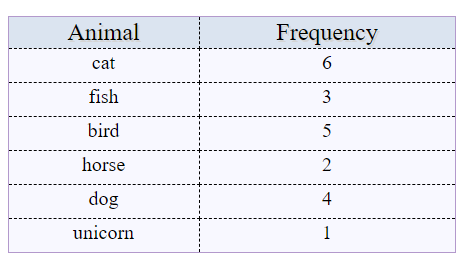
Much clearer! Now even a quick glance let us see that cat was picked most (6 times) and bird almost as often (5 times).
A frequency table is not as cute as the image the teacher prepared for her class. But it works much better for doing math, and circumvents her clip art's lack of multiculturalism.
6 cats + 2 horses + 4 dogs + 1 unicorn = 13 four-legged animals
There were 13 answers that were four-legged animals. We can count 21 answers total.
So the fraction is 13⁄21
There were 13 answers that were four-legged animals. We can count 21 answers total.
percentage = part ÷ whole = 13 ÷ 21 = 0.619 ≈ 62%
I have sudden urge to rotate that frequency table 90 degrees counter-clockwise.

Next I have sudden urge to replace the frequency numbers with colorful bars.

Uhg. That is way too ugly. But you can see the theory behind turning a frequency table into the type of chart below.

Much nicer! This chart is pretty enough to be useful when answering questions.
With the bar chart it is easy to see that the top three were cat, bird, and dog.
Definition
A bar chart compares the frequencies of several unordered categorical data types.
Some people really like sorting their bar chart categories from tallest bar to shortest bar. These are called basic Pareto charts.
Definition
A basic Pareto chart is a bar chart with categories sorted from tallest bar to shortest bar.

Notice that we can order the categories in our example however we want. There is no inherent ordering to pet choices. This is an example of categorical data. The frequencies belong to categories that lack a naturally prefered order.
Categorical data happens all the time in real life.
Examples of Categorical Data
What are the populations of various states?
The states are the categories, and the populations the frequencies. We could sort the states alphabetically, by when the joined the union, by increasing or decreasing population size, etc.
How many students in a classroom have black, brown, green, or blue eyes?
The colors are the categories, and the counts of students with each eye color are the frequencies. We could sort the eye colors alphabetically, in the order they first appear in the survey answers, by increasing or decreasing frequency, etc.
In an extended family, how many people can play different types of music instruments?
The instruments are the categories, and the counts of how many family members can play each instrument are the frequencies. We could sort the music instruments alphabetically, by physical size, by increasing or decreasing frequency, etc.
Some categories could be arranged in multiple ways without too much fuss, but there is a "most natural" way to order the categories. This situation is named ordinal data.
Ordinal data also happens all the time in real life.
Examples of Ordinal Data
How many students are in each grade level at a certain elementary school?
The grade levels are the categories, which are almost numbers but also include kindergarten. The counts of students in each grade level are the frequencies. Any ordering other than starting at kindergarten and then increasing looks wrong.
In a college writing class, how many students earned each letter grade?
The letters are the categories, and the counts of students for each letter grade are the frequencies. Any ordering other than F, D, C, B, A looks wrong.
Chart the highest level of education earned by people in a certain city.
The categories are probably named something like "never completed high school", "completed high school", "two-year college degree", "four-year college degree", "graduate degree", and "completed post-graduate studies". The counts of people with each as their highest are the frequencies. Any ordering that does not start "never completed high school" and work its way up through "completed post-graduate studies" looks wrong.
Finally, many situations have numerical data in which the categories themselves are numbers. With numerical data the horizontal axis of a bar chart looks like a number line.
Numerical data also happens all the time in real life.
Examples of Numerical Data
How many calories do I eat on each day of January?
The day numbers are numeric categories, and the counts of calories each day are the frequencies. The horizontal axis is a number line from 1 to 31.
Everyone in a math class scored between 70 and 100 on a test. How many students got each score?
The scores are numeric categories, and the counts of students for score are the frequencies. The horizontal axis is a number line from 70 to 100.
In a certain neighborhood home prices range from $100,000 to $180,000. Each home value is rounded to the nearest $10,000. How many homes have each price?
The prices are the categories, and the counts of homes with each price are the frequencies. The horizontal axis is a number line from $100,000 to $180,000 counting with intervals of $10,000.
At this point we have established some vocabulary and can make frequency tables and bar charts. That can help us present data clearly. But for most applications we need more tools.
When we make a bar chart with numerical data something special can happen.
Definition
A histogram is like a bar chart, but instead of comparing several unordered categorical data types it shows how a single quantitative data type is distributed among ordered "bins" each with a range of values.
Histograms may have their vertical axis labeled with either counted or relative frequency.
In a histogram, the categories can be numeric values, such as ages, weights, heights, test scores, etc. When the categories are numeric they will have a natural order from smallest to greatest.
Not all histograms have numeric categories. Common examples include populations for different countries, costs of living in different cities, popularity of different foods, etc.
In a histogram, the height of the bar counts how many things are in each category. So the height is always numeric.
Below is a chart that shows midterm scores for a Math 25 class back in Winter term 2016.

Notice that each student in the class has his or her own piece of bar height somewhere on the histogram. Bars that are 1 high are each representing a certain student. Bars that are 2 high are each counting two students. And so on. We could point to any unit of bar height and sensibly ask, "Which student in the class is this?"
The word "inclusive" tells us to include both the 80% bar and the 90% bar. So we are being asked to total the heights of all the yellow bars.
1 + 1 + 2 + 3 + 2 + 1 = 10 students
We are being asked to total the heights of all the bars. Let's group them by color just to help avoid making a careless mistake.
(1 + 1 + 1 + 1) + (1 + 1 + 1) + (1 + 1 + 2 + 3 + 2 + 1) + (3 + 2 + 1) = 23 students
The histogram above was also color-coded to group the categories into D, C, B, and A grades. But color-coding is not normally a part of histograms.
All histograms are designed. The histogram above uses categories of size 1.7% (starting at the lowest score of 48%). This visually sorts the students a certain way. The color coding emphasizes that there is a green A subgroup that did amazing, a big yellow B subgroup that did well, three orange C students who squeaked by, and four blue D students who definitely need improvement.
If the instructor instead used wider categories of size 5% the histogram would change. Below is exactly the same set of test scores, but with wider categories and altered color-coding.

Their new category appears to be a low A, which is a big improvement from the histogram above where their category appeared to be a middle B. They would like the second histogram much better!
In the new histogram he is in the category "78% to almost 83%". This puts him at the highest score in the yellow B category. He would also prefer the second histogram.
In the new histogram she is grouped with a student who did slightly worse. Both are together in the category "73% to almost 78%". This puts her at the lowest score in the yellow B category. She would also prefer the second histogram.
Mathematicians call histogram categories bins. It helps to picture the sections of the x-axis as physical bins that items are put into. That reminds us that designing the bins is a choice with consequences.
Someone who is careless, and makes a histogram without thinking carefully about the categories, is still making a choice! It is an unintentional and sloppy choice. Hopefully it does no harm.
Please remember to pay attention to histogram bins. Perhaps the person who made the histogram has an agenda. Perhaps that person is sleepy and not paying attention to why bin size matters. Perhaps that person is you!
| Person | Finger Snaps in 15 Sec |
|---|---|
| Annette Azzlemahm | 40 and 46 |
| Bronson Boldstock | 54 and 57 |
| Clarabelle Crinkmack | 47 and 48 |
| Dexter Dazzlespout | 48 and 45 |
| Eliza Ebbletack | 40 and 45 |
| Frederick Fiddlefeather | 52 and 46 |
| Ginger Gupperworth | 52 and 60 |
| Heathcliff Hablingford | 57 and 20 |
| Your Attempts |
| Bin | Frequency (raw count) | Relative Frequency (as decimals) | Relative Frequency (as percentages) |
|---|---|---|---|
| 20 to ? | |||
| ? to ? | |||
| ? to ? | |||
| ? to ? | |||
| ? to ? | |||
| ? to 60 | |||
| Total |

Khan Academy
OCLPhase2
Finding the mean of a data set
Finding the mean of a data list
Finding the mean from a frequency table
Now we are going to combine to earlier ideas.
First, remember from our discussion about rounding that the accuracy of equipment matters. If a pharmacist's scale measures accurately to the tenth of a milligram, then labeling a bottle 4.7 mg should be accurate but labeling a bottle 4.75 mg includes guesswork in the hundredth of a milligram place.
What we did not mention in that rounding section was how the true accuracy "moves" during arithmetic. What happens if that pharmacist divides that 4.7 mg into seven equal doses, one for each day of the week?
The value of 7 is completely accurate. The amount of 4.7 mg has two meaningful digits: because of her scale's limitation, if the pharmacist had written any smaller decimal places those would include guesswork. So we pick the least accurate starting number and say that our answer will have the same number of significant digits.
In this example, we have two significant digits. So we write 4.7 mg ÷ 7 → 0.47143 mg = 0.47 mg and round away the extra digits.
The less accurate starting number has two significant digits. So we should round our answer to only have two significant digits.
1.875 g + 2.3 grans → 4.175 g = 4.2 g
In other words, because the second value could have been 2.31 grams or 2.34 grams we cannot say for sure what the hundredths place of our answer should be.
Now remember the pattern we used to talk about what a zero or negative exponent might mean. We used lists of descending exponents that had repeated division. For example, the descending list of 10n has each step be ÷10.
|
10 6 = 1,000,000
10 5 = 100,000 10 4 = 10,000 10 3 = 1,000 10 2 = 100 10 1 = 10 10 0 = 1 10 −1 = 1⁄10 10 −2 = 1⁄100 10 −3 = 1⁄1,000 10 −4 = 1⁄10,000 |
We call this list powers of ten because sometimes people use the word "powers" to mean "exponents".
Scientists have agreed to communicate clearly by only writing significant digits. The rest of the number is hidden by using the powers of ten. This is called scientific notation if we agree to write numbers as having a ones digit and some smaller decimal place digits.
If this sounds tricky, please recognize that for some powers of ten with positive exponents it is very similar to how news articles write big numbers. Instead of writing $2,500,000 the news article writes $2.5 million. Scientific notation is the same, except it will write 106 instead of the word million.
As far as pure math cares, the numbers 3,250 and 3.25 × 10³ are completely identical. But in scientific writing, the latter adds the potentially important information that all three digits are accurately measured.
The moral of the story is this rule:
The Scientific Notation Rounding Rule
When doing arithmetic with numbers written in scientific notation, round your answer so that it has the same number of significant digits as the starting number with the smallest number of significant digits.
Also, write your answer in scientific notation unless the problem instructs you otherwise.
This is the rule when the powers of ten have positive exponents. Try a problem using the Desmos scientific calculator
The less accurate starting number has three significant digits. So we should round our answer to only have three significant digits.
4.795 × 104 × 5.15 = → 246,942.5 = 2.5 × 10⁵ oxygen atoms
In the final step we wanted a ones digit and then smaller decimal place digits, and so we did five decimal point scoots left. This means we put a 105 as the power of ten in our answer.

The rule also is used when the powers of ten have negative exponents.
The less accurate starting number has two significant digits. So we should round our answer to only have two significant digits.
4.795 × 10−2 × 5.2 = → 0.24934 = 2.5 × 10⁻¹ grams of potassium
In the final step we wanted a ones digit and then smaller decimal place digits, and so we did one decimal point scoots right. This means we put a 10−1 as the power of ten in our answer.

Using scientific notation is a bit like riding a bicycle. Once you are used to it, your brain quickly translates 2.5 × 10⁶ into 2.5 million or 2,500,000. Getting used to it takes a little while.
Most handheld calculators have a setting that tells the calculator to always write answers in scientific notation. This makes doing certain chemistry homework assignments much quicker!