
Perhaps your FAA-approved Aviation program uses these two textbooks?

These books have a glaring weakness: their chapters about math and physics are atrocious. Those chapters sometimes skip over definitions, use subscripts inconsistently, do not have enough example problems, and in other ways are needlessly confusing.
This page is intended to provide a clearer introduction to Aviation physics.
Note that a FAA-approved Aviation program uses Imperial measurement units instead of SI units.
The speed of a moving object is how much distance it travels as time passes.
speed = distance ÷ time
We normally use the word velocity instead of speed. Velocity includes the direction traveled. You can imagine that velocity is like labeling a moving vehicle with an arrow, and speed is the number measuring the length of that arrow. But when we plug velocity into a formula we ignore the arrow and only plug in the speed number.
In many situations we are not given a distance, but instead two positions. We can use subtraction to find the change in position. We can reword the above equation.
velocity = change in position ÷ time
In some situations it can sometimes be helpful to imagine the change in position as drawing an arrow from the original position to the new position. In other situations we only think about the distance traveled.
Most of us are better at thinking of speeds in terms of miles per hour than in terms of feet per second. We can do a conversion.
velocity in miles per hour = velocity in feet per second ÷ 1.467
The number 1.467 comes from dividing two conversion rates. There are 5,280 feet per mile, and 3,600 seconds per hour.
The word acceleration describes how much velocity changes. This again includes direction. Again we can subtract to find how much an amount changes.
acceleration = change in velocity ÷ time
Because velocity is measured in "feet per second", the rate of change of velocity is measured in "feet per second, per second". This often abbreviated as  .
.
Please pardon how website text must use a diagonal fraction bar, such as ft⁄sec2. You should use write horizontal fraction bars.
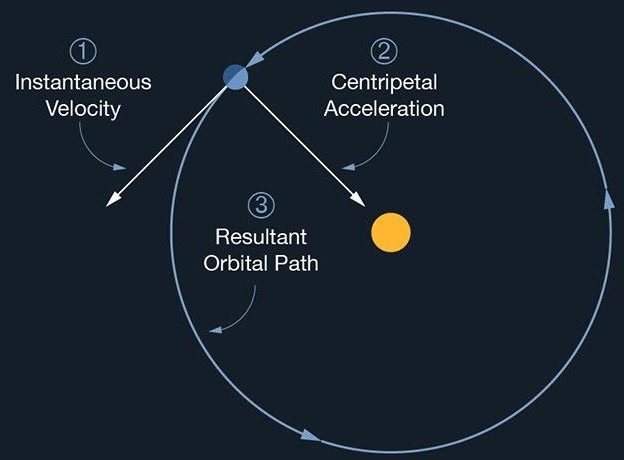 A drag racer accelerating forward has its acceleration arrow pointing forward. But the moon has its acceleration arrow pointing at 90° to its direction of motion as it orbits the earth.
An object in free fall accelerates due to gravity. Although this acceleration does decrease slightly with altitude, we will draw an arrow pointing down and the use number 32.2 ft⁄sec2 which is the value at the earth's surface. We often are lazy and write the letter g in a formula instead of writing 32.2
Sometimes aviation accelerations are written as a G forces, which is a ratio of the aircraft's acceleration to g.
G forces = acceleration in feet per second per second ÷ g
Remember, whenever you see g in a formula, plug in 32.2.
You can think of the division in the G forces formula as a fraction, replacing the division symbol with a fraction bar. Remember that when the numerator (top) of a fraction is less than the denominator (bottom), the result is less than 1. So an acceleration less than g is less than 1 G force.
An untrained person can handle an aircraft accelerating at 2 or 3 G forces before passing out. Type different numbers in the box to try making a result of 3 G forces.
Your Turn to Fiddle
An aircraft increases speed from 50 feet per second to 300 feet per second in seconds. This produces ??? G forces.
This page will update as you type in these fiddle boxes. If it says NaN that means not a number. Why are you typing letters where you should type numbers?
Here are some practice problems. Each time you load this webpage the numbers in problems like this will change. Get as much practice as you need!
By the way, the nicest scientific calculator software for our purposes is from Desmos. It can be used as a website or put on a mobile device as an app (download links for Android and iPhone).
Casual use of the English language is sloppy about mass and weight. But we need to be careful and accurate with our words.
The mass of an object is how much "stuff" is in it. If we looked closely enough we would be counting protons, neutrons, and electrons. The unit of mass you are probably most familiar with is the kilogram.
A subtly important definition is that force is how energy is transferred over a distance.
One formula for force is
force = mass × acceleration
Sometimes it is useful to rewrite this force formula to spell out how acceleration is defined.
force = mass × change in velocity ÷ time
Remember that in the Imperial measurement system we measure velocity in feet per second, and acceleration in feet per second per second.
The weight of an object is how much force it pushes downward due to gravity. We multiply its mass by g. The unit of weight you are probably most familiar with is the pound.
Mass is about stuff. Weight is about that stuff pressing down on a scale.
Mass is about counting protons, neutrons, and electrons. Weight is pushing down on a scale with force.
You may have heard someone say that "a kilogram is 2.2 pounds". This is not true! That person should have said "a kilogram of stuff weighs 2.2 pounds" because the kilogram of mass, after being multiplied by the acceleration from gravity, results in a force of 2.2 pounds.
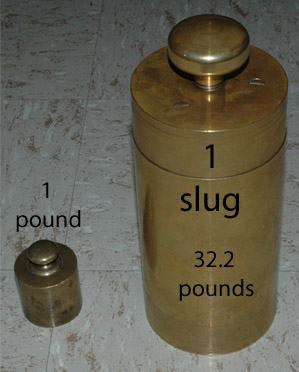 What about if we are traditional American aviation students and do not want to use kilograms? In the Imperial measurement system the amount of mass that weighs one pound is simply called a pound-mass to be carefully distinct from the pound of force.
There is also a unit in the Imperial measurement system called a slug which is amount of mass that weighs 32.2 pounds.
In real life, no one uses pound-mass or slugs. Instead, because we focus on when gravity is the acceleration, we change the formula force = mass × acceleration to get weight = mass × g. Then we divide both sides by g. The result is:
weight ÷ g = mass
Now whenever we need to use mass in a physics formula, we can plug in weight ÷ g instead. This allows us to think about pounds of weight, as we are used to with our bathroom scales and much else in life.
Remember G forces? Unfortunately, the G force is misnamed. It is a ratio of accelerations, not a force. Every day we deal with situations that involve thousands of G forces because the time span is really tiny.
Your Turn to Fiddle
An apple dropped out a window lands on the sidewalk, and the bottom 3 inches squish. It was falling at feet per second. This means the impact duration was ??? seconds. (Multiply your fiddle by 12 to find the number of inches per second, then divide the 2 inches by that result.)
This is a tiny amount of time! Dividing by such a small decimal will make big numbers.
The first big number will be the acceleration.
acceleration = change in velocity ÷ time
The change of speed is between your chosen feet per second to having no speed while squashed on the sidewalk. Divided by that tiny amount of time, and we get an acceleration of ??? feet per second per second. We can divide by 32.2 to see is ??? G forces!
The next big number will be the force, which looks bigger than it is.
Most apples weigh between a sixth and a third of a pound. Let's say this apple weighs pounds.
We divide that weight by g to get the apple's mass. Then because force = mass × acceleration we multiply the mass by the above acceleration to get ??? pounds of force as the apple hits the sidewalk.
That might seem like a lot. But sprinters can apply forces of 800 or more pounds with each leg.
Remember that if the apple was dropped from 5 stories up and fell for 2 seconds then it would be moving at about 64 feet per second when it squashed. (There would be two seconds that each added 32.2 feet per second to a speed that was initially zero.) Fiddling above with that speed and a weight of 0.3 pounds produces about 764 pounds of force.
What would leave a bigger bruise, being kicked by a sprinter or being hit by an apple that fell 5 stories? About the same!
(Note: In this fiddle box changing the top input does not recalculate the pounds of force as the apple hits the sidewalk. Change the bottom input to update that number.)
Our applications will often ask us to compare the weights of two substances, or how the weight of one substance changes as temperature or pressure changes.
We could approach this by talking about density, which measures mass per volume. But with the Imperial measurement system we prefer to think about weight instead of mass whenever possible. So we will use a nifty trick to avoid dealing with mass when thinking about density.
Instead we measure how a substance's density compares to the density of water. This ratio has the strange name of specific gravity.
specific gravity = density of a substance ÷ density of water
Notice that when we make a ratio of two densities, they have the same "per volume" component. So those "per volume" parts will cancel out. What is left over shows us that we can also find specific gravity with a ratio of weights.
specific gravity = weight of a substance ÷ weight of an equal volume of water
Because specific gravity is a ratio of two amounts with the same measurement units, the measurement units cancel out. This means specific gravity is a "dimensionless" number that lacks measurement units.
The specific gravity of water is 1 by definition. The density of water divided by itself is 1. (Or the weight of water divided by itself is 1.)
Here are some examples of specific gravity at standard conditions.
When discuss aircraft fuel we might compare the specific gravity of liquids. Perhaps a certain jet fuel has a specific gravity of 0.785.
Most solids are denser than water. The specific gravity of lead is 11.4. But ice is an exception because water expands as it freezes: the specific gravity of ice is 0.917.
Some gasses are less dense than water, and others are more dense. The specific gravity of acetylene is 0.898. The specific gravity of oxygen is 1.105.
However, all of those examples of specific gravity are oversimplifications! Be careful when looking up specific gravity numbers in a table!
The density of a substance decreases as temperature rises. The density of gas decreases as pressure decreases. So we really should have said "In a hanger at ground level and at normal temperatures the specific gravity of water is 1." The specific gravity of water will decrease as it is heated. The specific gravity of oxygen will increase if it moves into a high-pressure portion of a turbine engine, or decrease if it moves into a low-pressure portion of a turbine engine.
That is why the phrase standard conditions was tucked into a sentence above. Aviation physics uses International Standard Atmosphere (ISA) for its standard conditions. This specifies the temperature is 59 °F and 14.7 PSI (also called 1 atmosphere) of pressure.
(This will confuse chemists, who are used to Standard Temperature and Pressure (STP) for their standard conditions. STP is colder, with the standard being 39.2 °F. What is considered standard pressure is unchanged from ISA.)
By the way, at ISA standard conditions water has a density of 62.3 pounds per cubic foot, or 8.33 pounds per gallon.
In conclusion, we should note that officially the International Standard Atmosphere is a model of how the atmosphere behaves, not merely a list of typical temperature, pressure, and so forth. The awkward phrase "ISA standard conditions" is often replaced by the much nicer phrase standard day.
The math portion of this website has a discussion about temperature unit conversions.
Fortunately, we do not need to know details about how heat transfers between substances, how much heat is generated by friction, etc. Usually in textbook problems we are simply provided with the temperatures at important places within the systems we work with, and in real life we take temperature measurements ourselves. But a few bits of jargon can be important.
Heat is a type of energy, so it can be measured in foot-pounds.
However, when using the Imperial measurement system, heat is traditionally rated in British Thermal Units (BTU), which measure the amount of heat (778 foot-pounds) required to raise one pound of water by 1 degree Fahrenheit.
For example, jet fuel has a rating of about 18,500 BTUs per pound. If we could burn one pound of this fuel with perfect efficiency, it would generate 18,500 BTUs of energy. If we multiply by 778 we rewrite that as 14,393,000 foot-pounds of energy. So with theoretical efficiency, and ignoring friction and drag, that much fuel could move a 1,250 pound aircraft about 14,393,000 foot-pounds ÷ 1,250 pounds ≈ 11,500 feet.
(In real life there would be a 25% to 65% energy loss, depending upon whether the aircraft was rolling or flying, and many other conditions.)
Recall how we compared a substance's density to the density of water, and named that ratio specific gravity. As a ratio of two items that had the same measurement units, specific gravity was "dimensionless" because the measurement units canceled out.
It would be nice to do a similar thing and compare how efficiently a substance transfers heat with how efficiently water transfers heat. Then we could have another friendly dimensionless ratio.
Unfortunately, for historical reasons, the specific heat capacity of a substance was instead defined as the amount of heat energy needed to raise the substance's temperature by one degree Fahrenheit.
specific heat capacity = heat energy ÷ substance weight ÷ change in temperature
That formula means specific heat capacity does have measurement units: BTUs (energy) per pounds (weight) per °F (temperature change). Blah. This means a table of specific heat capacity values for different substances will have quite different values in Imperial or SI measurement systems.
Because of how BTU was defined, the specific heat capacity of water is 1 BTU per pound per °F of temperature change.
Water is remarkable at resisting temperature changes. Most substances have a smaller specific heat capacity than water.
For example, copper's specific heat capacity is only 0.092 BTU per pound per °F. (If we were a laboratory chemist using SI units, we would instead write 385 Joules per kilogram per °C.)
The specific heat capacity of air varies based on pressure. In most aviation conditions it ranges from 0.17 to 0.24 BTU per pound per °F.
The specific heat capacity of steel varies based on the alloy. It ranges from 0.1 to 0.15 BTU per pound per °F.
Be warned that people often say "specific heat" instead of "specific heat capacity" because it sounds like "specific gravity".
Normally a specific heat capacity value is something we look up. We rearrange the above formula to isolate either the heat energy or the change in temperature.
This version answers the question "how much energy is required to raise the substance's temperature a certain amount?"
heat energy = substance weight × change in temperature × specific heat capacity
This version answers the question "how much would the temperature change if we added a certain amount of heat energy?"
change in temperature = heat energy ÷ substance weight ÷ specific heat capacity
Anyone who has used hot water to help remove the metal lid from a jar knows that materials (especially metals) expand when heated.
For our purposes, we only care about linear expansion in one direction at a time. The formula simply applies two scale factors to the item's initial length.
change in length = initial length × change in temperature × coefficient of linear expansion
As with specific heat capacity, the coefficient has measurement units and will therefore look very different in Imperial or SI measurement units.
For example, copper's coefficient of linear expansion is 9.3 ×10⁻⁶ per °F in Imperial measurement units (but 1.65 ×10⁻⁵ per °C in SI measurement units).
If the stuck jar lid was stainless steel, its coefficient of linear expansion would be very similar to that of copper, at about 9.5 ×10⁻⁶ per °F. The type of steel alloy can change this value.
If the stuck jar lid was aluminum, its coefficient of linear expansion would be about 13 ×10−6 per °F.
By comparing these coefficients (13 ÷ 9.5 ≈ 1.39) we can see that aluminum expands roughly 39% more than copper or steel.
Notice that the linear expansion formula applies equally well to lengths measured in inches or feet.
Unfortunately, the One Plus Trick cannot be used if we want to find the new length in one step. Attempting to do so would scale the temperature change as well as the length! We are stuck finding the change in length as one step, and as a second step adding it onto the initial length to find the new length.
Again we are fortunate and do not need to know much about friction. We only consider the case when an object is moving horizontally, so all its weight is perpendicular to its motion. But the jargon can be important.
Friction is a force that resists motion. As a force, it is measured in pounds.
The types of friction we care about all use the same formula, which simply applies a scale factor to weight.
friction with jargon = weight × scale factor with jargon
If the object is resting on the ground and we try to push it, we talk about static friction and call that scale factor the "coefficient of static friction".
If the object is sliding across the ground and we try to push it, we talk about sliding friction and call that scale factor the "coefficient of sliding friction".
If the object is rolling and we try to push it, we talk about rolling friction and call that scale factor the "coefficient of rolling friction".
We always think of static friction as how much force is required to start the object moving.
But we often think of sliding or rolling friction as how much force is required to keep the object moving at its current speed.
None of those situations have anything to do with aerodynamic drag as an aircraft moves through air. The equation for aerodynamic drag is much more complicated than simply scaling weight. It involves air density, aircraft velocity and frontal area, the wing's planform area, and a scale factor that changes a bit based on the situation.
So remember that friction is simple but drag is complicated.
We start with the conservation of momentum. To move an aircraft forward, an equal momentum must be created in the opposite direction.
The formula for momentum is
momentum = mass × velocity
So to create more forward movement for our aircraft, we could push backwards more air or we could push that air backwards faster (or a bit of both). These options are not equally useful.
Recall that the formula for kinetic energy has a velocity2 term in its numerator. Moving air backwards twice as fast would require four times as much energy. Moving air backwards three times as fast would require nine times as much energy.
So engines prefer to do more by moving more air. The most efficient engines move a lot of air, but only increases the speed of that air slightly (imagine the huge intake and fan of a commercial airliner engine).
This type of efficiency is really about how well the engine converts mechanical power into useful thrust power. It is called propulsive efficiency and uses this formula:
propulsive efficiency = 2 × aircraft velocity ÷ (aircraft velocity + exhaust velocity)
The parenthesis are crucial when using the formula. Remember, the Desmos scientific calculator linked above can include parenthesis without any problem. (Tangentially, this is the only formula we use in which the parenthesis must be typed into the calculator.)
This formula spits out the decimal format of the propulsive efficiency. If you want to the percentage format, multiply the decimal format by 100.
Notice that if the aircraft velocity equals exhaust velocity, the propulsive efficiency is 100%. However, that describes an empty tube instead of an engine!
We already commented that an ideal aircraft would accelerate a lot of air by only a small amount. Its exhaust velocity would be only slightly higher than its own velocity. We can see this in the formula for propulsive efficiency if we remember that a division symbol can be replaced by a fraction bar. The 2 × aircraft velocity (which is like the top of a fraction) would be only a tiny bit smaller than the (aircraft velocity + exhaust velocity) (which is like the bottom of a fraction).
Viewing this formula as a fraction also helps us see that the measurement units in this formula cancel out. This is what we need, since an efficiency rating should be a percentage without a measurement unit label. This means that it does not matter how we measure velocity when using the formula, as long as the aircraft and exhaust velocities have the same measurement units. As long as they match they can both be feet per minute, feet per second, miles per hour, etc.
We can smash together the momentum and weight formulas. We know that weight ÷ g = mass so where mass appears in the above momentum formula we can replace it with weight ÷ g. We are allowed to slide the ÷ g from beside the weight to the far right.
momentum = weight × velocity ÷ g
This second version is much more useful. We normally talk about how many pounds an item weighs, not its mass in pound-mass or slugs!
Tangentially, the units for momentum in the Imperial system turn out to be slug-feet per second. But you can ignore this. Practical situations only care about how momentum changes, not the value of a single momentum measurement. Besides, it sounds too much like squamous Cthulhu-esque creatures at a track meet.
It is time to smash together two formulas we used above to deal with mass and force. Let's use a cyan color to show that they are review.
weight ÷ g = mass
force = mass × acceleration
We again look where mass appears in the force formula we can replace it with weight ÷ g, and are again allowed to slide the ÷ g from beside the weight to the far right.
force = weight × acceleration ÷ g
Our aviation applications will consider both aircraft and air as an accelerated object.
This formula can be used to measure the force needed to accelerate something (the energy spent to get an aircraft moving) or the force produced when something is accelerated (the energy created by an engine that accelerates air backwards).
We saw above that when working with acceleration we will also want to be prepared with a version of the formula for situations in which we are instead given the change in velocity and the time. We remember that acceleration = change in velocity ÷ time and smash that into the above formula.
force = weight × change in velocity ÷ time ÷ g
As before, we can use this formula to measure the the energy spent to increase an aircraft's speed, or the the energy created by an engine that increases the speed that air moves.
We can also use this twice as we consider both the thrust from the air's change in velocity and also the thrust from the fuel's change in velocity. But the latter is usually negligible compared to the former.
Remember from our discussion above about momentum that an efficient engine moves more air.
A second formula for force is
force = change in pressure × area
 In this formula the change in pressure is measured in psi (pounds per square inch).
In rare cases you might be given a pressure measured in pounds per square foot. Then you should divide by 144 square inches per square foot to find the psi.
The formula for area of a circle is
circle area = π × radius2
which means that this time a squared exponent works in our favor. An intake that is twice as wide brings in four times as much air. An intake that is three times as wide brings in nine times as much air.
The force created by an engine is called thrust. Because thrust is a force it is also measured in pounds.
We have seen that thrust can come from accelerating gasses (with air being the most common moving gas) or from creating pressure with a propeller or fan. The thrust produced by accelerating gasses is named reactive thrust. The thrust produced by creating pressure with a propeller or fan lacks such a fancy name and is called pressure thrust.
If an engine has a propeller or fan it will create both types of thrust, so we will need to add forces together.
Time to do that!
inaccurate total thrust = (weight × change in velocity ÷ time ÷ g) + (change in pressure × area)
Notice that the math rules for "order of operations" make the parenthesis not needed. They are included to help our eyes by making the formula easier to read. They also help us remember the structure of this thrust formula: we add two terms together, the first about acceleration and the second about pressure.
Please keep in mind that this equation is about air flow and not about the aircraft. Do not be tempted to use the aircraft's weight for the weight number. We are looking at the weight of the air moving through the engine!
As was mentioned slightly earlier, there are actually two sources of reactive thrust: the air's change in velocity and also the fuel's change in velocity. The previous formula ignores the reactive thrust from the fuel's change in velocity, which for light aircraft this is negligible and the slightly inaccurate formula is sufficient.
To be as accurate possible (for large aircraft) this formula would have two copies of the first part that represents reactive thrust. In the first copy we would plug in the air's weight and change in velocity, and in the second copy we would plug in the fuel's weight and change in velocity.
The result is awkward long to write in words, and probably wraps around the edge of the screen.
accurate total thrust = (air's weight × change in air's velocity ÷ time ÷ g) + (fuel's weight × change in fuel's velocity ÷ time ÷ g) + (change in pressure × area)
This is a nice time to see some physics jargon. The Greek letter delta, which looks like Δ, is used to mean "change in". Subscripts are used to show which copy of the reactive thrust is for air (little a subscripts) and which copy of the reactive thrust is for fuel (little f subscripts). The capital letters W, V, and P stand for weight, velocity, and pressure.
accurate total thrust = (Wa × ΔVa ÷ time ÷ g) + (Wf × ΔVf ÷ time ÷ g) + (ΔP × area)
Your Turn to Fiddle
An engine has 60 pounds of airflow every 1 second. Air passing through the engine changes from the aircraft's velocity of 400 feet per second to an exhaust velocity of 1,200 feet per second.
The engine burns pounds of fuel each second, with those gasses are accelerated from zero to 1,300 feet per second.
The pressure at the exhaust nozzle is 12 psi. The area of the exhaust nozzle is 50 square inches.
Fiddle to explore how much the amount of fuel burned contributes to the accurate total thrust.
•airflow reactive thrust: ??? foot-pounds of energy.
•fuel reactive thrust: ??? foot-pounds of energy.
•pressure thrust: ??? foot-pounds of energy.
•accurate total thrust: ??? foot-pounds of energy.
Note that while cruising a light aircraft may burn only 0.1 to 0.25 pounds of fuel per second, compared to a commercial jet engine burning 6 to 6.5 pounds per second.
A commercial jet engine during takeoff, or a fighter jet using afterburners, can burn 20 to 22 pounds of fuel per second.
When an engine is stationary and the air is initially still we call the created force(s) static thrust (or sometimes gross thrust). When an engine is moving, the air entering the engine will not be still and we use the term net thrust.
YouTube Videos
A rifle with over 30,000 foot-pounds of muzzle energy, by Kentucky Ballistics
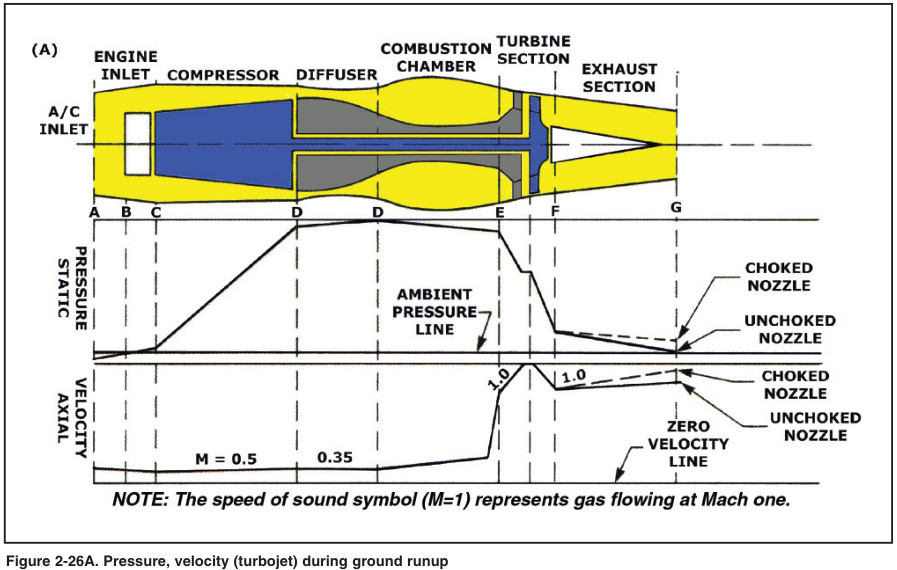 If you have a physics background, you might have the habit of trying to mentally divide an entire system into its potential energy part and its kinetic energy part.
Aircraft engines do use both kinds of energy. Force does measure energy. But do not try to divide the entire engine into an overall potential energy part and an overall kinetic energy part.
Instead, learn to mentally divide the engine into its mechanical portions. Each of these will alter both potential energy and kinetic energy in a way that is important to understand before mentally following the airflow into the next mechanical portion.
We will see diagrams and more details later. But as the two simplest examples, the compressor changes kinetic energy into potential energy as air is slowed and compressed, whereas the combustion chamber changes potential energy into kinetic energy as air expands and fuel burns.
 We will often use diagrams that look like the flow of air through a pipe. We name the "downstream" direction axial as if the pipe was a steamroller's front wheel rotating on an axle. When we look at a cross-section of the pipe, the direction from the center of the pipe to an outer edge we call radial as if we were drawing a radius line.
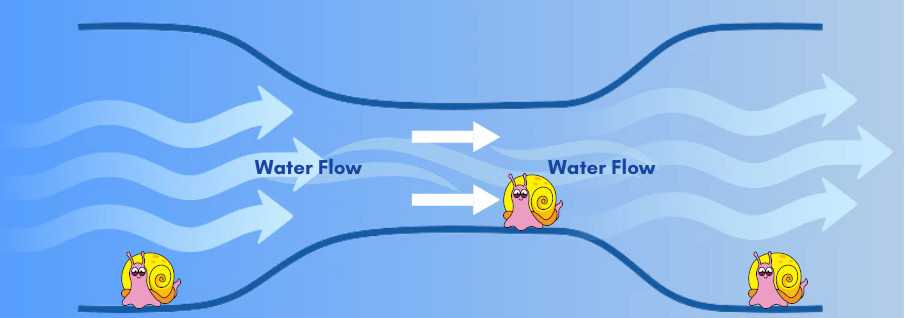 Imagine water flowing through a stream at a constant rate. It moves from a wide pool to a narrow portion. Then it eventually moves into another wide pool.
Focus on where the water has a chance to spread out as it moves from the more narrow area into the second pool. This pulls water quickly from the narrow portion, making the stream's flow quickest within the narrow portion. As water enters the second pool and spreads out, this extra radial motion "distracts" from the axial motion as energy is instead used to move radially. So the water in the pool has less axial speed than when it was earlier in the narrow portion.
Similarly, the water in the first pool also moves more slowly than the water in the narrow portion.
Now imagine snails that live at the edge of that stream. A snail that lives in a pond is not pushed much axially, because the water in the pond flows downstream slowly. But if we look at a cross-section of the pond where that snail is, there is a lot of water radially between the center of the pond and the snail. The snails in the pools are firmly pressed against the stream bed.
In contrast, a snail that lives in the narrow portion feels the water flowing downstream more quickly and is pushed more axially. But since each bit of water moves past the snail more quickly, it does not have time to push as much radially. That snail is pressed much less radially against the stream bed.
We do not actually need the snails. Where the water is flowing downstream slowly, each molecule of water presses on its neighboring molecules of water more. Where the water is flowing downstream quickly, each molecule of water presses on its neighboring molecules of water less.
How much the molecules in a gas press on each other is named static pressure.
How much the velocity of a gas pushes on objects is named ram pressure.
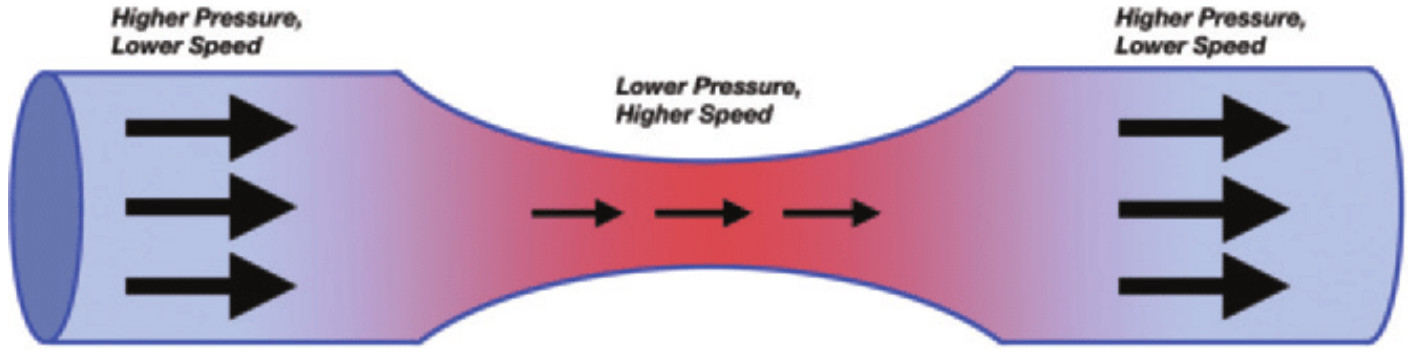 The same happens with air flow in a pipe. Where the pipe is wide the air's velocity is lower but the air's static pressure is higher. Where the pipe is narrow the air's velocity is higher but the air's static pressure is lower. This is named the Venturi effect.
In other words, a restriction increases velocity and lowers static pressure, while an expansion decreases velocity and raises static pressure.
Sound is a pressure disturbance that propagates through the air (or other material). How should we picture sound in our imagination?
Imagine a tournament billiards table whose length and width are 4.5 times as large as normal (so about 40 feet by 20 feet). Two billiard balls move around on this table. That is similar to comparing the size of two air molecules with how far they travel on average before impacting another air molecule. Air molecules are small compared to the distances between them!
Next imagine beating a drum to make a sound wave: a traveling wiggle of air. But this wiggle does not move like a chain reaction of dominoes knocking each other over. Because air molecules are so small compared to the distances between them, each air molecule takes a bit of time to reach the next so it can pass along the wiggle. Also realize that air molecules are always moving a bit randomly, so they are not efficient at moving downstream to pass along the wiggle.
In other words, when picturing a sound wave do not imagine a row of people, each holding a beanbag, passing their beanbag to the next person down the row almost simultaneously. That is way too compact and efficient! Instead imagine a sequence of drunk people spaced out along a trail, each about 350 feet apart from his or her neighbor, and each has to run to the next person to pass a beanbag. The "speed limit" of the speed of sound is similar to how a running drunk beanbag-passer can only run so fast.
Now we can talk about how the speed of sound limits air flow.
Remember that the Venturi effect described how flowing into a restriction causes air to increase in axial velocity and decrease in static pressure. But the speed of sound is a speed limit for how fast pressure changes can move through air. So once the restricted air reaches the speed of sound, it is moving downstream so fast that it does not react to the pressure of air upstream.
Metaphorically, a drunk is sprinting down the trail at maximum running speed, and previous drunk along the trail cannot catch up to push the sprinter forward faster.
So when the flow of air in an engine reaches the speed of sound at a restriction (such as an exhaust nozzle), there is an exception to the Venturi effect. As the sonic speed air gets restricted it will still decrease in static pressure, but that will not cause more air mass to flow. We say the air flow is choked at that restriction.
We will discuss the parts of a jet engine later. But since we just discussed the speed of sound, let's consider one application.
An engine's compressor uses rotating blades that spin like a fan. If these blades spin faster than the speed of sound, the air produces shock waves that interfere with the compressor's job. How fast can they spin?
One factor is the size of the rotating blades. As the blade tips spin they trace a circle. How long is this path for each rotation? We can remember that
circle circumference = π × diameter
Another factor is how the speed of sound changes with air temperature. At higher temperatures the air molecules are wiggling faster, and more easily transfer a pressure disturbance.
The temperature in the rear stages of the compressor may be many hundreds of degrees higher than in the front stages. So the speed of sound will be lower in the front stages and higher in the rear stages. If we look at the ratio of blade tip speed to the speed of sound, even though the blade tips all spin at the same fixed speed this ratio will be higher Mach number in the front stages and a lower in the rear stages.
We call the this ratio the Mach number.
Overall, the relevant formulas are:
tip speed in feet per second = π × diameter × rotations per minute ÷ 60
tip speed in mach number = tip speed in feet per second ÷ 49.03 ÷ (temperature in Fahrenheit + 459.7)½
We saw in the section above about thrust that the formulas about forces care about changes in pressure between two locations, not just the static pressure at one location.
As rule of thumb for the altitudes used in aviation, atmospheric pressure is 14.7 psi and drops by about 0.5 psi for every 1,000 feet of altitude gain.
Tangentially, air weighs about 0.07647 pounds per cubic foot at sea level, and this drops by about 0.0022 pounds per cubic foot for every 1,000 feet of altitude gain.
 There are tables of constants for a standard day on this Moodle page.
In the 1600s, Blaise Pascal discovered that when a liquid is compressed this sets up an equal pressure against all of the walls of its container.
This means when we build a simple device with hydraulic pistons, the input and output pistons have an equal pressure.
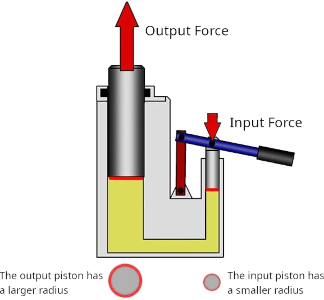
In the math pages, we talked about variation. Does this system have direct or indirect variation?
We start by writing a simple equation that states the pressures are equal.
input pressure = output pressure
Recall that a second formula for force is
force = change in pressure × area
We can put these together. The change is pressure is distributed equally against both piston areas.
input force⁄input piston area = output force⁄output piston area
So this simple hydraulic system has direct variation when considering force and piston area.
Also recall that the formula for area of a circle is
circle area = π × radius2
We can put that into our direct variation formula to get
input force⁄input piston radius squared = output force⁄output piston radius squared
Here is where the might of hydraulic systems happens. The system has direct variation when considering force and the square of the piston radius.
In other words, if the output piston is twice as wide, the output force is four times a big!
If the output piston is 5 times as wide, the output force is 25 times a big!
We give the name mechanical advantage to how much the input force is multiplied.
For this hydraulic system, the mechanical advantage can be more simply written as
mechanical advantage = (output radius ÷ input radius)2
If you skim through the formulas on this page, you might notice that having a squared exponent is rare. The exponent is what makes hydraulic systems mighty!
What if we switch our focus to how far each piston moves?
The volume of liquid moved by the input piston and output system will be the same.
input volume displaced = output volume displaced
In both cases this volume is equal to the distance the piston travels multiplied by the piston's area.
input piston distance × input piston area = output piston distance × output piston area
So this simple hydraulic system has indirect variation when considering piston area and distance.
As before, we can combine the above formula with the circle area formula.
input piston distance⁄input piston radius squared = output piston distance⁄output piston radius squared
We can paraphrase that result by saying that the mechanical advantage also describes how much the input piston distance is divided.
If the output piston is twice as wide, the output piston only moves one fourth the distance.
If the output piston is 5 times as wide, the output piston only moves one twenty-fifth the distance.
When a force causes or resists motion, the amount of energy it uses is called work.
The formula for work is
work = force × distance
Work can measure lifting an object: the force of gravity is resisted to move a distance.
Work can measure how the force of thrust moves the aircraft a distance.
In either case work involves a force is applied through a distance. As far as physics jargon is concerned, if you tire yourself out pushing on a stationary wall you are not moving that wall any distance, so no work (in the physics sense) happens even though you feel like you are "doing work" (in the sense of getting tired).
We learned above that a force is how energy is transferred over a distance. Measuring the work done (the amount of energy used by that force) requires knowing that distance.
Earlier we saw that weight is a force. When a weight moves up or down a distance we name the energy potential energy. Lifting an object up requires spending energy, and the object gains potential energy.
potential energy = weight × distance
Allowing an object to fall releases some of its potential energy. The energy of motion is named kinetic energy.
kinetic energy = weight × velocity2 ÷ 2 ÷ g
A traditional physics problem asks us to compare potential energy and kinetic energy.
Your Turn to Fiddle
An airplane weighs 10,000 pounds.
Its altitude decreases by feet, which releases ??? foot-pounds of potential energy.
It is flying at a velocity of feet per second (about ??? miles per hour), which means it has ??? foot-pounds of kinetic energy.
Can you fiddle with the two inputs to make the amounts of energy equal?
Power is how quickly work is performed.
The formula for power as measured in foot-pounds per minute is
power (measured in foot-pounds per minute) = work ÷ time
Unfortunately, a foot-pounds per minute is a tiny and impractical size. For most situations we prefer to use horsepower, which is bundles of 33,000 foot-pounds per minute.
So formula for power as measured in horsepower can be written as
horsepower = force × distance ÷ time ÷ 33,000
Horsepower was defined while thinking about a horse pulling a mill wheel, not how much power a horse can pull (which is closer to 5 or 6 horsepower). An athlete can sustain producing about one-third of a horsepower.
The previous formula used the common Imperial measurement units. We would plug in force in pounds, distance in feet, and time in minutes.
But in aviation we also care about the horsepower of an aircraft whose velocity is measured in miles per hour, or sometimes in feet per second. There are 5,280 feet in a mile. There are 60 minutes in an hour. At this point in our mental gymnastics we also realize that no real-life engine runs at 100% efficiency. So after we make adjustments the above formula becomes
horsepower = force × speed in miles per hour ÷ percent efficiency ÷ 375
horsepower = force × speed in feet per second ÷ percent efficiency ÷ 550
When using these formulas please remember that an efficiency written as a percentage needs to be divided by 100 to change it into a decimal.
We can also rearrange either formula so that the force of thrust is by itself. For example:
force = horsepower × 375 × percent efficiency ÷ speed in miles per hour
A special formula for force looks very different than any other, but we can explain why.
Remember this formula for force?
force = mass × acceleration
If an object is restrained to move in a circle, the force pulling the object to the center of the circle is named centripetal force. This is the force that keeps water in a bucket if we swing the bucket around us on a string.
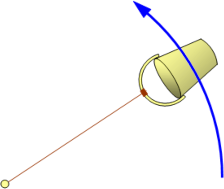
The bucket has two different types of acceleration.
First, it might be speeding up or slowing down over time, as we often think of acceleration.
Second, its direction is constantly changing even if its speed is constant. Acceleration is a vector, and the change in direction as the string prevents the bucket from flying away in a straight line counts as acceleration.
So we add those details to the formula.
centripetal force = mass × change in speed over time × directional change
How do we actually measure the directional change? If we spin the bucket faster then the direction changes more each moment, so it is proportional to velocity. Also, if we make the circle bigger then the direction changes less each moment, so it is inversely proportional to radius. Finally, if we spin the bucket faster then it spends less time in each bit of arc of the circle, so it is proportional to time.
centripetal force = mass × (velocity ÷ time) × (velocity ÷ radius × time)
FloatHeadPhysics made a very nice video explanation of this directional change. The animations help!
The centripetal force formula can be simplified by combining the velocity variables and having the time variables cancel. We also want to replace mass with weight ÷ g. It is usually written as
centripetal force = velocity2 × weight ÷ g ÷ radius ← measure velocity in feet per second, radius in feet
Remember how an exponent was what makes hydraulic systems mighty? In a similar way, centripetal force "feels" extra strong because it uses velocity2.
Notice that we must measure both velocity and radius using feet (not inches).
Changing from feet to inches involves a ÷12. This would appear in the velocity2 as ÷122, but in the radius as only ÷12. One of the velocity's ÷12 bits would cancel out with the radius ÷12 bit. But the other would velocity ÷12 bit would stick around. That means if we use the centripetal force with inches we need to stick in that extra ÷12.
centripetal force = velocity2 × weight ÷ g ÷ radius ÷ 12 ← measure velocity in inches per second, radius in inches
Similarly, 1 mile per hour is about 1.467 feet per second, and there are 5,280 feet in a mile. 1.4672 ≈ 2.152. So we could also modify the equation as
centripetal force = velocity2 × 2.152 × weight ÷ g ÷ radius ÷ 5,280 ← measure velocity in miles per hour, radius in miles
We just discussed how circular motion involves two types of acceleration. Can we compare that with gravitational acceleration to get G forces? Sure!
First we can compare the centripetal force with the force of gravity. (Remember that weight is simply the force of gravity acting on an object.)
comparing force ratio = centripetal force ÷ weight
Next we divide both variables on the right side by mass. (The division can be rewritten as a fraction, and we are allowed to do ÷ mass to the top and bottom of a fraction.) A force divided by mass becomes an acceleration. A weight divided by a mass becomes the constant g.
comparing force ratio = acceleration ÷ g
Earlier we had another name for acceleration ÷ g. We called it G forces.
So our ratio of comparing forces was both centripetal force ÷ weight (in one equation) and also G forces (in the other equation). So those must be equal.
In other words, we can divide the weight out of any of our three centripetal force equations to get a G force equation.
G forces = centripetal force ÷ weight
You might remember from the fiddle box about a falling apple that many situations involve surprisingly high numbers of G forces. This is especially true within an engine!
For example, imagine that the tip of a 5 pound fan blade is rotating in a circle of radius 3 feet at a velocity of 1,100 feet per second. This means the tip of the blade feels a centripetal force of 1,1002 × 5 ÷ g ÷ 3 ≈ 62,630 pounds, creating 62,630 ÷ 5 = 12,526 G forces!
The force of lift is a third case in which an exponent has a mighty impact.
The formula for production of lift is
lift force = wing planform area × coefficient of lift × velocity2 × air density × g ÷ 2
We can see from this equation that if we double the wing planform area the lift also doubles, but if we double the velocity the lift quadruples!
The coefficient of lift is a dimensionless value that depends on the airfoil's shape and angle of attack.
The last few items are sometimes called the dynamic pressure.
lift force = wing planform area × coefficient of lift × dynamic pressure
Note that dynamic pressure is indeed a pressure, with measurement units of pounds per square foot. It measures the kinetic energy density of moving air (we multiply it an area to get a force).
We just discussed work. Work is when a force is applied through a distance.
A similar concept is torque, which is when a force causing rotation is applied perpendicular to a distance.
The formula for torque looks similar to the formula for work because it can be summarized as "force × distance". But the "distance" measures the separation between where the force is applied and the center of rotation.
torque = force × distance to center of rotation
In the simplest case, the point where force is applied is at the opposite end of the object from the center of rotation.
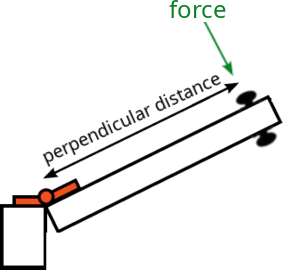
For example, if you pull on a doorknob with 0.5 pounds of force, and the distance between the doorknob and the hinges is 3 feet, then the torque is 0.5 pounds × 3 feet = 1.5 foot-pounds.
A wheelbarrow works like that door, but we consider a weight in the wheelbarrow. This uses indirect variation.
input force × distance from input to center of rotation = output force × distance from output to center of rotation
As an example, your wheelbarrow has a 5 foot distance from the wheel to the handle grips. A weight of 200 pounds is placed in the wheelbarrow, with that weight's center of gravity 1.5 feet from the wheel. How much force is needed to lift the handles up? We can write 5 feet × y pounds ÷ = 1.5 feet × 200 pounds and solve for y to find an answer of 60 pounds.
Note that pulling a vehicle up a ramp can be analyzed in the same way.
input horizontal force × horizontal distance along the ramp = output vertical force × vertical distance up the ramp

In other words, if a ramp is 6 times as long as it is tall, a vehicle can be pulled up the ramp with only one-sixth the force required to simply lift the vehicle the ramp's height.
A slightly more complicated situation is a pulley system.
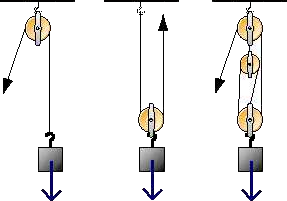
The simplest pulley system is a single pulley fixed to the ceiling, as in the first part of the diagram. This system is symmetrical. The rope on either side of the pulley feels the same force. A fixed pulley is only useful for allowing us to choose the direction we pull. It does not offer any helpful mechanical advantage.
A movable pulley, as in the second part of the diagram, does provide a mechanical advantage of 2. We end up pulling the rope twice as far as the weight is lifted. The weight is lifted with twice the force we apply.
A block and tackle system can provide even more mechanical advantage. Count the number of rope segments supporting the weight (but not the rope end we pull on). In the third part of the diagram is a block and tackle system in which three rope segments support the weight. So it's mechanical advantage is 3. The rope will be pulled 3 times as far as the weight is lifted. The weight is lifted with three times the force we apply.
Picture an engine in which a piston drives a crankshaft.

We are going to smush together three formulas: torque, circumference, and power. Ready?
In our situation the crankshaft makes a single rotation. The end attached to the piston traces a circle.
circumference = π × diameter.
But this circumference equation can be paraphrased in our situation.
rotational distance = π × crankshaft length × 2.
As with our doorknob and door, the crankshaft has torque.
crankshaft torque = force downward on piston × crankshaft length
We can combine these circumference and torque equations.
crankshaft torque × π × 2 = force downward on piston × rotational distance
Next we remember our formula for power as measured in horsepower. That formula was
horsepower = force × distance ÷ time ÷ 33,000
The next smush gets a bit tricky. We will replace the force × distance portion of that formula for power. Because the formula for power involves work (not torque), we ask what distance the force travels through. The answer is the rotational distance.
So we replace with force × distance with crankshaft torque × π × 2 to get
horsepower = crankshaft torque × π × 2 ÷ time ÷ 33,000
We can also replace time with rotations ÷ rotations per minute.
horsepower = crankshaft torque × π × 2 ÷ (rotations ÷ rotations per minute) ÷ 33,000
Finally we clean this up and the result for a single rotation is
crankshaft torque = horsepower × 5,252 ÷ rotations per minute
What a nice result! This gives us a simple way, at a specified rpm, to change the horsepower of an engine into the amount of torque on the crankshaft.
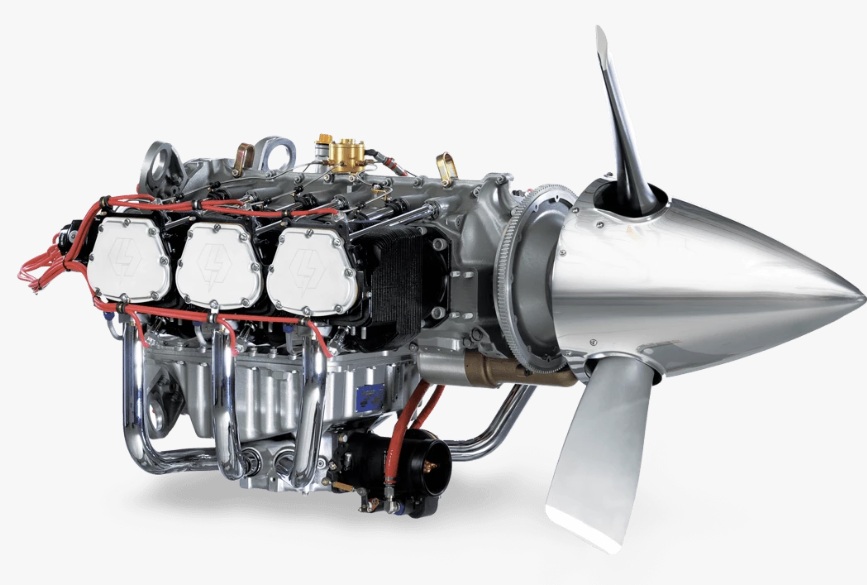 Light aircraft with a cruising speed of under 250 m.p.h. do commonly use a reciprocating (piston) engine instead of a jet engine. This happens for the same reason that reciprocating engines are used as automobile engines: lower initial and operating costs.
In a reciprocating engine the compression, combustion, and expansion processes all occur in one location (the piston's cylinder) instead of in different locations as happens in a jet engine. However, reciprocating engines weigh much more (per amount of power they produce) than turbine engines. This makes them unsuitable for larger aircraft.
There are several types of jet engines.
Jet Engine Fundamentals, by Nick Maverick
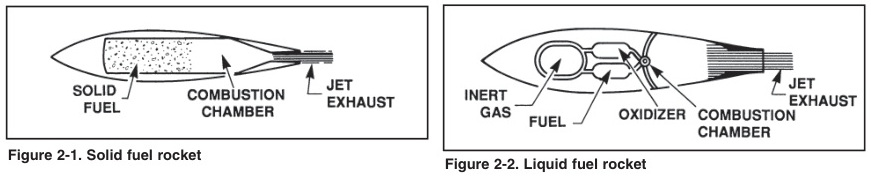 A rocket jet combusts an oxidizer and fuel. It carries both, in a solid or liquid form, instead of taking in air from the atmosphere.
A second type of potential energy is how fuel stores energy, ready to be released in a chemical reaction.
Rocket jets are an appropriate time to consider how much energy we get from jet fuel.
Remember that heat is traditionally rated in British Thermal Units (BTU). Jet fuel has a rating of about 18,500 BTUs per pound.
Burning 1 BTU of fuel each hour produces 0.000393 horsepower.
We put those numbers together to find that 1 pound of jet fuel theoretically has enough energy to provide about 7.27 horsepower for one hour (or 436 horsepower for one minute).
However, no engine has 100% efficiency. Jet engines tend to have 30% to 50% efficiency. In contrast, diesel engines have about 42% efficiency, and gasoline engines have only 20% to 30% efficiency.
Your Turn to Fiddle
A rocket that weighs 3,000 pounds has a jet that burns pounds of jet fuel during its one-minute takeoff. The engine has a 40% efficiency. Using 40% of the 436 horsepower over 1 minute per pound of fuel that was suggested above, this produces about ??? horsepower over that minute.
One horsepower is equivalent to 550 foot-pounds per minute (we have seen that 550 earlier!). So we can convert that minute of horsepower into ??? foot-pounds of energy.
About one-tenth of that energy will be lost to air resistance, leaving ??? foot-pounds of energy remaining.
If we consider all that remaining energy being converted into potential energy, we divide by the rocket's weight to find out that the rocket could ascend ??? feet straight up.
Alternatively, if we think of all that remaining energy as converted into kinetic energy, we find out the rocket attains a velocity of about ??? feet per second (about ??? miles per hour). This is only an estimate, for we are ignoring how air resistance actually changes with velocity.
Note that Earth's escape velocity is about 25,000 miles per hour. Even if all 3,000 pounds of our rocket's weight was jet fuel, the rocket is still doomed to return. Rockets that reach orbit are much larger! The rocket in this example might be a Tomahawk Missile, which carries about one-third of its weight as fuel.
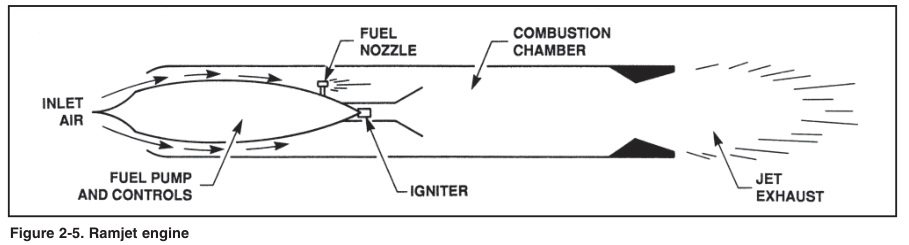 A ramjet combusts subsonic compressed atmospheric air and fuel.
The ramjet gets its name because it has a front air intake. For historic reasons involving how early aviators thought like sailors, the word ram is part of terms dealing with an aircraft impacting the air.
There is a still experimental version of the ramjet engine called a scramjet that combusts supersonic compressed atmospheric air and fuel.
A pulsejet is obsolete engine similar to a ramjet but inlet flapper valves are closed during combustion.
A gas turbine engine extracts energy from exhaust gases after combustion of subsonic compressed atmospheric air and fuel.
When discussing gas turbine engine, several terms have the word "ram" (as happened with the name of the ramjet engine).
Those together are called the ram effect: an aircraft's high forward speed forces air into an engine intake or cooling system with an increase in air pressure and density that can act as natural compression to improve engine efficiency and enhance cooling. Significant benefits starting around 150 miles per hour.
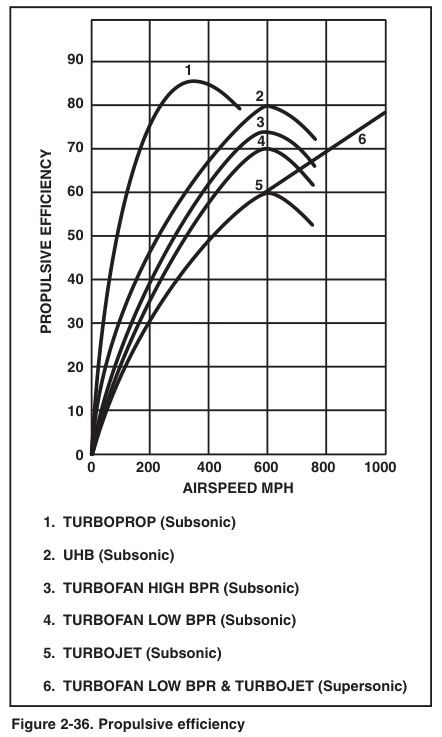 Our discussion of engine horsepower commented that no engine is 100% efficient, even when at rest. The ram effect means that gas turbine engines have gain in efficiency as they increase in velocity, up to a certain airspeed at which their efficiency beings to decrease.
When using gas a fuel, a new type of efficiency called thermal efficiency is used. It looks backwards, since hindsight vision is 20/20, and ponders "The fuel I burned had a value in horsepower. How much of that turned into useful engine work?"
Thermal efficiency is usually below 55%. A lot of our fuel's energy gets used creating waste heat (often 45% or more) and overcoming friction (can be 5% or more).
The formula for thermal efficiency is a simple ratio. But we will use an pinkish color for the last item to remind ourselves that it is a bit of a fairy tale.
thermal efficiency = engine output in horsepower ÷ fuel rating in horsepower
What makes that formula a fairy tale is that we never actually see fuel rated in horsepower. Someone could measure the energy stored as potential chemical energy in a certain large metal drum full of fuel. But the power resulting from burning that fuel would depend on how quickly it was burned. Remember that power = work ÷ time.
What actually happens is that someone gives us a fuel consumption rate (usually in pounds per hour) and the fuel's energy rated in British thermal units (BTU) per pound. Then we do a preparatory step to find the mythical fuel rating in horsepower.
fuel rating in horsepower = fuel rating in BTUs per pound × fuel consumption rate in pounds per hour × 13 ÷ 33,000
In that equation the 13 comes from 778 foot-pounds per BTU being divided by 60 minutes per hour. The 33,000 is again converting from foot-pounds per minute into horsepower.
We could smash those formulas together instead of doing two steps. But unless you have a wide screen the text will wrap around awkwardly. Notice that when we divide by a conglomerate that is three items multiplied together the equivalent smash is to dividing by each of those in sequence.
thermal efficiency = engine output in horsepower ÷ fuel rating in BTUs per pound ÷ fuel consumption rate in pounds per hour ÷ 13
Besides, the cruel person asking you to do this type of calculation will probably as for each step separately anyways.
We now have seen two kinds of efficiency:
Imagine that the fuel's energy goes along a path: first it has to combust and generate mechanical power, and second it has to use that mechanical power to create thrust.
Both types of efficiencies are percentages. When two percentages are combined, we multiply.
(If a birthday party ends with one-quarter of the cake as a leftover amount, and you eat one-half of that leftover amount for breakfast the next day, you eat ¼ × ½ = ⅛ of the original cake.)
This means an engine's overall efficiency is
overall efficiency = thermal efficiency × propulsive efficiency
As before, if any efficiency number provided in percentage format it can be divided by 100 to change it into decimal format for easier use in the formulas.
Next we look at the four types of gas turbine engines.
The turbojet is an obsolete sequence of intake, compressor, combustion chamber, turbine, and exhaust. It was the simplest to invent, but is loud and uses too much fuel.
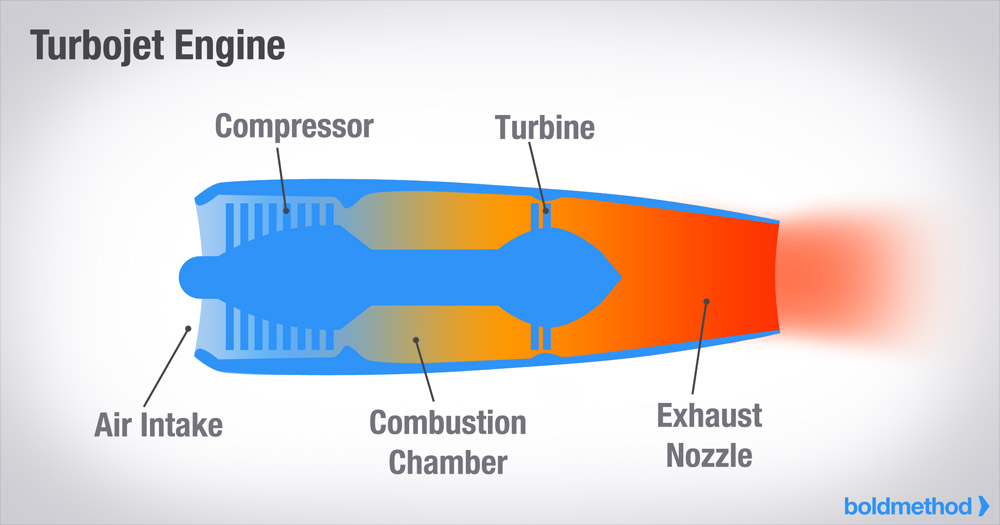
The diagram below is less colorful but does also include a turbojet's exhaust cone, which collects the exhaust gases discharged from the turbine and arranges them into a uniform wall of gases.
How much power does the combustion chamber generate?
horsepower = change in temperature × airflow in pounds per second × 186.72 ÷ 550
It takes 186.72 foot-pounds of energy required to raise a pound of air one degree Fahrenheit. The 550 is the conversion from horsepower to foot-pounds per second.
A more awkward version of this formula appears in some textbooks. For historic reasons, to use BTUs, it breaks apart the 186.72 into 0.24 × 778. Let's use a gray color for this formula to remind ourselves that it is so old-fashioned.
horsepower = change in temperature × 0.24 × airflow in pounds per second × 778 ÷ 550
In large engines the combustion chamber can generate over 100,000 horsepower. This drives the compressor, as well as creating forward thrust.
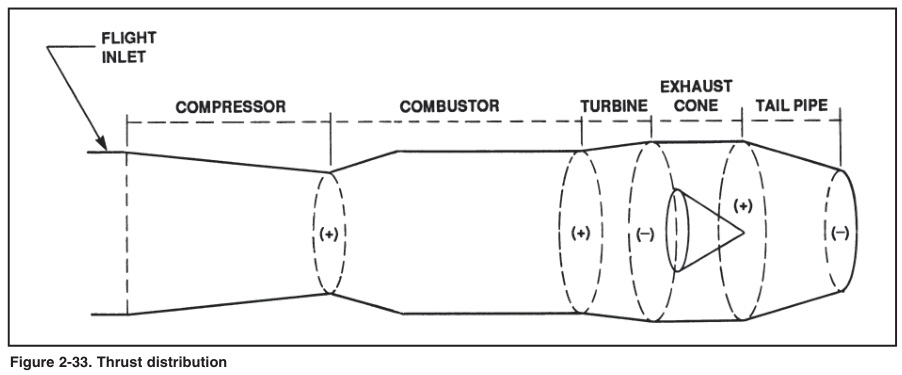
Now that we have seen the mechanical portions of a turbojet, please notice that not all of them create positive thrust.
In fact, some of them can create negative thrust when the engine is static!
The compressor, combustion chamber, and exhaust cone create positive thrust.
The turbine and exhaust nozzle create negative thrust.
Why? Recall the total thrust formula. Let's use a cyan color to show that we are reviewing an old equation.
total thrust = (weight × change in velocity ÷ time ÷ g) + (change in pressure × area)
A reasonable but naively incorrect approach would be to use this formula five times: once for each of the five mechanical portions of a turbojet engine. But this only considers the axial forces, and ignores how pressure forces act on the engine's walls, ducts, and blades.
Instead we must compare the formula at the boundary cross-sections between the portions of of an example engine, using the velocity and pressure at each boundary. At each boundary does the axial thrust increase or decrease, and by how much?
Boundary between Air Intake and Compressor
The engine is at rest, so there is no force on the air flow here.
Boundary between Compressor and Combustion Chamber
Our engine has an air flow of 30 pounds of air per 1 second. At this boundary the air velocity is 400 feet per second and the pressure is 55 psi. This cross-section has an area of 60 square inches.
force = (30 × 400 ÷ 1 ÷ g) + (55 × 60) = 3,673 pounds
All of that 3,673 pounds of force is new, positive thrust generated in the compressor.
Boundary between Combustion Chamber and Turbine
Our engine has an air flow of 30 pounds of air per 1 second. At this boundary the air velocity is 1,055 feet per second and the pressure is 53 psi. This cross-section has an area of 157 square inches.
force = (30 × 1,055 ÷ 1 ÷ g) + (53 × 157) = 9,304 pounds
This is an increase of 9,304 pounds − 3,673 pounds = 5,631 pounds of additional, positive thrust generated in the combustion chamber.
Boundary between Turbine and Exhaust Cone
Our engine has an air flow of 30 pounds of air per 1 second. At this boundary the air velocity is 605.7 feet per second and the pressure is 11 psi. This cross-section has an area of 170 square inches.
force = (30 × 605.7 ÷ 1 ÷ g) + (11 × 170) = 2,434 pounds
This is a decrease of 2,434 pounds − 9,304 pounds = − 6,870 pounds, creating negative, rearward force generated in the turbine.
Boundary between Exhaust Cone and Exhaust Nozzle
Our engine has an air flow of 30 pounds of air per 1 second. At this boundary the air velocity is 593.4 feet per second and the pressure is 12 psi. This cross-section has an area of 202 square inches.
force = (30 × 593.4 ÷ 1 ÷ g) + (12 × 202) = 2,977 pounds
This is an increase of 2,977 pounds − 2,434 pounds = 543 pounds of additional, positive thrust generated in the exhaust cone.
Boundary between Exhaust Nozzle and Ambient Air
Our engine has an air flow of 30 pounds of air per 1 second. At this final boundary the air velocity is 1,900 feet per second and the pressure is 5 psi. This cross-section has an area of 105 square inches.
force = (30 × 1,900 ÷ 1 ÷ g) + (5 × 10⁵) = 2,295 pounds
This is a decrease of 2,295 pounds − 2,977 pounds = − 682 pounds, creating negative, rearward force generated in the exhaust nozzle.
Overall
What is our overall sum of these thrust values?
3,673 + 5,631 − 6,870 + 543 − 682 = 2,295 pounds of overall forward thrust
In general, positive thrust happens when pressure pushes against diverging surfaces (like the diffuser or the compressor) and negative thrust happens when pressure pushes against converging surfaces (like a tapering exhaust nozzle). However, the details are more complicated because pressure also pushes against other parts of the engine, such as the turbine blades.
The turboprop improves the turbojet's efficiency by adding a forward propeller that the turbojet spins with a shaft and gearbox.
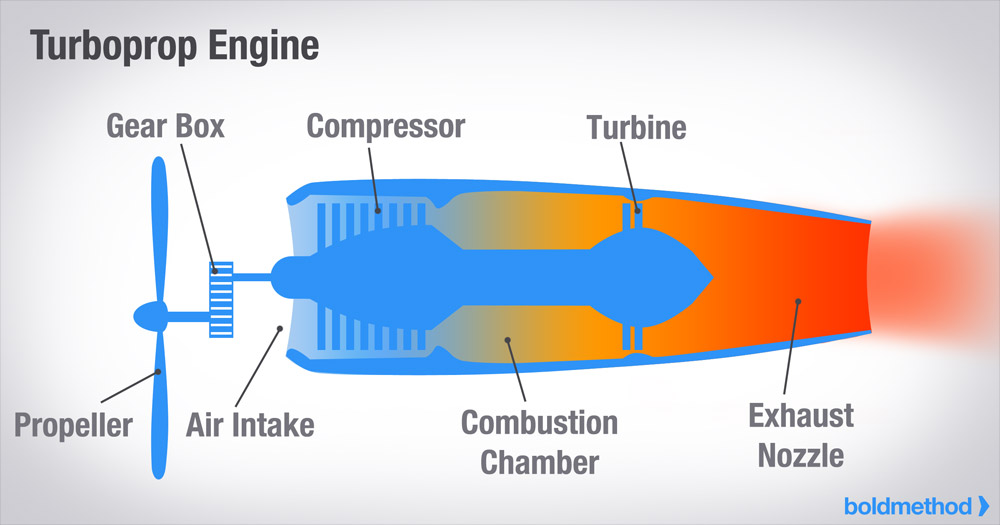
When looking turboprop engine forces we often do not separate total thrust into reactive thrust and pressure thrust. Instead we divide total thrust differently.
Most of the engine's power goes to the propeller, and only a small part of the reactive thrust comes from the rearward momentum of exhaust gasses. So we might instead focus on the shaft horsepower to the propeller as one item, and the combined jet thrust from the exhaust gasses (that small part of reactive thrust from exhaust gas momentum, combined with the pressure thrust) as a second item.
However, we do not want to be think about a horsepower amount for the shaft and a pounds amount for the exhaust. So let's look above for the rearranged formula that changed horsepower into force. We will use a cyan color to show that it is review.
force = horsepower × 375 × percent efficiency ÷ speed in miles per hour
We normally use the an efficiency of 80% when finding the horsepower of a propeller. So the equation becomes
propeller force = shaft horsepower × 375 × 0.80 ÷ speed in miles per hour
Now we have a propeller force we can add to the exhaust thrust.
Next notice how a turboprop engine has two airflows. The air that flows through the propeller but does not enter the intake will produce thrust. The that flows through the propeller into the intake will move through the turbojet portion of the engine and also produce thrust, but as we just saw most of its energy will have been diverted to the shaft.
When a turboprop engine is at rest, assume the jet thrust created by its exhaust is only 40% effective. This assumption allows us to talk about the two airflows as if they were summarized as an static equivalent shaft horsepower.
static equivalent shaft horsepower = shaft horsepower + (jet thrust in pounds × 0.40)
Once again the math rules for "order of operations" do not require the parenthesis, but we include them to help our eyes to help us remember the propeller and jet are two parts working together.
When a turboprop engine is moving, can no longer assume the jet thrust created by its exhaust is only 40% effective. We need to do more math to find the in-flight equivalent shaft horsepower.
in-flight equivalent shaft horsepower = shaft horsepower + (jet thrust in pounds × speed in miles per hour ÷ percent efficiency ÷ 375)
Apologies if that formula wraps at the edge of the screen onto a second line. Hopefully you can see what each of the terms is about.
Once again the math rules for "order of operations" do not require the parenthesis, but we include them to help our eyes to help us remember the propeller and jet are two parts working together.
The turbofan adds a fan in front of a turbojet "core", and places both in another tube so the space around the core is bypass flow (link).
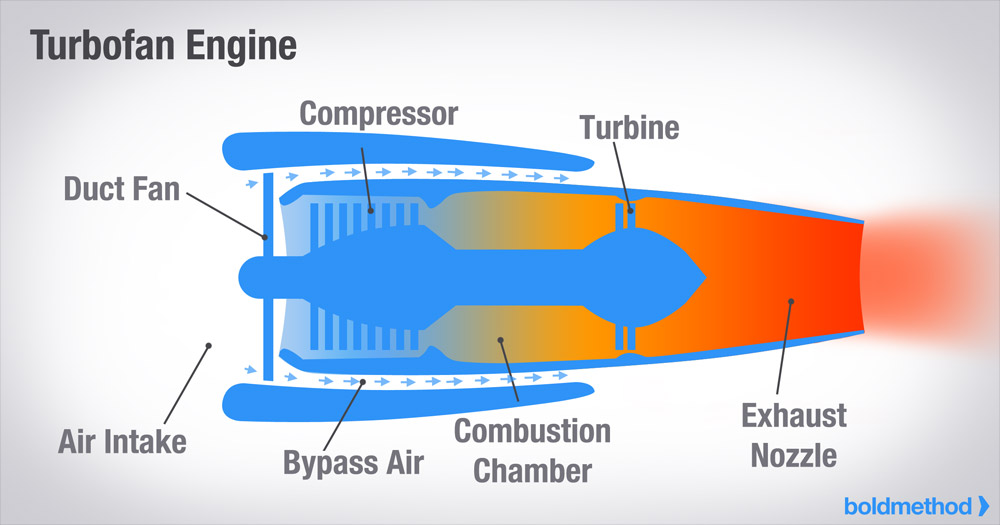
The airflows through the bypass and core produce thrust separately.
This means we modify the thrust formula to have two terms about creating force from acceleration.
thrust = (core weight × core change in velocity ÷ time ÷ g) + (bypass weight × bypass change in velocity ÷ time ÷ g) + (change in pressure × area)
Apologies if that formula wraps at the edge of the screen onto a second line. Hopefully you can see what each of the three terms is about.
For helicopters, the turboshaft is like we moved the turboprop's propeller behind the turbojet and tweaked it so most of the power goes to the shaft instead of the exhaust. It also has an entire transmission between the turbojet and propeller, not merely a gearbox.
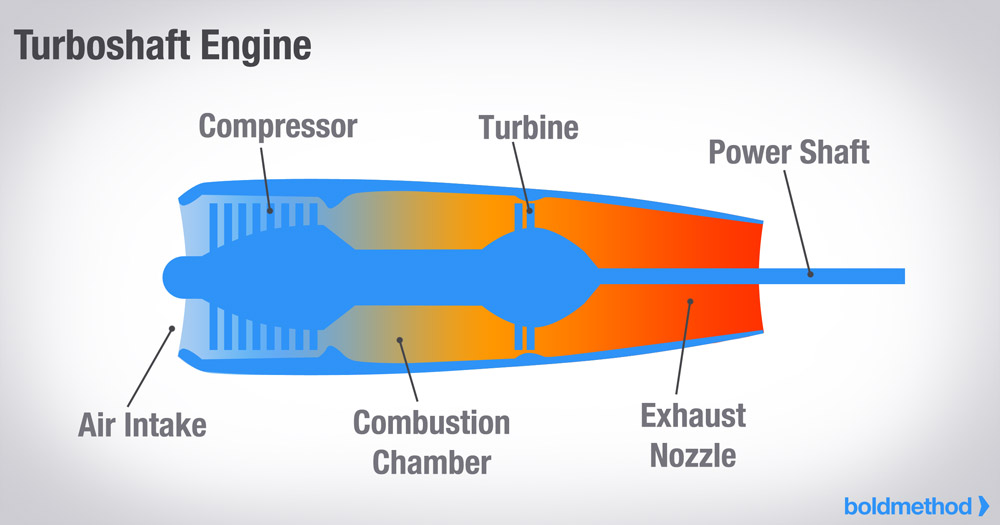
The same formula we used for the propeller force of a turboprop engine also applies to a turboshaft engine.
propeller force = shaft horsepower × 375 × 0.80 ÷ speed in miles per hour