 Factfulness by Hans Rosling and his family is currently one of the most important books in the world.
| The High Five | • | Other Books | • | Videos | • | E-Books | • | Podcasts | • | Apps | • | OERs |
There are no problems, just pauses between ideas.
- David Morrell
What does it mean to be math literate?
Someone who is computer literate has not memorized every detail of the software programs they use, but knows how to find those details when they need to do something new.
Someone who is economically literate is not completely fluent with every financial theory, but knows the basics of the important financial theories and how to read about finance when he or she wants to learn more.
Someone who is math literate similarly needs to know about certain foundational ideas and where to find sources to learn more.
Much of traditional upper division college mathematics is trapped in the past. Its content was established after World War II, when the topics of math literacy were chosen because electrical engineering and rocketry were the exciting and promising careers for that generation that appeared to show a new direction for math in society. Those jobs involve trigonometry, calculus, and imaginary numbers. So those topics dominate traditional upper division mathematics.
Today math literacy needs different topics. The five most important for our generation are:
Fortunately, for each of these five topics an exemplary book stands high above the crowd.
Factfulness by Hans Rosling and his family is currently one of the most important books in the world.
First, a bit of history. Hans Rosling presented two TED talks in 2010 about global population growth and global demographics. In 2014 he returned and presented about how most people are incredibly ignorant about what the world is really like and how it is changing, especially about population growth. He founded a website named GapMinder to work on correcting misconceptions based on outdated stereotypes..
The book Factfulness is his inspiring and enlightening finale. It has two parts.
First, it talks about many examples of how people and the planet are doing much better than most people realize. It uses charts and statistics but is quick to read and not burdened down by the math.
 Second, and most relevant to our class, is the book's discussions about why most people are ignorant about those issues. There are Ten Rules of Thumb about how our brains naturally latch onto dramatic information instead of accurate information. Thus Factfulness is also guidebook for learning to use math to see the world more clearly, with better habits.
The first chapter of Factfulness is available freely online, from Bill Gates or this website.
 Algorithms to Live By: The Computer Science of Human Decisions by Brian Christian and Tom Griffiths is a book about happiness through already solved problems.
The study of Computer Science has expanded far from its orginial scope of electronic calculations and simple computations. It now studies general issues about how to solve problems when you do not know all the information, when information is fuzzy, when there is random chance involved, or when new options appear as the problem develops.
Those are real-life issues too. In many fascinating ways computer scientists have mathematically solved all sorts of common problems. The answers they found can apply to the real-life issues everyone faces. The book shares these issues and answers in a very readable way, and might help reduce your stress when you recognize already answered solutions to common everyday situations.
 Freakonomics (Revised and Expanded Edition) by Steven D. Levitt and Stephen J. Dubner has become the classic introduction to behavioral economics.
The phrase "behavioral economics" was invented because of two trends. It is a response to classical economics, which ignores how most shopping behavior is based upon loyalty to a store, brand, or habit instead of a fully-reasearched pursuit of the best deal. It also extends economics by looking at non-economic behaviors using classical ways to measure and discuss incentives, options risks, and equilibria.
Freakonomics is fun to read, and also helpful for learning to use math to see the world more clearly.
The authors host a main podcast and a question of the day podcast to continue sharing their favorite examples of behavioral economics.
 A Random Walk Down Wall Street (12th Edition) by Burton G. Malkiel has become the classic introduction to investing.
Although most students in a community college math class are not themselves doing much investing, a lot of them do talk with parents or grandparents about investing—or they know they should be having those conversations but do not yet feel ready.
This book explains why anyone can invest as well as the experts. It explains how to think about risk. It describes how your age, income, and personality should affect your investing strategy.
 The Character of Physical Law by Richard P. Feynman is a book about why mathematics is the language of nature, and how this turns into science.
This book is the transcription of a set of lectures, whose video is here for people who prefer watching and listening over reading a book.
 The best math book to sound smart at parties (and feel smart all the time) is Aha! Insight.
The author, Martin Gardener, was a magician and puzzle connoisseur. This book contains his favorite puzzles from when he wrote the "Mathematical Games" column in Scientific American for twenty-five years. There are logic puzzles, number puzzles, language puzzles, and more.
The illustrations are adorable. The puzzles and their explanations are elegant. Someone you know will love this book—probably you!
 The best introduction to statistics that I know of is Naked Statistics by Charles Wheelan. This book calls itself a textbook but is easy to read.
Our class does a lot with the most foundational and basic statistics. The books above about behavioral economics do a little more with basic statistics.
But statistics can be interesting, helpful, and even awesome in its own right. It is not only a nice part of math because of our class topics and behavioral economics. This book shares how statistics can generally be useful and fun, and part of learning to use math to see the world more clearly.
Most statistics textbooks have a lot of math. There is a tradititonal set of stuff they teach, which involves many formulas, some of which are tricky. This is not that kind of book. The author purposefully avoids formulas to focus on the intuition that is developed by people who study statistics.
 Mathematician's Delight by W. W. Sawyer is the only math textbook in our classroom library. It was written in 1943.
This book describes all sorts of mathematical concepts, from the definition of a rectangle to imaginary numbers, with an unusually welcoming approach.
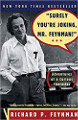 "Surely You're Joking, Mr. Feynman!": Adventures of a Curious Character by Richard P. Feynman is a book about happiness through problem solving.
Many our classroom library books are "business books" of one kind or another. This book is not. It is purely about using math to see the world more clearly.
Richard Feynman was not the smartest mathematician or physicist at Los Alamos. But he was the most fun. His stories share his approach to life. He balanced practical jokes with gentle kindness, faking it to get ahead with up-front honesty, and most importantly focusing on problems as something fun to analyze and scrutinize whether or not getting a final answer was important or even possible.
Feynman approached personal decisions with behavorial economics, and he did it decades before that topic had been formally invented. No other math book has such fun stories about moving ants, cracking top-secret safes, or picking up women at bars.
 Sanjay Sarma is a leader in open education. In Grasp he writes about all levels of learning: neurological, cognitive, pedagogical, social, and historical.
This book explains what makes learning effective. It explains why certain kinds of math classes do not work for many students.
This is an important book for current and future teachers to read, no matter the age of your students.
 One of the most popular books about economics is Moneyball by Michael Lewis.
This book will be an obvious choice if you love sports. But it is not a book about playing a sport. It is about the business of owning and managing a sports team
With just the right amount of math it tells the story of when conventional wisdom was wrong, and using math to see the world more clearly not only turbocharged the Oakland A's but revolutionized that industry.
 Priced to Influence, Sell & Satisfy by Utpal Dholakia is a great introduction to pricing issues.
A specific kind of behavioral economics is how to pick prices for retail or menu items. Everyone has heard about how a price of $4.99 appears to be a better deal than $5 despite a mere one cent difference. There are actually dozens of behavior issues about pricing. This book is very readable as an introduction to the topic. It remains clear, yet goes into many issues quite deeply.
During class we will learn the basics of markup, discount, and menu pricing. This book goes much further. It might also be more fun.
 The Complete Idiot's Guide to Game Theory by Edward C. Rosenthal is the best introduction to its topic.
A deeper layer of behavioral economics is considering how your competitors are doing business. Not only will good decisions about pricing depend on your customers, they also depend on your competition.
The study of competitive decision-making is called game theory. Finding an easy to read book about game theory can be tricky. Most dive into complicated math right away. Yet this book is great. It teaches enough to be of practical help in business decisions, without burdensome math. Every topic is accessible, even if you skip certain extra-complicated parts at the end of a few chapters.
This book is not as fun to read as the books above, but might make a big difference in how profitably you run a business.
 Markup & Profit: A Contractor's Guide, Revisited by Michael C. Stone is a specialized introduction to pricing for contractors.
A contractor's bid is like a small business plan. All pricing must consider materials and labor. But for contractors these can quickly get complicated in ways specific to the trade.
This book has a very specific target audience. If you are part of that specific target audience, doing a book report with this book might be your most valued part of the class.
 How to Read a Paper: The Basics of Evidence-based Medicine and Healthcare by Trisha Greenhalgh is a specialized book useful for nursing students.
Sometimes using math to see the world more clearly involves many specialized issues. This book goes deeply into which issues apply to reading medical papers. It is the most advanced textbook in our classroom library. Yet it could be worth the more difficult read by helping jump-start a nursing career.
It is is another book with a very specific target audience.
 A Billion Wicked Thoughts by Ogi Ogas and Sai Gaddam is the world's most salacious book about data mining.
In 2010 two researchers decided that all academic research about human sexual behavior was stupid. It all depended upon surveys, and everyone knows that people lie like crazy on surveys, especially when talking about sex.
If someone wanted actual information about human sexual behavior they would need to look where people were honest. So Ogi Ogas and Sai Gaddam looked at anonymous data from internet searches (on search engines, dating websites, and porn websites). This vast amount of data is the "billion wicked thoughts". Then they did it again looking at sexy romance novels. What would their data analysis tools tell them about that type of titillation?
Unfortunately, in an effort to make their book as readable as possible, they spend very little time talking about the actual data mining. How did they dig through that immense amount of data to get their charts and rates? How did they deal with signal-to-noise? Which of the issues they discuss are most appropriate for data mined answers? Which questions have they answered definitively, and which are a stretch to try to answer using data mining?
So for this topic we need two books. Sifting through data is an important topic. How to use data about sales can help a person run any small business.
 The best companion book I know of is Data Smart by John W. Foreman. This book is a guidebook. Each chapter leads the reader step-by-step through a spreadsheet. It really demonstrates how small business data can be used to answer useful questions.
I hesitate to recommend this pair of books. I worry that A Billion Wicked Thoughts is long and full of numbers without enough actual math, and will waste time being entertaining and distracting. I worry that Data Smart will take many more hours to get through than a book you only have to read. However, a student who has a lot of time might have a lot of fun and learn great lessons about how to run a business from these books. But please heed my warning that one of these books is barely a math book, and the other is actually a small math course.
 |
The website Khan Academy is the most famous website for math videos. |
 |
The website Hawkes Learning also has nice math videos. |
 |
The website Learners TV also has nice math videos. |
 |
YouTube has some great playlists or channels for math videos. Below is a list of student favorites. |
Place Value (Math Antics)
Math with Mr. J has a playlist with 45 videos.
Mathispower4u has a playlist with 16 videos.
Khan Academy has a playlist with 6 videos.
Rounding (Math Antics)
Step by Step Rounding (Math with Mr. J)
Rounding Numbers and Rounding Decimals - The Easy Way! (The Organic Chemistry Tutor)
BittingerBasicMath has three video example problems: one, two, three
Mathispower4u has a playlist with 10 videos.
Khan Academy has a playlist with 11 videos.
Multi-Digit Addition (Math Antics)
Addition (The Organic Chemistry Tutor)
Math with Mr. J has a playlist with 17 videos.
Multi-Digit Subtraction (Math Antics)
Subtraction (The Organic Chemistry Tutor)
Math with Mr. J has a playlist with 17 videos.
Mathispower4u has a playlist with 15 videos.
Khan Academy has a playlist with 19 videos.
The Organic Chemistry Tutor has three videos: one, two, three
Your teacher made a video with three methods for multiplication, and another with three methods for division.
MooMoo Math has two videos with other methods for division: the line method and the box method
Math Antics has a playlist with 11 videos
Math with Mr. J has playlists for multiplication (5 videos), divisibility rules (12 videos), and division (5 videos). (He also has two much longer playlists for multiplication and division, if you like his style and want more.)
Mathispower4u has a playlist with 20 videos.
Khan Academy has playlist with 42 videos.
MooMoo Math has four nice videos introducing fractions.
Mathispower4u has a video introducing fractions.
Math Antics has a good starting playlist with 8 videos, of which the first 4 are especially helpful.
Khan Academy also has a good starting playlist with 15 videos, but it unfortunately shuffled the topics of making and comparing fractions. First watch videos 12, then 2, then 10, then 6.
Math with Mr. J has six nice videos. Two are about putting and rounding fractions on a number line. One is about word problems in which we create fractions using division. Three are about jargon, such as proper, improper, and other words.
The Organic Chemistry Tutor has a playlist with 43 videos, but the nice ones are too advanced.
Math with Mr. J and Khan Academy both have videos about the differences between variables, expressions, and equations.
As examples of using formulas, Math with Mr. J has two videos about switching between Fahrenheit and Celsius for measuring temperature.
Math Antics has two nice videos introducing decimals, and a playlist with 6 videos about percentages.
MooMoo Math has a playlist with 8 videos about reading decimals, and two playlists with 11 and 6 videos about sorting decimals and fractions. (Strangely, they do not seem to have any introductory percentage videos.)
Mathispower4u has a playlist with 36 videos, and then he put moving from fractions to decimals in its own playlist with 8 videos.
Khan Academy also has a playlist with 15 videos about decimals, and a playlist with 29 videos that has some good videos about percentages.
Math with Mr. J has a playlist with 14 videos about percentages. Unfortunately, his playlist about decimals is an enormous, unsorted, and unwieldy mess of 75 videos. So here direct links to videos about decimal grids, decimal words, rounding decimals, comparing decimals, sorting, fraction→decimals, decimals→fractions, decimals→percents, and percents→decimals.
Math Antics has a video about mean/median, a video about probability, and a playlist of 4 videos about measurement.
Math with Mr. J has a playlist with six videos that is monstly about mean/median.
MooMoo Math has videos about frequency, mean/median, and probability with dice and trees.
Mathispower4u has an enormous playlist for probability but it is well sorted so you can start at the top and go until you feel done. His playlist about data is not nicely sorted, but two highlights are about frequency tables and mean/median
Khan Academy has another unsorted playlist about data. Highlights include videos about frequency and mean/median. It has a nice video about probability with dice.
Math Antics has two playlists, each with six videos.
Math with Mr. J has a video about complementary/supplementary angles, then a very long playlist with enough good stuff that it's worth scrolling to our topics and skipping everything else.
MooMoo Math has a videos about types of angles and complementary/supplementary angles, nice videos about the area of a triangle or trapezoid or circle, and a video about a two-part area subtraction puzzle.
Mathispower4u also has a videos about types of angles and complementary/supplementary angles, perimeter and circumference, and three nice videos about area.
Khan Academy has two playlists about geometry, basic and advanced. The advanced playlist has interesting history and a wider variety of easy topics (it's not just harder stuff).
Math with Mr. J and Khan Academy both have videos about the differences between variables, expressions, and equations.
Math with Mr. J also has long playlists about order of operations, evaluating expressions, terms, and solving one-step equations.
MathAntics has a playlist of 4 videos that introduce algebra.
The Organic Chemistry Tutor has videos about order of operations, evaluating expressions, combining like terms, solving one-step equations, and inequalities.
MooMoo Math has videos about evaluating expressions, combining like terms, solving one-step equations, an introduction to inequalities, inequalities on the number line, compound inequalities, and solving inequalities.
Mathispower4u has long and slightly disorganized playlists that can be a bit overwhelming. But his explanations are high-quality. If you want to explore his videos, for this math topic then check out these four playlists: one, two, three, four.
All of Khan Academy's introductary algebra videos are here.
As other examples of using formulas, Math with Mr. J has two videos about switching between Fahrenheit and Celsius for measuring temperature.
Math with Mr. J. has a basic playlist about coordinate pairs.
MathAntics has a nice playlist about graphing.
The Organic Chemistry Tutor has a nice playlist about linear equations and slope.
Mathispower4u has a lot of relevant playlists, some very short and some longer:
MooMoo Math has an unsorted playlist about graphing, and another unsorted playlist specifically about graphing speed and acceleration. These might be helpful, but keep alert that the videos are not in order.
Khan Academy has a confusing playlist about graphing.
Sadly, this topic marks our departure from Math Antics and from Math with Mr. J. They are great YouTubers but they have not created videos for any other Math E content.
Mathispower4u has precisely the playlists we are looking for: solving systems of equations with graphing, substitution, elimination, and also the relevant application problems.
The Organic Chemistry Tutor has a few good videos for solving systems of equations with graphing, substitution (with a focus on avoiding creating fractions), elimination. He also has two reviews of both substitution and elimination, one general and one focusing on fraction and decimal coefficients. He also has a useful video named One Solution, No Solution, or Infinitely Many Solutions.
MooMoo Math has two playlists, but these are a bit disorganized.
Khan Academpy has a nice short playlist and a crazy big playlist.
The Organic Chemistry Tutor has polynomial videos about vocabulary jargon, addition/subtraction, and the FOIL method of multiplication.
Mathispower4u has a video about vocabulary jargon, playlists about polynomial addition/subtraction and multiplication, and a video about the kind of division we do.
MooMoo Math has a mess of videos about polynomials that really need a cleaner playlist. These include simplifying, combining like terms, adding/subtracting, multiplying binomials (including the special cases of squaring a binomial, the FOIL method, and the difference of two squares), multiplying bigger polynomials, and the kind of division we do.
Khan Academy has a ton of videos about polynomials. There are some about jargon, simplifying (1, 2), adding (1, 2), subtracting (1, 2, 3), both adding and subtracting (1, 2, 3, 4), multiplying (1, 2, 3), multiplying with the area model or the FOIL method (1, 2), difference of squares, and the kind of division we do.
The Organic Chemistry Tutor has several videos about factoring trinomials (1, 2, 3, 4, 5, 6) and a video about the Zero Product Property.
Mathispower4u has a nice factoring trinomials playlist and a video about the Zero Product Property.
MooMoo Math has videos about extracting the GCF, factoring when the lead coefficient is 1, and also three more factoring videos.
Khan Academy has three videos about extracting the GCF, two videos about when the lead coefficient is 1, and then four more videos.
The Organic Chemistry Tutor has videos about simplifying, multiplying, and dividing rational expressions. Then videos about adding and subtracting with like or unlike denominators. Thenctwo videos about solving equations that include rational expressions. Finally, two videos do an overview.
Mathispower4u has a rational expression playlist but be warned that its videos have no sensible order.
MooMoo Math politely makes different videos about simplifying rational expressions with positive versus negative exponents. It has one video about both multiplying and dividing. It has separate videos for adding and subtracting with like or unlike denominators. It has two videos about solving equations that include rational expressions. Finally, two videos do an overview.
Khan Academy has a long rational expression playlist but be warned that its videos have no sensible order.
Some of our old friends are back for these topics!
MathAntics has one video about scientific notation.
MooMooMath has two videos that introduce scientific notation, and as an advanced topic nine videos about arithmetic with scientific notation (1, 2, 3, 4, 5, 6, 7, 8, 9).
Mathispower4u has an enitre playlist about scientific notation.
The Organic Chemistry Tutor has two videos that introduce scientific notation, and as an advanced topic four videos about arithmetic with scientific notation.
Khan Academy has a sadly unsorted playlist named "exponents, radicals, and scientific notation".
Math with Mr. J. has videos about what a square root is, simplifying the square roots of perfect squares and other numbers, and an overview.
MathAntics has a video about what is a square root, and about simplifying square roots of numbers.
MooMooMath has a video introducing square roots, four videos about simplifying square roots, videos about doing arithmetic with square roots with expressions that lack variables and square roots that have variables, and two videos about using square roots to solve quadratic equations.
Mathispower4u has videos introducing square roots, about square roots of perfect squares, other numbers, and expressions, two videos about simplifying square roots that contain fractions, two more videos about doing arithmetic with square roots, and finally an entire playlist about using square roots to solve quadratic equations.
The Organic Chemistry Tutor has a video about simplifying square roots with only contain numbers, and two videos about simplfying square roots that also contain variables. He has three videos about doing arithmetic with square roots, and one video about a trick named rationalizing the denominator. Finally, he has five videos about using square roots to solve quadratic equations.
Khan Academy has two videos that introduce square roots, three videos about simplifying square roots that contain numbers, a single video about simplifying square roots that contain variables, a video about arithmetic with square roots, a video about rationalizing the denominator, and four videos about using square roots to solve quadratic equations.
MooMooMath has videos about using the Quadratic Formula to solve an equation, and to do word problems.
The Organic Chemistry Tutor has three videos.
Khan Academy has two introductory videos and then a nice set of five example problems.
Mathispower4u has a playlist with videos about many special cases.
MooMooMath has a video about graphing parabolas.
The Organic Chemistry Tutor has a video about graphing parabolas and a uniquely important video about min/max word problems.
Khan Academy outdoes itself for this topic. It starts with a visual introduction to parabolas, does two examples of graphing with table of values, one example of graphing in factored form, and then three more examples of graphing using the roots and vertex. Then it has a uniquely important video aboutshifting and scaling parabolas.
Mathispower4u has an enormously complex playlist. You can ignore all his use of advanced terms (directrix, focus, latus rectum) and avoid the videos made more recently whose thumbnails show his face.
LCC students can use their LCC e-mail and L# to log into the State Library of Oregon's downloadable math e-books.
There are some interesting titles, such as Practical Math Success in 20 Minutes a Day and Express Review Guides: Math Word Problems, that try to be interesting and efficient as they explain math fundamentals with their own voice.
That website has many other math resources. Look under three different "centers" at the upper menu. The centers named School Center, College Students, and Adult Core Skills all have different math resources appropriate to our topics.
 |
As mentioned above, the authors of Freakonomics host a main podcast and a question of the day podcast to continue sharing their favorite examples of behavioral economics. |
 |
The Skeptoid podcast examines popular myths, using just enough math and history to clear up confusions. |
 |
The Breaking Math podcast highlights interesting math news and applications without getting too deep into the math. |
 |
The podcast This Week in Virology is timely and full of math. |
 |
The podcast Brains On! does not always use math, but has some nicely mathy episodes. |
 |
The popular Netflix show Adam Ruins Everything has a few old podcast episodes that involve math. |
 |
The Adam who ruins everything has a second podcast named Factually! that so far involves little math, but might still be appropriate for our assignments. |
 |
A group of teachers reflect in the podcast Math Before Breakfast. |
 |
For seven years Jason Marshall had a fun podcast named Quick and Dirty Tips with short episodes (most only 7-8 minutes) about math tricks and techniques. |
 |
The Math Ed Podcast interviews researchers in mathematics education. |
 |
Bedtime Math for fun challenges ranging from trivial to tricky |
 |
Socratic for general help with math (or many subjects) but not solving specific problems |
 |
Photomath for arithmetic and algebra steps |
 |
Microsoft Math for arithmetic and algebra steps |
 |
Mathway for paid help with pre-algebra |
Many textbooks are Open Educational Resources, which means that anyone can use them. They can be printed inexpensively, or used for free online. Some grant permission for instructors to modify them to best fit their classes.
Below are links to three OER textbooks that teach similar math topics to our first three topics. Seeing the same concepts explained in different ways can be very helpful!
 Prealgebra Textbook by College of the Redwoods is a pretty standard textbook. It has a consistent attitude of "here is a technique" rather than exploring concepts. The homework has answers for odd numbered problems. The first three chapters are a bit heavy on the "new math" of the 1960s rather than explaining with diagrams or arrays. Each chapter is a PDF file with a convenient table of contents on the third page.
 Prealgebra by Santa Ana College uses the nice CNX OpenStax website. It is a the friendliest of these OER textbooks, with very elaborate inclusion of Math 10 concepts. It has a good use of warm-up problems for each section. It helpfully explains the "language of algebra" before it discusses more advanced ideas such as simplifying terms. Note that the proportion topic (6.5) is hidden at the end of Percents chapter. Beware the awkward numbering of example and try-it problems.
 Arithmetic for College Students by the Monterey Institute for Technology and Education is decent, and also has a very elaborate inclusion of Math 10 concepts. Unfortunately, it is formatted as one huge PDF file and its table of contents lacks links. Neither example problems nor self-check problems are numbered well. This book likes to use parenthesis to show multiplication, as well as a grouping structure. Beware how it models the bad habit of neglecting to label with words the rates in proportions. Unfortunately, it uses the equal sign 905 times to mean "the next step in a process" before finally showing an equation as an equation.
Note that the § symbol means "section".
After opening the link, you might need to use CTRL-F to search for the section number. That will let you jump to the right place.
If searching with CTRL-F for the section number is not working well, try adding a space afterwards. That sometimes jumps to a section, rather than an example problem that happens to include a similar decimal value.
| Rounding | College of the Redwoods | Santa Ana | OpenText |
|---|---|---|---|
| Decimal Accuracy | Place Value in §1.1
Place Value with Decimals in §5.1 Rounding Basics in §1.1 Rounding with Decimals in §5.1 |
Place Value in §1.1
Rounding in §1.1 |
Place Value in §1.1.2
Ordering Decimals in §3.2.1 Rounding in §1.1.2 Rounding Decimals in §3.2.1 |
| Estimating | nothing for estimating | nothing for estimating | nothing for estimating |
| Fraction Format | College of the Redwoods | Santa Ana | OpenText |
| Thinking About Division | Division of whole numbers in §1.1 | nothing for thinking about division | Models of multiplication in §1.3.1
Representing division in §1.4 |
| Divisibility and Factors | Factors, Divisibility in §1.4 | Finding Factors in §2.4 | Tests of divisibility in §2.2.1 |
| Desired Denominators | Equivalent Fractions in §4.1 | Ladder Factorization in §2.5
Reducing Fractions in §4.2 |
Reducing Fractions in §2.2.2
Comparing Fractions in §2.2.3 |
| Fractions and Decimals | Decimals to Fractions in §5.1 | Decimal to Fraction Format in §5.1
Fractions to Decimal Format in §5.3 |
Decimals and Fractions in §3.1.1 |
| Ratios and Rates | Introduction to Ratios and Rates in §6.1 | Ratios and Rate in §5.6 | Ratios and Rate in §4.1 |
| Percent Format | College of the Redwoods | Santa Ana | OpenText |
| Decimal Point Scoots | Decimal Scoots in §5.3 (awkward)
Decimal Scoots in §6.4 (much better) |
Decimal Scoots for Powers of 10 in §5.2
Decimal Scoots for Powers of One-Tenth in §7.5 |
Decimal Scoots on Whole Numbers in §1.3.1
Decimal Scoots on Whole Numbers in §1.4 Decimal Scoots on Decimals in §3.3.1 Decimal Scoots on Decimals in §3.3.2 |
| Four Replacements for % | Percent in §7.1 | Understand Percent in §6.1 | The Meaning of Percent in §3.4.1 |
| Percents, Decimals, and Fractions | Decimals, Percents, and Fractions in §7.1 | The RIP LOP Pattern in §6.1
Decimals, Fractions, and Percents in §6.1 |
Convert Percents, Decimals, and Fractions in §3.4.1 |
| Measurement | College of the Redwoods | Santa Ana | OpenText |
| Units and Their History | nothing for measurement unit history | nothing for measurement unit history | nothing for measurement unit history |
| One Step Conversions | Unit Conversion: American System in §6.3 | Systems of Measurement in §7.5 | U. S. Measurement in §4.4 |
| More about SI Prefixes | Unit Conversion: Metric System in §6.4 | included above | Metric Measurement in §4.5 |
| Exponents and Square Roots | Exponents in §1.4
Square Roots in §5.7 |
Exponents in §2.1
Square Roots in §5.7 |
Exponents and Square Roots in §1.5.1 |
| Fractions | College of the Redwoods | Santa Ana | OpenText |
|---|---|---|---|
| Fraction × and ÷ | Expressions Defined in §3.1
Evaluating an Expression in §3.2 Multiplying Fractions in §4.2 Dividing Fractions in §4.3 Multiplying and Dividing Mixed Fractions in §4.5 |
Expressions vs. Equations in §2.1
Multiplying and Dividing Fractions in §4.2 |
Multiplying Fractions in §2.3
Dividing Fractions in §2.4 |
| Fraction + and − | Equivalent Fractions in §4.1
Fraction Addition in §4.4 Fraction Addition in §5.5 |
Visualizing Fractions in §4.1
+ and − with Common Denominators in §4.4 + and − with Different Denominators in §4.5 |
+ and − with
Like Denominators in §2.5
+ and − with Unlike Denominators in §2.6 |
| Mixed Number Subtraction | Adding and Subtracting Mixed Fractions in §4.6 | Add and Subtract Mixed Numbers in §4.6 | + and − with
Like Denominators in §2.5
+ and − with Unlike Denominators in §2.6 |
| Order and Terms | Addition and Subtraction in §1.2
Multiplication and Division in §1.3 Order of Operations in §1.5 Order of Operations with Fractions in §4.7 |
PEMDAS explained carefully in §2.1 | Order of Operations in §1.5.2 |
| Goeswith Chains | nothing for connecting rates together | nothing for connecting rates together | nothing for connecting rates together |
| Percentages | College of the Redwoods | Santa Ana | OpenText |
| Percent Of | Find a Given Percent of a Given Number in §7.2 | Solve General Applications of Percent in §6.2 | Finding a Percent of a Whole in §3.4.2 |
| Percent Change | Find a Percent Given Two Numbers in §7.2 | General Applications of Percent in §6.2 | Solving Percent Problems in §3.5 |
| The One Plus Trick | Balance Formula Using Simple Interest in §7.5 | nothing for one plus trick | nothing for one plus trick |
| Simple Interest | Interest in §7.5 | Simple Interest Applications in §6.4 | Solving Percent Applications in §3.6.1 |
| Measurement | College of the Redwoods | Santa Ana | OpenText |
| Unit Analysis | Unit Conversion: American System in §6.3 | Systems of Measurement in §7.5 | U.S. Measurement — Length in §4.4.1
U.S. Measurement — Weight in §4.4.2 |
| Polygon Perimeter and Area | Area of Rectangle in §1.3
Area of Parallelogram and Triangle in §4.2 Area of Trapezoid in §4.7 |
Perimeter in §1.2
Area of Rectangle in §1.4 Perimeter and Area in §9.4 |
Perimeter in §1.2.1 and §1.7
Areas and Perimeters in §1.3.2 and §1.7 Other Areas in §1.7 Area of Triangle in §4.4.1 |
| Circle Circumference and Area | The Circle in §5.3
(hidden in the middle of the section) |
Circumference and Area in §5.3
(also hidden in the middle of the section) Geometry Applications in §9.5 |
Circumference and Area of Circles in §3.3.1
(yet again hidden in the middle of the section) |
| Fractions | College of the Redwoods | Santa Ana | OpenText |
|---|---|---|---|
| One Step Equations | Solving Equations in §1.6
Solving Fraction Equations in §4.8 |
Solving Equations with + and − in §2.3
Solving Equations with Fractions in §4.7 Solving Linear Equations in §8.1 Solving Linear Equations in §8.2 |
Solving with Equations in §3.5 |
| Two Step Equations | Solving Equations II in §3.5 | Solving Linear Equations in §8.3 | nothing for these |
| Proportions and Cross Multiplying | Introduction to Proportion in §6.2 | Solve Proportions in §6.5 | Proportions in §4.2 |
| Proportions with Variables | Solving Proportions in §6.2 | Solve Proportions in §6.5 | Proportions in §4.2 |
| Proportion Word Problems | Proportion Applications in §6.2 | Proportion Applications in §6.5 | Proportions in §4.2 |
| Scale Factors | nothing for scaling | nothing for scaling | Proportions in §4.2 |
| Percentages | College of the Redwoods | Santa Ana | OpenText |
| Percent Sentences | Basic Percent Problems in §7.2 | Applications of Percent in §6.2 | Solving Percent Problems in §3.5 |
| Percent Word Problems | Percent Applications in §7.3 | More Applications of Percent in §6.3 | Solving Percent Problems in §3.5 |
| Measurement | College of the Redwoods | Santa Ana | OpenText |
| Temperature | nothing for temperature | Systems of Measurement in §7.5 | Temperature Scales in §4.6 |
| Area Puzzles | nothing for area puzzles | Properties of Polygons in §9.4
Properties of Circles in §9.5 |
Shapes Build from Rectangles in §1.3.2 |
| Variables and Negatives | Variables in §1.6
Introduction to Integers in §2.1 |
Introduction to Integers in §3.1
Identity, Inverse, Zero in §7.4 |
Integers in §5.1.1
Variables and Expressions in §5.5.1 |